


Black Batting for Quilts: When and How to Use It
You've just finished quilting a dark, saturated quilt. The stitches look clean, the Ruby Star Society prints still have their jewel-tone punch, and the Hobbs wideback sits smoothly on the frame. Then the quilt comes out of the wash with a pale veil of lint scattered over the navy, wine, and black patches. That frustrating contrast often begins with the batting layer.
Black batting for quilts solves a visual problem, not a structural one. Matching the batting to the quilt top, backing, thread, quilting density, and washing plan can keep dark fabrics looking deep and intentional. Choosing it automatically can dull light areas or create shadowing where you wanted brightness.
The Finishing Problem Most Quilters Don't See Coming
A finished quilt can look perfect on the frame and still reveal a problem during washing. White or pale batting fibers may migrate upward through the fabric weave and cling to dark patches. Quilters often call this bearding, and on a black or jewel-toned quilt, the effect resembles dust on a black car.
I've seen this most clearly on modern quilts made with saturated blues, deep purples, vivid reds, and black backgrounds. The piecing is precise, the quilting has crisp stitch-definition, yet stray light fibers make the surface look hazy instead of rich.
Practical rule: If the quilt top is dark enough that pale lint will be obvious, consider the batting color before you load the sandwich.
The issue isn't that white batting is defective. Natural cotton and cotton-blend battings remain useful for quilts with light or mixed-value fabrics. The problem is contrast. A pale fiber is easy to spot against a dark print, while a dyed black fiber visually disappears into a dark fabric sandwich.
That makes black batting one part of a broader finishing workflow. Thread color still matters, backing value still matters, and the quilt's fabric opacity still determines whether the middle layer can show through. For a practical overview of the complete finishing process, see this guide to finishing a quilt.
The best result comes from treating batting as a fabric-pairing decision. A dark top paired with a compatible dark wideback gives the batting a quiet supporting role. A dark top paired with a pale, open-weave backing may still expose the middle layer from the reverse side, especially around dense quilting or needle holes.
What Black Batting Actually Is and Why the Color Matters
Black batting is quilt batting made with dyed fibers. The fiber content may be cotton, polyester, wool, or a blend, so the word “black” describes the color rather than the loft, drape, or quilting behavior.
The easiest analogy is a dark jacket with a charcoal lining. The lining doesn't make the jacket stronger just because it's dark. It helps the inside look visually consistent when a seam or opening reveals it. Black batting works similarly beneath dark quilt fabrics.
Hobbs lists its black 80/20 batting as 80% black cotton and 20% black polyester, using color-fast dyed fibers intended to avoid light fiber lint during quilting. You can review the fiber composition and product specifications in the Hobbs Heirloom Premium 80/20 black cotton blend batting details.
What the dye changes
The dye changes how the batting behaves visually when fibers migrate, the weave opens slightly, or the backing shows through a quilting motif. It doesn't automatically change the batting's warmth, stitch-definition, or drape. Those characteristics come from the fiber blend, loft, bonding, and construction.
For beginners, loft means the thickness and puff of the batting. A low-loft batting gives a flatter, more traditional surface, while a higher-loft option creates more dimensional texture. Bearding means batting fibers working their way through the fabric, often around needle holes or open weaves.
Black batting is particularly useful beneath:
- Dark solids: Black, charcoal, midnight navy, and other deep values conceal dark fibers naturally.
- Saturated prints: Ruby Star Society and other modern prints with intense reds, greens, blues, or purples can retain a cleaner visual depth.
- Dark-background designs: A matching middle layer reduces the chance of pale lint interrupting the background.
- Dark backings: Similar values make the quilt sandwich read as a cohesive whole.
The historical tradition behind batting is much older than color-specific batting. African-American and early American quilts used raw cotton, worn clothing, blankets, wool, and even old quilts as insulating middle layers. The Trc Leiden record also describes raw wool or cotton wadding and cotton lining or backing in African-American quilting traditions, including the importance of Gee's Bend quilts. Contemporary black batting is therefore a modern color-matching refinement built on a long history of practical quiltmaking.
For a comparison with natural fibers, this overview of 100% cotton batting is a useful reference point.
Blends, Weights, and Constructions Available
Black batting isn't one universal material. The color solves the visibility problem, while fiber blend, loft, scrim, and bonding determine how the batting handles under the needle.
Hobbs' black 80/20 cotton/poly blend is a practical longarm option. The manufacturer lists 3–5% shrinkage and a maximum stitch distance of 4 inches for that product, specifications that matter when you're planning quilting density and the finished texture. The shrinkage rate places it in a familiar range for cotton-blend battings used when a traditional crinkled finish is welcome.
A 100% cotton black batting offers a flatter hand and a more natural drape. It can suit hand quilting, heirloom work, and quilts where a soft, understated finish matters more than extra loft. Polyester options generally offer a different feel, often with more loft and less natural drape, so test a sample before committing a large quilt.
Comparison at a glance
| Blend Type | Typical Loft | Recommended Stitch Distance | Shrinkage | Best For |
|---|---|---|---|---|
| 100% black cotton | Low loft | Follow the product label | Varies by product | Flat hand, hand quilting, heirloom-style finishes |
| Black 80/20 cotton/poly | Low to moderate loft | Up to 4 inches for the Hobbs black 80/20 product | 3–5% | Longarm quilting and traditional crinkle |
| Black polyester | Low or mid loft | Follow the product label | Varies by product | Lightweight projects where loft and low lint are priorities |
| Fusible black batting | Usually low loft | Follow the product label | Varies by product | Small wall hangings, runners, and simplified basting |
The verified construction guidance available for black batting points toward low-loft forms, whether cotton or polyester, and one Hobbs black 80/20 product carries the four-inch maximum stitch-distance specification. Don't transfer a stitch limit from one batting to another. Read the package or manufacturer guidance for the exact roll on your frame.
Fusible batting can make sense for a small table runner or wall hanging, particularly when spray basting feels risky on a domestic machine. It isn't automatically the best choice for a large longarm quilt, where handling, heat, and the adhesive construction need to match the manufacturer's directions.
The central decision is simple. Choose the blend and loft for the quilt's drape, texture, and stitch-definition, then choose black because the fabric values make that color useful. This batting comparison guide can help you compare constructions before cutting.
Matching Black Batting to Your Quilt Top and Backing
The quilt's average color value should drive the batting choice, not the single darkest fabric in the top. A quilt dominated by black, deep charcoal, midnight navy, saturated wine, or dark modern prints is a natural candidate. A quilt with large cream, white, pastel, or low-volume areas usually isn't.
Black batting can telegraph through thin or open-weave fabrics. Under white or cream fabric, it may create a gray cast or shadow, especially where the quilting pulls the surface taut. That's why a mixed quilt requires judgment. If the light sections occupy a substantial visual area, lighter batting may preserve their brightness better.
Pair all three layers
Backing can intensify or soften the effect. A white 108-inch wideback over black batting may look cooler and flatter than the same backing over natural batting. A charcoal, slate, black, or dark tonal wideback generally keeps the layers visually aligned.
Think of the quilt sandwich as a value system:
- Dark top, dark batting, dark backing: Usually the most visually unified pairing.
- Dark top, black batting, light backing: Useful on the top, but inspect the reverse for shadowing.
- Mixed-value top, black batting, light backing: Higher risk of dulling whites and exposing dark fibers.
- Light top, black batting, light backing: Usually a poor match unless the fabrics are opaque and the shadowing is intentional.
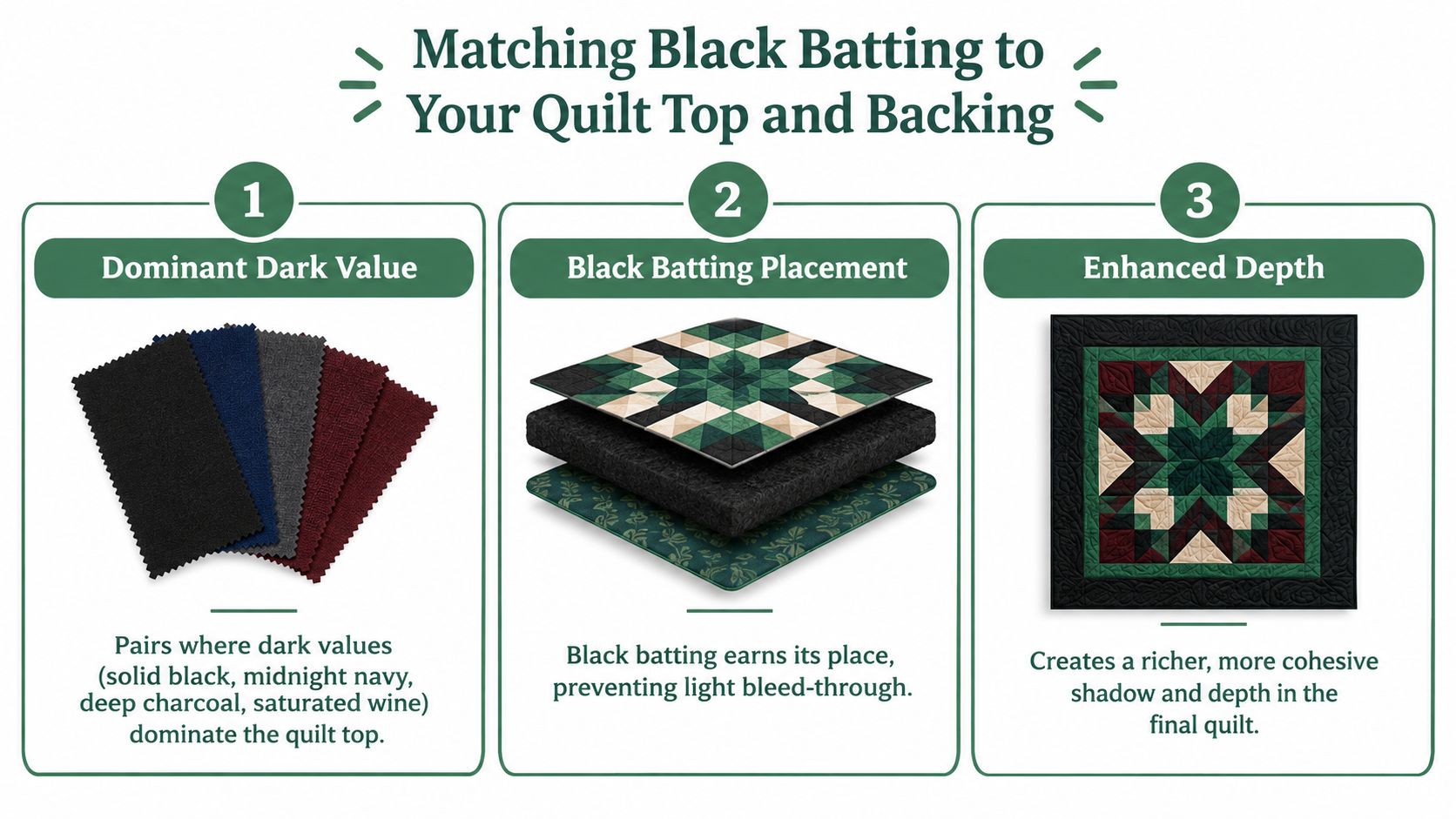
Ruby Star Society prints often make this decision visible quickly because saturated color and dark backgrounds show pale lint easily. Alison Glass-style high-contrast prints can also benefit from a dark middle layer when the darker values dominate, but the pale areas still deserve a close inspection.
Before cutting the full batting, place a sample of the top fabric over the batting and view it under the lighting where the quilt will be used. Add a scrap of the planned backing beneath it. This small test reveals whether black batting enriches the palette or creates unwanted gray shadows.
Sizing, Yardage, and How Much to Buy
Buy batting by the actual quilt dimensions, then add working room. The batting needs to extend beyond the quilt top so you can load, square, and trim without losing coverage at the edges.
A reliable cutting rule is to add at least 4 inches on every side. A 60 by 80 inch quilt top therefore needs a batting piece measuring 68 by 88 inches, calculated by adding eight inches to each finished dimension. The extra margin gives the longarmer space to secure the layers and account for movement.
Measure in this order
- Measure the finished quilt top. Record width and length after pressing and squaring.
- Add the required margin. Use the batting manufacturer's recommended allowance, with four inches per side as the practical minimum described here.
- Check the roll width. A wide roll may let you cut the batting in one piece, while a narrower package may require planning around the quilt dimensions.
- Round up before ordering. A small surplus is more useful than discovering a short edge after loading.
Black batting is available in packaged and roll formats, including options intended for longarm work. Buying by the linear yard can be efficient for a shop or an active quilter working across different project sizes, while a precut package may be more convenient for an occasional project.
The required cut size is determined by the quilt top, not by whether the batting is black. Don't assume a color-specific product needs a different margin. Also don't join pieces casually beneath a quilt with open quilting, since a seam or change in thickness can affect stitch-definition and tension.
| Quilt Size | Top Dimensions (in) | Cut Size Needed (in) | Approx. Yards off 96in Roll |
|---|---|---|---|
| Crib | Not specified | Add at least 4 inches per side | Measure from the finished top |
| Throw | Not specified | Add at least 4 inches per side | Measure from the finished top |
| Twin | Not specified | Add at least 4 inches per side | Measure from the finished top |
| Queen | Not specified | Add at least 4 inches per side | Measure from the finished top |
| King | Not specified | Add at least 4 inches per side | Measure from the finished top |
The table avoids guessed dimensions because packaged sizes vary by product and supplier. For a detailed explanation of roll purchasing and cutting, use this batting-by-the-roll guide.
When comparing Hobbs and Pellon options, check the exact fiber content, width, loft, and stitch guidance rather than choosing by brand name alone. Fusible construction may help small domestic-machine projects, while non-fusible roll batting generally suits larger quilts and longarm loading.
Quilting, Care, and Longarm Tips
Load black batting much like natural batting, but handle it deliberately. Dyed fibers can release faint dark dust during cutting or movement, which may transfer to a light backing or nearby fabric. Keep the work surface clean, and avoid placing a pale quilt back directly on an unprotected cutting area after trimming.
On a longarm, float the batting on the leaders when that matches your loading workflow. Smooth it from the center outward, check that the edges run square, and baste enough of the first section to stabilize the sandwich before beginning the main design.
Test tension before committing
Black batting usually doesn't demand a completely different tension setup, but the thread still has to suit both visible surfaces. A dark top with a light Hobbs wideback may need a neutral or blended thread choice that doesn't look harsh from either side.
Make a test sandwich using the actual top fabric, backing, thread, and batting. Check:
- Top tension: Look for bobbin thread pulling upward or top thread sinking.
- Back tension: Inspect the reverse under good light, where dark batting may make small tension issues harder to judge.
- Stitch-definition: Confirm that the chosen loft supports the quilting design without flattening the texture.
- Edge behavior: Watch for shifting, rippling, or drag as the machine advances.
Follow the product's stated maximum stitch distance. For Hobbs black 80/20, the listed maximum is 4 inches, so don't treat a larger spacing as interchangeable because another batting allows it. The manufacturer's specification is the controlling reference for that product.
The first wash changes the texture. Hobbs lists 3–5% shrinkage for its black 80/20 cotton/poly blend, so expect the quilt to contract and develop more crinkle after washing. Prewashing the batting isn't a universal solution, and it can complicate handling, bonding, or scrim stability.
Before the first wash: Photograph the quilt, note the batting product, and follow its care label rather than relying on a generic wash routine.
For finished quilts, a cautious approach uses cold water and mild detergent, followed by low tumble drying or flat drying when practical. Test a small sample if the quilt includes fabrics with uncertain colorfastness. Black batting is meant to reduce visual distraction from light fibers, but it can't compensate for unstable fabric dye, unsuitable thread, or a backing whose weave is too open.
You'll find related tools and longarm workflow supplies in this quilting supplies collection.
When Black Batting Is the Wrong Choice
Black batting isn't a universal upgrade. It's the wrong choice when the quilt's light values need to stay bright and clean.
Large white, cream, pastel, and low-volume areas can reveal the dark middle layer as shadowing or a gray cast. A baby quilt in soft colors, a wedding signature quilt with an ivory background, or an heirloom white wholecloth usually reads better with natural or bleached batting.
The same caution applies to light backings. A cream-on-cream wideback can show darker areas beneath quilting motifs, particularly when the backing fabric is thin or loosely woven. The batting may be visually perfect from the front and distracting from the reverse.
Skip black batting when
- Light values dominate: Pale fabrics can lose brightness when a dark layer sits underneath.
- The design is wholecloth and light: Every needle mark and shadow may be visible against a single-tone surface.
- The project is a delicate heirloom: Natural cotton may better support the desired soft, traditional appearance.
- The backing is very light: Dark fibers can show through the reverse.
- The project is tiny: A small wall hanging or runner may not justify specialty batting if a suitable natural option is already available.
Black batting also isn't limited to black quilts. Saturated red, purple, green, and blue tops can benefit when their average value is dark and the fabrics are opaque enough to conceal the middle layer. The question is whether the dark batting disappears into the overall composition.
The right question isn't “Is the quilt black?” It's “Will a dark middle layer support the value structure from both sides?”
A test sandwich remains the safest answer. Place the top and backing over the proposed batting, then inspect it in daylight and under indoor lighting. If the light fabric looks muted before quilting, the finished quilt won't rescue the pairing.
Choosing the Right Roll for Your Next Quilt
A dark quilt made with Ruby Star Society prints can change noticeably after quilting if the batting, top, and wideback do not share the same value range. Choose the roll by checking project scale, fabric value, and finishing method together. The fiber blend and construction then determine the finished hand, loft, and handling.
For saturated prints and a longarm finish, an 80/20 black blend offers cotton character with polyester stability. Hobbs lists 3–5% shrinkage and a 4-inch maximum stitch distance for its black 80/20 product, so set quilting density and wash expectations around those specifications.
Pure cotton black batting suits quilts where drape and a flatter, traditional surface matter most. For a small domestic-machine project, fusible black batting can simplify basting, provided its instructions suit the fabrics and the iron-on construction fits the planned finish.
Match the purchase to the project
- Dark longarm quilt: Choose a black cotton blend or another product whose stitch-distance guidance supports the design.
- Small wall hanging: Low-loft cotton or fusible construction can give a flat finish with simpler handling.
- Table runner: Low loft keeps the piece manageable and avoids unnecessary puff.
- Large quilt: A roll-by-the-yard format makes it easier to cut one continuous piece and avoid an awkward join.
- Mixed-value quilt: Compare black with natural batting in a fabric sandwich before ordering the full amount.
The backing belongs in the same decision. A dark or tonal 108-inch wideback keeps visual depth consistent, while a light backing needs closer inspection for shadowing. Lay the actual top, batting, and backing together under daylight and indoor lighting. Product color names cannot show how the three layers will interact.
QuiltKit.com carries quilting supplies and batting options from Hobbs, Pellon, and The Warm Company, including black batting and roll-by-the-yard formats. Its selection includes the Hobbs Heirloom Black Batting 80/20 108-inch wide batting roll and Quilters Dream Select Black Poly Batting Throw Roll, which lets you compare construction and project scale in one purchase workflow.
Review black batting and wideback options on QuiltKit.com, then compare width, fiber content, loft, and care guidance with the quilt plan. QuiltKit's Email Sign-up Savings can be saved for a later batting or backing purchase.
Choose the batting and backing as a fabric pairing, not by color alone. QuiltKit.com offers black batting, Hobbs and Pellon options, roll-by-the-yard formats, and wideback fabrics for coordinated finishing. Visit QuiltKit.com and check that the selected layers support the top's value range and the intended quilting method.