


Bulk Sewing Notions: The Ultimate Buyer's Guide
The most popular advice about bulk sewing notions is also the least useful: buy the largest quantity at the lowest unit price. That approach can leave a guild with mismatched thread, an educator with missing kit components, or a maker with a full shelf of supplies that don't behave consistently from one project to the next.
Bulk buying works when it protects your workflow. Standardized SKUs, predictable lead times, dye-lot traceability, and dependable replenishment matter more than shaving a fraction from the price of a needle or spool. A low-cost notion that causes puckering, skipped stitches, or a mid-class stockout is expensive long before the invoice arrives.
The Strategic Advantage of Bulk Sewing Notions
Bulk notions belong to a replenishment system, not a bargain bin. Thread, needles, zippers, buttons, pins, elastic, trims, batting, and cutting supplies are used repeatedly, so the purchasing decision affects every kit, workshop, and production run that follows.
The category has substantial demand. The modern sewing supplies market was estimated at about $5.5 billion in 2025 and is projected to reach about $7.417 billion by 2031, with an implied 5.11% compound annual growth rate over that period, according to the sewing notions market overview. Another 2026 market summary places the broader sewing-related category at roughly $15 billion annually, which shows that estimates vary depending on the category boundary, while still pointing to a large global demand base.
That scale doesn't automatically make every bulk purchase sensible. It does explain why professional suppliers focus on repeatable SKUs, broad assortments, and replenishment rather than one-off retail presentation.
Reliability beats the lowest invoice
In a shared studio, a mixed batch can create more work than it saves. When we tested bulk threads on a longarm, inconsistent tension between batches caused more puckering than the fabric choice itself. That experience changed how we evaluate notions. We now approve the exact thread construction, color, and supplier SKU before placing a recurring order.
Practical rule: A cheaper notion isn't cheaper if it adds rework, delays packing, or makes one class produce a visibly different finish from the next.
Wholesale dry-goods distribution commonly groups thread, zippers, buttons, ribbons, and related trims with piece goods and notions. The NAICS 424310 category description emphasizes the commercial nature of this supply chain, where institutional and business buyers depend on repeat inventory, standardized products, and efficient handling.
For a guild or classroom, create an approved-notions list. Record the manufacturer, item name, size, fiber or material, color reference, and acceptable substitute. Don't approve “blue thread” or “medium zipper” as descriptions. Approve the actual specification.
Build continuity into every kit
A ready-to-sew kit should contain components that work together. If a pattern needs a particular zipper length, thread weight, needle type, or binding finish, those details belong in the packing record. This prevents volunteers and assistants from making untracked substitutions under time pressure.
A seasonal kit may be assembled months before use. A workshop may depend on the same tools across several teaching dates. A small maker business may need the same trim to appear across a collection. QuiltKit's clearance quilt kit guidance is useful when comparing project formats, but the procurement principle remains the same: document what belongs in the kit before ordering at volume.
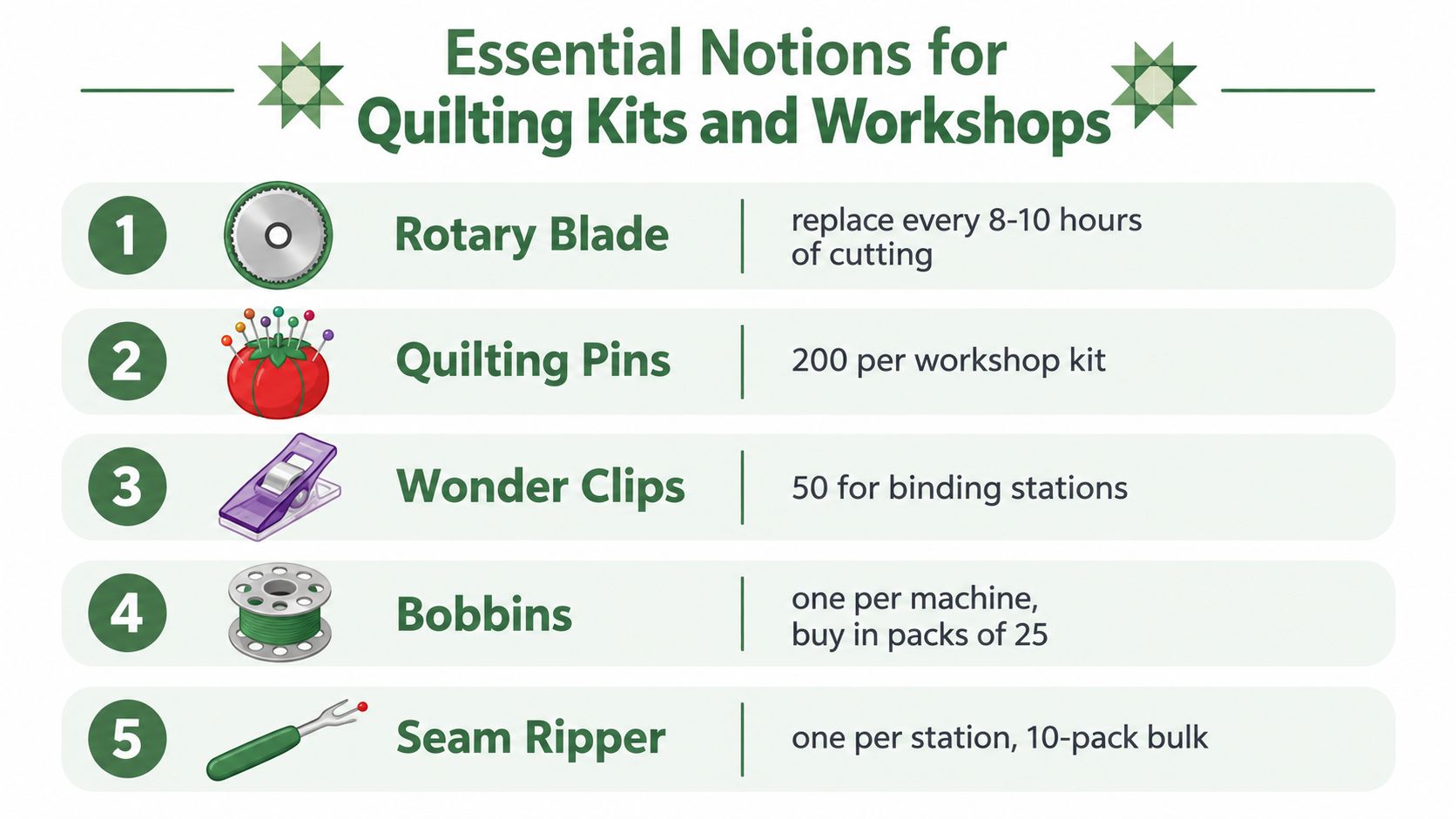
Essential Notions for Quilting Kits and Workshops
The right master list starts with the project, not the supplier's product menu. A precision piecing workshop needs different needle and thread choices from a binding station or a heavy topstitching class.
Stock the tools that prevent interruptions
For accurate quilting kits and workshops, I separate notions into machine consumables, hand tools, cutting supplies, and finishing components. That division makes it easier to count, pack, and reorder without confusing a teaching tool with a per-project component.
- Machine needles: Use 80/12 Microtex needles for clean precision piecing when the fabric and thread call for a fine, sharp point. Reserve 90/14 topstitch needles for heavier thread or more substantial layered work, after testing tension and penetration on a sample.
- Thread: Stock a dependable cotton or polyester thread in an approved weight. Polyester can offer useful strength and abrasion resistance, while cotton may suit a project where fiber matching and a traditional hand are priorities.
- Pins and clips: Glass-head pins are practical for quilting because the heads tolerate contact with an iron better than many plastic alternatives. Wonder Clips are especially useful at binding stations, thick seam intersections, and layered edges.
- Seam rippers: Include an ergonomic seam ripper in beginner kits and place a durable one at every shared workstation. A sharp, comfortable tool reduces the temptation to pull stitches aggressively and damage the fabric.
- Zippers, labels, and trims: Colorful zippers, decorative buttons, custom labels, and elastic should be specified by size, material, color, and intended use. A visual match isn't enough when the component must carry stress or pass through several fabric layers.
A half-square triangle topper may need a fine needle, neutral piecing thread, pins, and a trimming tool. A seasonal table runner can require a different needle choice if it includes interfacing, decorative thread, or a denser fabric. Put the exact requirement on the kit checklist instead of relying on a general “notions included” label.
The beginner quilting supplies guide can help new makers distinguish basic tools from project-specific components. For advanced quilters, the more important questions concern stitch definition, thread tension, needle deflection, and whether the notion preserves a flat seam.
Match the notion to the construction
Notions must suit the fabric weight and design intent. A thread or elastic that is too heavy can distort a seam, while a weak fastener can fail during use. Technical sewing standards emphasize a finish that is flat, smooth, durable, and free from unnecessary bulk, with secure, even stitching, as explained in the sewing quality standards from Washington State University Extension.
Before buying a large lot, test the complete combination. Sew the actual fabric, thread, needle, and fastener together, then press and handle the sample. For a guild, keep the approved sample with the inventory record so future volunteers can compare a new batch against the known result.
Navigating Wholesale and Bulk-Retail Sourcing
A true wholesale distributor and a bulk-retail storefront solve different procurement problems. Wholesale partners may require business documentation or minimum order quantities, but they often provide deeper SKU records, repeat-order support, and clearer batch information. Bulk-retail stores can be easier for a small maker to use, especially when the buyer needs modest quantities without opening a business account.
Wholesale dry-goods guidance identifies minimum order quantities, lead times, batch or dye-lot traceability, sample approval, and inventory reporting as important considerations for bulk buyers. Those details matter when one fabric color or trim must remain consistent across multiple classes.
Compare the purchasing routes
| Feature | True Wholesale Distributor | Bulk-Retail Storefront |
|---|---|---|
| Minimum order quantity | May apply by SKU, carton, roll, or color | Often more flexible, with smaller purchase quantities |
| Pricing | Usually structured for repeat commercial buying | May use tiered discounts or promotions |
| Batch traceability | More likely to provide lot, dye-lot, or production information | Can vary by product and stock source |
| Lead times | Often documented for recurring orders | May change with retail availability |
| Assortment | Broad professional catalog | Curated or consumer-facing selection |
| Replenishment | Better suited to scheduled purchasing | Useful for testing or filling short gaps |
| Business documentation | May be required | Often not required |
| Best fit | Guilds, educators, kit-makers, and ongoing production | Small trials, unusual colors, and modest demand |
One large wholesale distributor lists more than 15,000 products, including pins, needles, zippers, buttons, and thread, and offers same-business-day shipping for trade and retail partners through its wholesale sewing notions assortment. Another business-only supplier says it serves organizations buying bulk fabric, sewing supplies, foam, hardware, and tools, with thousands of items in stock and ready to ship, as described in its business wholesale supply information.
Those capabilities are valuable, but a large catalog isn't proof that a supplier is right for your workflow. Ask for a sample, confirm the replenishment process, and request written substitution rules before committing.
Ask questions before the first recurring order
Request the supplier's SKU, material specification, width or size, color reference, available lot information, expected lead time, and process for backorders. If the item is sold by the yard or roll, ask how partial quantities are labeled and whether the remaining stock can be traced to the original batch.
A small boutique maker may accept a flexible storefront if the order is occasional. A guild leader ordering batting for recurring workshops should prioritize consistent rolls, delivery windows, and a contact who can confirm availability. QuiltKit's wholesale batting-by-the-roll resource is relevant for buyers comparing roll formats with project requirements.
Calculating Cost-Per-Unit and Project Quantities
The invoice price is only the beginning of the calculation. A useful bulk sewing notions budget includes the product cost, freight, handling, storage space, inspection time, and the cost of defects or substitutions that interrupt production.
Use a simple formula:
True cost per usable unit = product cost + shipping + handling + inspection and rework costs, divided by usable units received.
If a supplier sends inconsistent thread, damaged packaging, or an unsuitable substitute, the unusable portion belongs in the calculation. A low listed price can lose its advantage once a teacher spends class time finding replacements or a kit-maker repacks an order.
Calculate from the finished project backward
Start with the finished item and work toward the purchasing unit. For a quilt kit, list the fabric, backing, batting, binding, thread, needle, pattern components, labels, and packaging. For a workshop, separate shared tools from consumables, because a rotary cutter may serve the room while needles and bobbins are assigned to individual machines.
Use the published dimensions rather than guessing. Wideback backing fabric is typically 108 inches wide and can eliminate seams for many quilts, according to quilt sizing and backing guidance. Longarm quilting often requires 6 to 8 inches of extra batting and backing on all sides, while batting should extend 4 to 6 inches beyond the quilt top on all sides. King quilts almost always require 120-inch batting, so a narrow roll can create unnecessary joins or complicate loading.
For a run of 50 king-size kits, don't multiply a generic backing estimate by 50 and place the order immediately. Confirm the finished quilt dimensions, the quilting method, the required overhang, the actual roll width, and whether the supplier's cutting policy creates usable remnants. Record the assumptions next to the quantity so someone else can audit the order.
Protect cash without creating stockouts
Buy stable, high-use items in larger lots when the specification is already approved. Thread, standard needles, labels, and frequently used batting formats usually justify a recurring reorder plan. Unusual zipper colors, decorative buttons, seasonal trims, and specialized elastic deserve smaller trial purchases until demand is proven.
A workshop teacher should count machines first, then assign a tested bobbin and needle plan to each machine. Keep a small, clearly labeled reserve for breakage and unexpected consumption rather than treating the reserve as free stock.
The fabric yardage calculation guide can support the fabric side of the worksheet. The same discipline should apply to notions. Calculate per finished kit, per student, and per production batch, then compare the result with the supplier's pack size.
Quality Control and Brand Anchoring
Premium sourcing makes the most difference where a notion directly affects stitch formation, cutting accuracy, loft, or the durability of the finished quilt. It makes less difference where a basic substitute performs the same job and doesn't touch the visible or structural finish.
I anchor batting tests around brands such as Hobbs Bonded Fibers, Pellon, and The Warm Company, then evaluate the actual loft, drape, needle penetration, and stitch definition in the intended project. For fabric and coordinating color, Ruby Star Society and Kona Cotton are useful brand references when a maker needs a controlled palette rather than an unverified substitute.
Spend more where failure is visible
A sharp, correctly sized needle supports even stitch formation and reduces damage from repeated penetration. A stable cutting blade helps preserve accurate edges, which matters when blocks depend on consistent seam allowances. Specialty threads deserve testing because their surface, twist, and weight can alter tension and stitch definition.
Thread fiber should suit the fabric and the intended use. A mismatch can contribute to seam distortion, puckering, or premature failure, particularly when the same combination is repeated across a large run. A high-thread-count finish with minimal fraying and a tight weave can make precision piecing easier, but the sample still needs to pass through the actual machine setup.
Quality check: Test the thread, needle, batting, and fabric as a system. Testing each item separately won't reveal how the combination behaves under tension.
Economy choices can work for basic pins, temporary basting materials, or low-risk practice projects. I wouldn't make the same compromise with cutting tools, specialty thread, needles, or a batting whose loft controls the final hand. The buttery drape of a soft cotton batting and the structural support of an 80/20 blend can produce very different results, so record the tested choice instead of describing it only as “premium.”
The quilting fabric brands guide can help coordinate fabric decisions with the notion and batting standards used in a kit. QuiltKit.com also carries ready-to-sew kits, quilting fabric, batting, widebacks, thread, and essential tools, which gives buyers one possible source for assembling compatible project materials.
Storage, Labeling, and Inventory Management
Bulk inventory becomes a liability when nobody knows what it is, where it belongs, or when it needs replacement. A professional-looking stash can still produce stockouts if volunteers count unopened cartons but overlook loose packs at workstations.
Store notions by function first, then by size, color, fiber, or brand. Keep adhesives and fusible materials in conditions recommended by the manufacturer, away from excessive heat and moisture. Protect elastic from heat, light, and unnecessary compression, and keep specialty threads covered so dust doesn't reach the tension path.
Use a bin system people can follow
Clear stackable bins work well when each bin has one primary notion type. A label should identify the item, specification, color or lot, quantity, and reorder trigger. Handwritten notes tend to disappear when a guild changes rooms or several teachers share the same shelves, so printed labels are preferable.
- Sort: Separate needles, thread, fasteners, trims, cutting tools, and finishing materials.
- Bin: Use containers that fit the item without crushing packages or tangling thread.
- Label: Record the manufacturer, SKU, size, color, lot information, and count.
- Log: Update the inventory sheet whenever a class or kit-packing session removes stock.
- Reorder: Set a visible threshold that reflects supplier lead time and upcoming workshop demand.
For batting and widebacks, keep the roll label attached until the material is fully used. Record the width, fiber content, blend, loft description, and lot information on the inventory sheet. If the tested 80/20 blend changes, the next person pulling material should see that change before cutting.
Prepare grab-and-go workshop bins
Make one bin for each teaching station or project type. A beginner sewing station might contain the approved needle, neutral thread, seam ripper, clips, pins, and a printed instruction card. A binding station can hold clips, hand needles, thread, and the tested binding method.
Before a class, replenish the bins from the main stock and return unused components afterward. This prevents every volunteer from opening a new package and gives the inventory manager a clean count after each event.
Frequently Asked Questions and Next Steps
Guilds and small sewing businesses rarely need more product lists. They need clear decisions about consistency, substitutions, and the point at which a premium notion earns its place in the budget.
What are the most important bulk sewing notions to standardize?
Standardize anything that affects stitch formation, cutting accuracy, fabric compatibility, or the visible finish. That usually includes the approved needle sizes, core thread types and weights, batting specifications, frequently used zippers, labels, and any trim included in a repeatable kit.
Basic pins and temporary supplies can often remain flexible. Keep the substitution rule written down, and test any replacement before it enters a class or production batch.
How should I request a consistent substitution for a backordered zipper?
Give the supplier the original SKU, size, material, color reference, teeth or coil type, length, and intended project. Ask for a sample or photograph before approving the replacement, then record the substitute as a separate approved SKU.
Don't accept “similar color” as a sufficient answer for a coordinated quilt kit. A slightly different zipper may be acceptable for an internal lining, but it can be conspicuous on a visible pouch or garment.
Do eco-friendly notions justify a higher per-unit cost?
They can, when the material supports the product's positioning, expected use, or disposal goals. Industry commentary has highlighted demand for options such as organic cotton thread and biodegradable buttons, alongside personalized components such as colorful zippers and decorative buttons, as discussed in wholesale sewing notions business guidance.
The premium makes more sense when customers can understand the benefit and when the notion still meets the required strength, handling, and finish standards. It makes less sense when the material is difficult to replenish or introduces inconsistency that undermines the kit.
Should a guild buy batting by the roll?
A roll can simplify repeat cutting and reduce the number of separate purchasing decisions, but only if the width, loft, fiber content, storage space, and project mix are suitable. Confirm the finished quilt dimensions and loading allowance before committing to a format.
Where can I buy coordinated quilting supplies in bulk?
Compare suppliers by specification control, replenishment, fulfillment communication, and substitution policy, not only by listed price. For ready-to-sew projects and related quilting materials, you can also review QuiltKit's curated quilt kits and finishing supplies as one purchasing option.
QuiltKit.com offers ready-to-sew quilt kits, modern solids, coordinated bundles, wideback cottons, and batting formats that can help reduce the number of separate sourcing decisions. Visit quiltkit.com to match your project with compatible quilting supplies, and join the list for Email Sign-up Savings when you're planning your next workshop, kit run, or roll-by-the-yard batting order.