


Cotton Batting by the Yard: A Buyer's Guide for Quilters
You've got a finished quilt top spread across the cutting table, but the batting decision still isn't settled. The packaged options are either too short, too narrow, or padded with more material than the project needs. Cotton batting by the yard solves that problem, provided you choose the width, construction, and cut length before you start loading the quilt.
The fiber content is only the beginning. Cotton's low loft, natural grip, washing behavior, stitch-spacing requirements, and tendency to arrive creased from a bolt all affect the finished drape. The math matters just as much, especially when you're buying full-width yardage for a longarm frame.
Why Cotton Batting by the Yard Changes How You Finish a Quilt
At the cutting table, the first question isn't “Which batting is softest?” It's “What finished area must this piece cover?” A quilt top needs working room on every side, and the answer changes with the batting width. Buying by the yard lets you order a continuous cut rather than forcing a bed quilt into a packaged crib, throw, or queen size.
That format is particularly useful for custom quilts, oversized tops, and longarm work. You can trim the batting to suit the project instead of piecing together an unnecessarily large precut. Retail formats now include full-width yardage and roll options, with widths such as 90, 96, 108, and 120 inches appearing in the market, as shown by listings for wide cotton and cotton-blend batting sold by the yard.
What cotton does on the bolt
Cotton batting feels denser than polyester when it's rolled. It doesn't spring open in the same airy way, and the folded or wound surface may show creases after shipping. I've learned not to load a tightly rolled cotton batt straight onto the frame and expect it to behave perfectly.
Spread it on a clean surface, separate the layers gently, and let it relax before loading. Don't iron the batt aggressively. High heat can affect some constructions, and compressing the fiber can change the loft you're trying to preserve.
Practical rule: Allow the batting to relax before you judge its loft or decide whether it will cover the top. A compressed roll can look smaller and flatter than it feels after airing.
The cut length also determines how much squaring you can do. Longarm leaders, clamps, and frame handling need a clean, stable edge. A cut based only on the quilt top dimensions leaves no margin for crooked edges, trimming, or a slight shift during loading.
Cotton batting's breathable, low-loft profile creates a soft hand and clear stitch definition, but it usually requires closer quilting than a lofty synthetic batt. That trade-off is why yardage selection should happen alongside the quilting plan, not after the backing is already mounted.
For a project requiring a specific cut, compare the available format with QuiltKit's by-the-yard batting options before ordering. Check the listed width and cut policy, because a yard of 90-inch batting and a yard of 120-inch batting are not equivalent amounts of usable surface.
100% Cotton vs Cotton Blend Batting Compared
The fiber choice affects more than warmth. It changes how the quilt moves on the frame, how closely you need to quilt, and whether the finished surface relaxes into a pronounced crinkle or stays flatter.
100% cotton batting has a low, breathable profile and a natural drape that softens after washing. An 80/20 batting combines 80% cotton and 20% polyester, giving the batt more structural stability and easier needling, as described in this 80/20 batting product specification.
Pure cotton suits a traditional, lightly padded quilt with a gentle crinkle. A cotton-poly blend is often more forgiving for quilts that will be handled frequently, moved through a longarm, or finished with a less dense design. The right choice depends on the target finish, not fiber content alone.
Side-by-side performance
| Property | 100% Cotton | Cotton Blend |
|---|---|---|
| Fiber content | Natural cotton | Commonly 80% cotton and 20% polyester |
| Loft | Typically low loft | Often low to medium loft |
| Hand | Soft, breathable, slightly grippy | Smooth, stable, and easier to guide |
| Drape | Natural and relaxed | More stable and flatter |
| Washing behavior | Commonly shrinks 3% to 5% after washing | Usually shows less draw-in than pure cotton, depending on construction |
| Longarm feel | More grip under the needle | Generally glides more easily |
| Best fit | Heirloom, hand-quilted, traditional quilts | Utility quilts, gifts, and large machine-quilted projects |
A cotton batt may be needle-punched to interlock the fibers and reduce shedding. That construction helps it hold together during handling, but it does not eliminate quilting-density requirements. Guidance on cotton batting construction and stitch spacing notes that quilting lines commonly need to be placed around 2 to 4 inches apart to limit shifting, migration, or clumping.
Use the manufacturer's spacing recommendation for the specific batt. A low-loft cotton product can need closer quilting than a similar-looking polyester blend, even when both packages show comparable loft.
Matching the fiber to the quilt
Choose 100% cotton when drape and a traditional surface matter as much as durability. It gives a flatter silhouette, soft hand, and visible texture after washing. It works well for a hand-quilted heirloom or summer quilt without a lofty, puffy interior.
Choose 80/20 when stability and easier machine handling matter more. The polyester component supports a steadier sandwich and can make a large quilt less demanding to maneuver. Hobbs Heirloom 80/20 is a familiar example for quilters who want cotton hand-feel with blend stability. For a traditional crinkled surface, a true cotton batt remains the more direct fit.
Review this guide to 100% cotton batting before choosing the cut length and planning the quilting density.
Understanding Batting Widths From 45 to 120 Inches
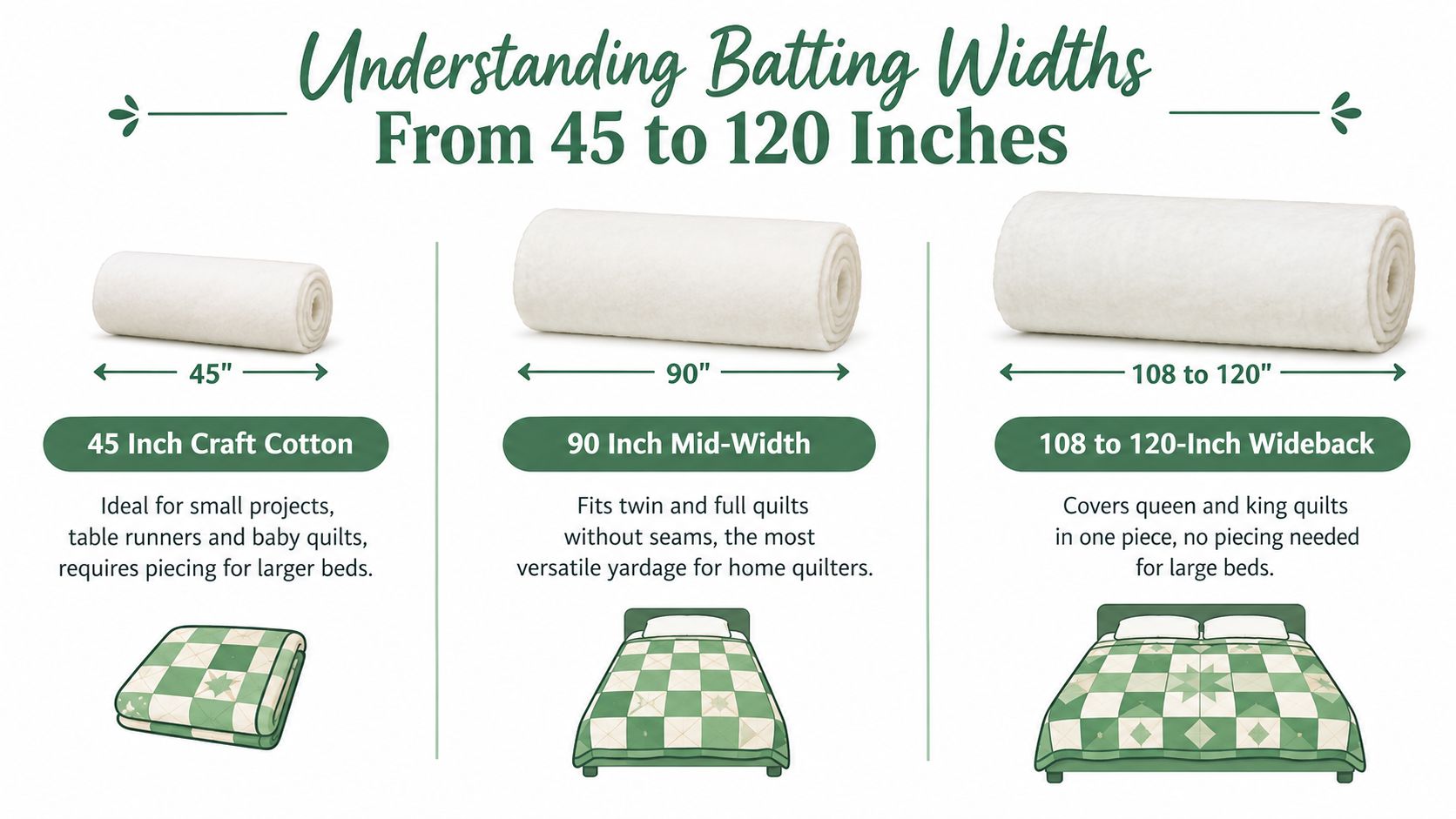
Batting widths determine whether your quilt lies on the frame in one clean piece or needs a seam. Standard listings include 45, 90, 96, 108, 120, and 124 inches, so always verify the actual width before calculating yardage rather than assuming every bolt is equivalent. The available width range is summarized in this batting size reference.
A 45-inch batt is practical for wall hangings, table runners, narrow panels, and small baby quilts. Larger projects require piecing, which can work well when the seam is planned away from a prominent quilting motif.
A 90-inch width is a versatile home-quilting option. It can cover many twin and full-size tops without a center seam, although the exact result depends on the finished dimensions and the required overhang.
Choosing wideback batting
Widths from 108 to 120 inches are useful for queen and king quilts because they can cover a broad top without a horizontal seam. Wideback batting costs more per linear yard in some shops, but the price can be justified when you'd otherwise buy multiple lengths, join them, and spend additional time aligning the seam.
Seaming isn't automatically wrong. For a domestic-machine quilt, a carefully joined batting seam can be serviceable, especially when the quilting design crosses it and the seam remains flat. On a longarm, however, a bulky or poorly aligned join can catch under the rollers and make tension or tracking less predictable.
Cotton shrinkage adds another consideration. If two pieces are joined before quilting, washing can pull the seam and alter alignment. Use a construction that keeps the join flat, and leave enough material around the perimeter to square the quilt after quilting.
This short longarm quilting workflow video can help you visualize how width affects loading and handling.
How to Measure and Order the Right Yardage
A quilt top can measure correctly on the design wall and still leave you short at the longarm frame. Measure the pressed, finished top after the borders are attached and the top is squared, then plan the batting around the frame, not the package label.
Use this calculation:
- Measure the top. Record the finished width and length.
- Add overhang. Add 8 inches to each dimension, giving 4 inches on every side. More overhang, up to 8 inches per side, gives additional control while loading.
- Check the bolt width. Compare the required width with the batting's usable width. If it fits, one length is usually enough.
- Convert length to yardage. Divide the required length in inches by 12 to find feet, then convert that result to yards.
- Round upward. Round to the next practical half-yard when the seller uses that increment.
- Allow for shrinkage. Follow the manufacturer's washing and quilting guidance before cutting, especially if you plan to pre-wash.
Cotton batting commonly shrinks 3% to 5% after washing. Do not remove that allowance from the order. The batting still needs its full working margin for squaring, loading, and trimming after quilting.
Yardage planning reference
Use the table as a starting point, then verify the top's actual dimensions and the batting's usable width. A listed width may not equal the full material available at the edge, and orientation can change whether one piece works.
| Quilt Size | 90" Batting | 108" Batting | 120" Batting |
|---|---|---|---|
| Twin | One length when the overhang fits | One length | One length |
| Full | Check finished width and overhang carefully | One length for many tops | One length |
| Queen | May require piecing or a different orientation | Often one length, depending on top dimensions | One length when the overhang fits |
| King | Frequently requires piecing | Check the finished width and margin | Most practical single-piece option |
The common ordering error is buying a length equal to the quilt top. That leaves no room to square the batt, secure it under the frame, or correct a slightly uneven cut. Confirm the seller's cut increments and bolt measurements in this batting-by-the-roll guide, then order upward rather than trying to stretch a short piece.
Top Batting Brands Available by the Yard
Brand names help, but the label still needs close reading. The same manufacturer may offer needle-punched, scrim-supported, bonded, natural, and blended products, each with a different hand and quilting recommendation.
Hobbs is a common longarm choice because its range includes both blend and cotton options. Hobbs Heirloom 80/20 is suited to quilters who want a stable cotton-poly blend with clear stitch definition. Hobbs Tuscany 100% cotton is the more traditional direction, with a softer natural hand and the flatter profile many heirloom makers prefer.
What the major lines are good at
Pellon offers cotton batting and related natural-fiber options, including cotton-bamboo constructions. Pellon Legacy 100% cotton suits projects where softness and drape take priority, while Nature's Blend can appeal to quilters looking for a softer-feeling natural combination. Availability by width varies, so check whether the listing is sold as cut yardage, a full bolt, or a packaged precut.
The Warm Company is known for Warm and Natural, a cotton batting with needle-punched construction. That mechanical interlocking helps the batt handle cleanly, but you should still follow the product's quilting-distance guidance rather than treating the name as a guarantee against movement.
| Brand | Cotton Line | Fiber | Available Widths |
|---|---|---|---|
| Hobbs | Heirloom, Tuscany | 80/20 blend or 100% cotton, depending on line | Varies by product, including wide formats |
| Pellon | Legacy, Nature's Blend | 100% cotton or cotton-bamboo, depending on line | Varies by product |
| The Warm Company | Warm and Natural | Cotton, with construction specified by product | Varies by product |
Some brands sell continuous cut yardage, while others emphasize packaged sizes or full bolts. A 120-inch cotton batt may be available only through selected sellers or special ordering, so don't design the cutting plan around a width you haven't confirmed.
For a natural cotton option, compare the listed fiber content, width, loft, and care instructions on Quilter's Dream Deluxe Natural Cotton Batting. QuiltKit also carries batting and wideback formats from brands including Hobbs, Pellon, and The Warm Company, but the exact stock format should be checked on the individual product page.
The product name matters less than the construction details. For longarm work, I check the width first, then the recommended stitch distance, then the way the batt feels when I pull it from the roll. A batt that looks economical can become expensive if it forces a seam, sheds heavily, or needs more handling than the quilt can tolerate.
Washing, Stitching, and Caring for Cotton Batting
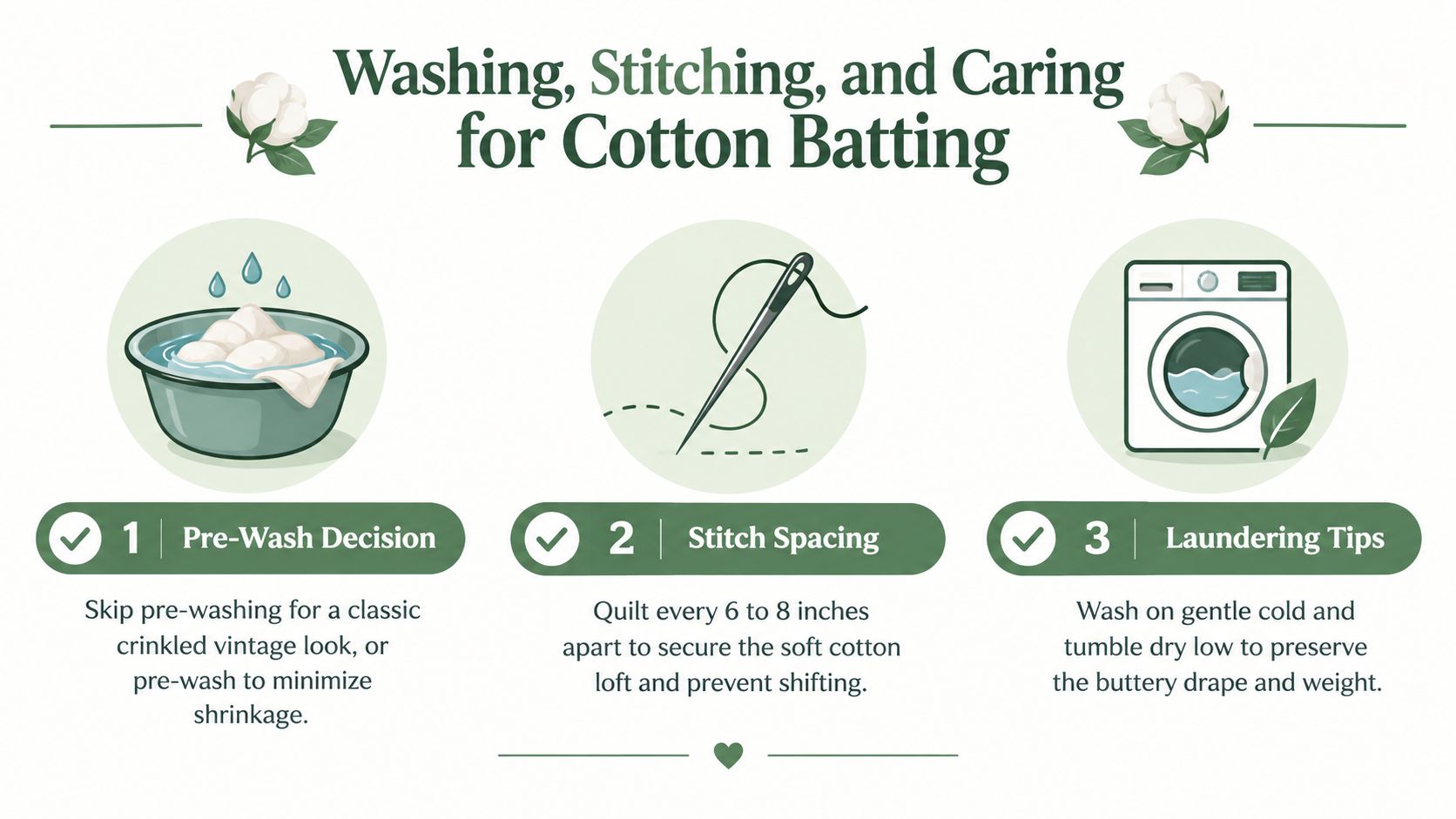
Pre-washing is a design decision, not a compulsory preparation step. Skip it when you want cotton's classic 3% to 5% draw-in and the puckered surface that develops around the quilting lines. Pre-wash only when accurate finished dimensions matter more than that traditional texture, and follow the specific manufacturer's instructions because scrim and other constructions can make pre-washing difficult.
If you do pre-wash, use cold water and dry the batting flat when possible. Don't twist or wring it, and don't assume pre-washing removes every later change in size.
Secure the sandwich correctly
Cotton needs enough quilting to keep the fibers from migrating, shifting, or clumping. Many batting guides place cotton quilting around 2 to 4 inches apart as a practical range, while the exact limit depends on the product's construction. Use the tighter end for a quilt that will be washed often or handled roughly.
For machine quilting, set the stitch length so the line forms consistently through all three layers. On a longarm, test tension on a scrap sandwich made from the actual top fabric, backing, and batting. Cotton grips more than many blends, so a setting that worked on polyester may produce looping or uneven penetration here.
One product infographic may describe a broader spacing range, but the safer practice is to follow the batt manufacturer's instructions and avoid assuming that every 100% cotton product behaves alike. Stitch density affects both stability and drape.
Launder the finished quilt gently
Wash the finished quilt in cold water on a gentle cycle. Dry it on low heat or air-dry it, depending on the care instructions for the fabrics and batting.
Avoid fabric softener. It coats cotton fibers and can reduce the absorbency and grip that make cotton useful inside a quilt sandwich.
For additional assembly guidance, use this practical resource on putting batting in a quilt. The goal is simple, controlled movement from cutting table to frame, followed by washing that preserves the intended hand rather than forcing an unwanted finish.
Common Misconceptions About Cotton Batting
Cotton batting is not defined by fiber content alone. Its construction affects how it loads on a longarm, responds to the needle, holds together during quilting, and changes after washing.
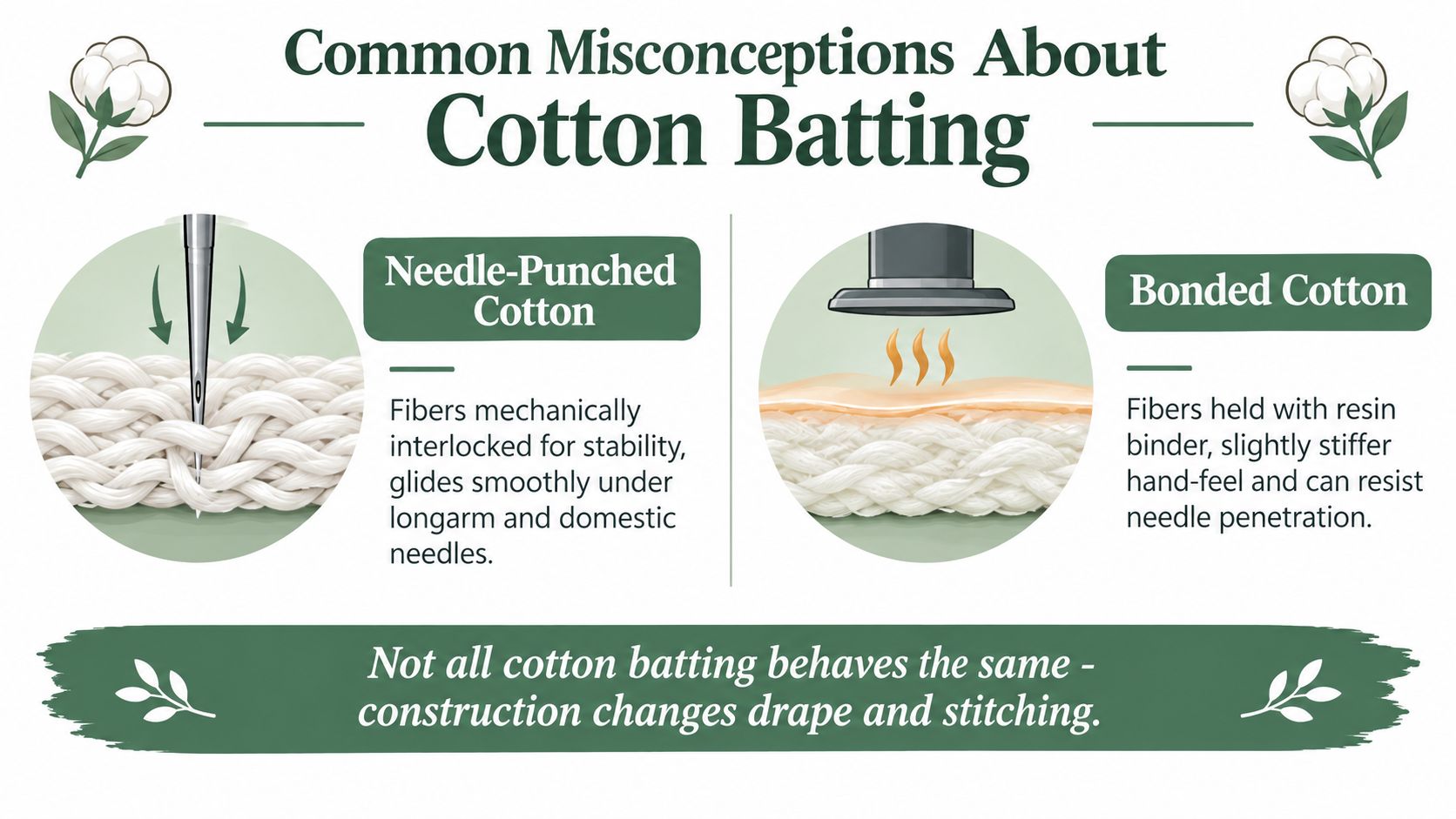
Needle-punched batting relies on mechanical action to interlock fibers. It generally feeds smoothly and resists separating while you load and quilt it. Bonded batting uses a binder to hold the fibers, often producing a firmer hand and different needle penetration. That difference matters more than the label when you are choosing batting by the yard.
Myth one, all cotton is equally breathable and stable
A cotton label does not guarantee the same feel or performance. Resin-bonded products may feel stiffer, resist the needle more than mechanically interlocked batting, and respond poorly to excessive iron heat. Repeated washing can alter the hand as well.
Test a small sample before cutting into a large order. Use the lowest iron setting suitable for that construction, and avoid holding the iron directly on the batt.
Myth two, loft automatically means warmth
Loft measures thickness, not warmth by itself. Low-loft cotton produces a flatter summer quilt with relaxed drape. A thicker blend creates more puff and a different stitch profile, while the top fabric, backing, quilting density, and intended use also affect the finished result.
Myth three, pre-washing eliminates shrinkage
Pre-washing can reduce unexpected draw-in, but it cannot guarantee that the completed quilt will remain unchanged. Batting that has not been pre-shrunk may still contract after quilting, and cotton commonly changes by 3% to 5% after washing, as noted in this batting care reference.
Myth four, stitch spacing is universal
Polyester spacing guidelines do not automatically apply to cotton. Check the recommendation for the exact product, confirm whether it includes scrim, and test the needle, thread, and tension on the actual quilt sandwich before committing to the full top. Width and loft may determine the fit, but stitch spacing determines how securely the layers stay together.
Matching Batting to Your Next Quilting Project
The most reliable choice combines fiber, width, loft, and cut length. Start with how the quilt will be used, then choose the construction that supports that use rather than buying the same batt for every project.
A wall hanging can tolerate a narrower width and a construction selected primarily for stitch definition. A frequently washed utility quilt benefits from a stable blend and a width that avoids an unnecessary seam. A hand-quilted heirloom usually rewards the softer grip and flatter drape of 100% needle-punched cotton.
Quick-fit project guide
| Project Type | Quilt Size (in) | Batting Width | Fiber Recommendation | Yardage (approx.) |
|---|---|---|---|---|
| Wall hanging | Measure finished top | 45" | Low-loft 100% cotton | Top length plus working margin |
| Baby quilt | Measure finished top | 45" or 90" | 100% cotton or 80/20 blend | One measured length |
| Bed runner | Measure finished top | 45" or 90" | Low-loft cotton | One measured length |
| Twin quilt | Measure finished top | 90" | 80/20 for utility, cotton for traditional drape | One length when width fits |
| Queen quilt | Measure finished top | 108" or 120" | 100% cotton for heirloom feel, blend for stability | One length when overhang fits |
| King quilt | Measure finished top | 120" | Wideback 80/20 or 100% cotton | One length when width fits |
The table uses project-specific planning rather than fixed package labels because quilt dimensions vary. Measure the top, add your overhang, and round the length upward. If the width won't cover the required dimension, decide whether a seam is acceptable before placing the order.
For a broader selection framework, review this guide to the best batting for quilts. QuiltKit's batting catalog includes by-the-yard choices such as 80/20 blends and natural cotton formats, so the useful comparison is the actual product width and construction, not just the brand name.
A 100% cotton batt remains the natural fit for a hand-quilted heirloom where breathable drape and controlled crinkle matter. An 80/20 blend is the practical workhorse for a quilt that will be washed and used often. For a king-size top where seaming would compromise the finish, a 120-inch roll can make the loading process cleaner, provided the width and cut length match your measured quilt.
People Also Ask
Is cotton batting sold by the yard?
Yes. Cotton batting is sold as cut yardage from bolts or rolls, often in wide formats. The usable amount depends on both the linear cut and the listed width, so compare those specifications before ordering.
How much extra batting should I buy?
Plan for at least 4 inches of overhang on each side, or 8 inches added to both the width and length of the quilt top. More margin can help with squaring and longarm handling.
Does 100% cotton batting shrink?
It commonly shrinks 3% to 5% after washing. Some quilters want that draw-in for a crinkled finish, while others pre-wash carefully or select a construction designed for greater dimensional stability.
Is 80/20 batting easier to quilt than 100% cotton?
An 80/20 blend is generally stable and easy to needle, while 100% cotton often has more grip and a softer, flatter drape. Your quilting density and the manufacturer's spacing recommendation still matter.
What width is best for a king-size quilt?
A 120-inch width can cover many king-size tops in one piece when the finished dimensions and overhang fit within the bolt width. Measure first, because king dimensions vary.
QuiltKit offers cotton batting by the yard, wide batting formats, quilt kits, widebacks, and finishing supplies for projects ranging from small runners to large bed quilts. Visit quiltkit.com to match your measured top with the right width and fiber, and join the Email Sign-up Savings list if you're still planning your purchase.