


Fabric Bundles for Quilting Guide with Yardage and Tips
You're standing at the cutting table with a baby quilt pattern on one side, a table runner idea on the other, and a college tailgate throw still waiting for team colors. The bolt wall offers too many choices, while your stash has plenty of fabric but no obvious plan. Fabric bundles for quilting solve that decision problem by grouping coordinated cuts and removing much of the matching and cutting work.
I've handled precuts from several fabric lines side by side, including Kona Cotton and Ruby Star Society fabrics. The differences show up quickly in weave tightness, surface feel, drape, and how cleanly the edges behave after cutting. This guide turns those observations into practical decisions, from bundle formats and yardage math to batting, widebacks, storage, and project-specific buying.
Introduction to Fabric Bundles for Quilting
A bundle is more than a stack of attractive fabric. It's a project-planning shortcut that brings color coordination and cutting labor under control. Quilting references describe precuts as building blocks for tutorials because they make quilting quicker and easier, particularly for gifts such as baby quilts, wedding quilts, and graduation projects. Missouri Star Quilt Co. explains how precuts support quick, coordinated quilting projects.
That convenience matters when you're working between family commitments, classes, or a full-time job. Instead of selecting prints one bolt at a time, you can begin with a color story designed to work together. A bundle can still leave room for contrast, layout changes, and personal accents.
My practical test: I look first at the cut quality, weave, and hand of the fabric, not just the number of pieces in the package.
I found that Kona Cotton solids often have a clean, dependable hand for precise piecing, while Ruby Star Society prints can bring a distinctive visual rhythm to modern blocks. Those tactile differences influence whether I'd choose a bundle for a pixel quilt, a traditional block, or a fast table runner.
You'll learn how fat quarters, charm packs, jelly rolls, layer cakes, and colorway bundles differ, how to convert piece counts into usable yardage, and how to select supporting supplies. The right bundle should make your next decision easier, not create another pile of fabric without a purpose.
Understanding Fabric Bundle Types
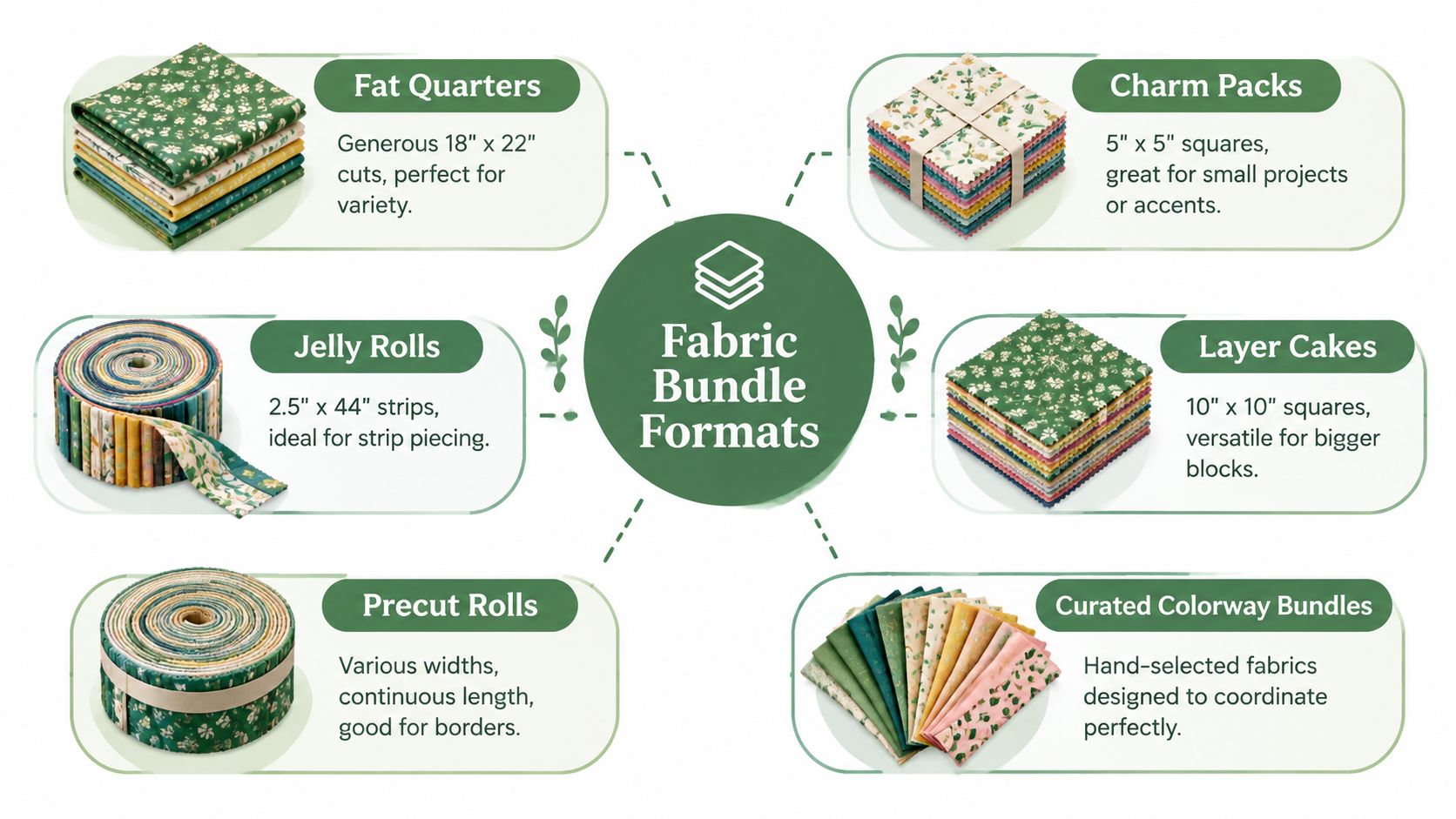
Precut quilting bundles use repeatable formats, so pattern designers can write instructions around familiar dimensions. The most widely used format is the fat quarter, cut from a 36" x 44" piece into four sections measuring 18" x 22". Each piece is roughly one quarter of a yard, while preserving more usable width than a standard quarter-yard cut. Broadway Fabrics outlines common bundle formats and fixed-count assortments.
Match the cut to the piecing job
- Fat quarters: These 18" x 22" cuts work well when you need variety, larger patches, or enough fabric to fussy-cut a motif. I've handled Marcus Fabrics fat quarters with a buttery Kona Cotton-like drape and minimal fraying along printed edges. Their generous shape makes them a flexible starting point for blocks, appliqué, and themed quilts.
- Charm packs: These are commonly 5" x 5" squares, useful for small patchwork, accents, and scrappy layouts. They're especially convenient when your pattern already calls for squares and you want to avoid cutting every piece from yardage.
- Jelly rolls: These are commonly 2.5" x 44" strips, made for strip piecing, log cabin arrangements, binding experiments, and fast linear designs. A tightly wound roll can save substantial preparation time, but check that the strips are cut consistently before sewing long seams.
- Layer cakes: These are commonly 10" x 10" squares, giving you larger starting pieces for blocks that would otherwise require several cuts from yardage. They're useful when a pattern depends on broad areas of print or when you want to preserve the scale of a large motif.
- Precut rolls: These can use various widths and continuous lengths, making them practical for borders, sashing, and repeated strip units. Read the product description carefully because “roll” describes the presentation, not one universal measurement.
- Curated colorway bundles: These group fabrics by palette, mood, or design direction rather than relying only on a standard cut. They're a strong choice for modern pixel quilts, high-contrast layouts, and projects where the relationship between colors matters more than matching a named collection.
Many retailers package fat-quarter assortments in fixed counts such as 6, 10, 11, 12, 13, 14, 16, 17, or 18 pieces, reflecting the category's move toward repeatable, project-ready packs. See a broader explanation of quilting fabric formats and precuts.
Read the fabric, not only the label
Quilting cotton is generally a medium-weight woven fabric. Guides commonly place quilting-weight cotton around 140 to 190 GSM, although the hand can vary noticeably between manufacturers and collections. This quilting fabric guide discusses weight, weave, and first-wash considerations.
When I test a bundle, I fold a piece on the bias, rub the surface lightly, and inspect the cut edge. A tight weave feels stable beneath the rotary ruler, while a looser or softer fabric may shift more during piecing. That doesn't make it unsuitable, but it can change how carefully I pin, press, and square the block.
A short visual explanation can help if the names still feel confusing:
The simplest rule is practical: choose a fat-quarter bundle for variety, a charm pack for small squares, a jelly roll for strips, a layer cake for larger squares, and a curated colorway for a deliberate visual concept.
Calculating Yardage for Quilting Projects
A bundle's piece count only becomes useful when you translate it into fabric area. For fat quarters, each 18" x 22" piece represents roughly one quarter of a yard, so a 12-piece fat-quarter bundle represents approximately 3 yards of cut fabric, not 6 yards. A comparison of 24 pieces and 40 pieces therefore represents roughly 6 yards and 10 yards, respectively, when using the quarter-yard conversion. This quilting fabric guide connects bundle counts with approximate yardage and project planning.
That distinction prevents one of the most common shopping mistakes. A bundle may contain a large total fabric area, but each individual print is still limited to its own cut. You can't always treat the entire stack as interchangeable yardage, especially if your pattern needs one fabric for borders, background, or repeated large pieces.
Use the project before the calculator
Quilt dimensions vary by pattern, block size, border treatment, quilting method, and desired overhang. The table below is a planning reference rather than a substitute for the cutting chart supplied with your pattern.
| Project | Finished Size | Approximate Yardage |
|---|---|---|
| Baby quilt | Pattern dependent | Check the pattern cutting chart |
| Table runner | Pattern dependent | Often suited to charm squares, strips, or small fat-quarter cuts |
| Lap quilt | Pattern dependent | Compare total piece area with the bundle contents |
| Throw quilt | Pattern dependent | Plan for additional background, borders, backing, and binding |
| Twin quilt | Pattern dependent | Verify the full materials list before buying precuts |
Because no universal yardage amount applies to every project in these categories, use the pattern's finished dimensions and cutting requirements as the authority. Use this QuiltKit yardage guide as a companion when checking pattern requirements.
A twelve-piece example
Suppose you're considering a 12-piece fat-quarter bundle for a baby quilt. The rough bundle total is 3 yards, because 12 quarter-yard equivalents equal 3 yards. That total describes the combined area of the cuts, but it doesn't automatically include background fabric, borders, binding, or backing.
A practical planning sequence looks like this:
- Read the pattern's cutting chart: Identify how many pieces come from fat quarters and whether the instructions require specific fabrics to repeat.
- Separate the roles: Mark which fabrics become blocks, which fabric becomes background, and which cuts need additional yardage.
- Account for the 1/4-inch seam allowance: Standard quilting patterns commonly assume a 1/4-inch seam allowance. Each patch needs an additional 1/2 inch in both width and height when you're cutting for two seam sides. Scrapish explains the quarter-inch seam allowance calculation.
- Add finishing materials: Backing, batting, and binding are separate from the pieced top unless the kit explicitly includes them.
- Allow for fabric behavior: If the bundle has not been preshrunk, washing can alter the relationship between pieces and the final dimensions.
This approach answers the question shoppers ask: “What can I make from this bundle?” A smaller assorted pack may suit a runner or accent project, while a larger assortment gives more design options and more total fabric. The pattern still determines whether that area is enough.
A bundle is a starting inventory, not a guarantee of finished quilt size. Compare the usable cut dimensions with the pattern's largest required pieces before purchasing, and buy separate yardage when a border or background must remain continuous.
Selecting Bundles by Project and Quilter Persona
The same fabric pack can be perfect for one quilter and frustrating for another. A beginner may value a simple sequence and preselected colors, while an advanced maker may care more about print scale, seam nesting, stitch definition, and whether the backing can be finished without extra bulk.
Current trend coverage points toward all-solids, intentional negative space, high contrast, earthy palettes, organic prints, statement bindings, and deliberate material mixing rather than generic floral assortments. It also suggests that shoppers often make decisions by style, color story, or use case instead of searching only for the phrase “fabric bundle.” Read the 2026 quilting trend discussion from Stitch Logic.
Choose by working style
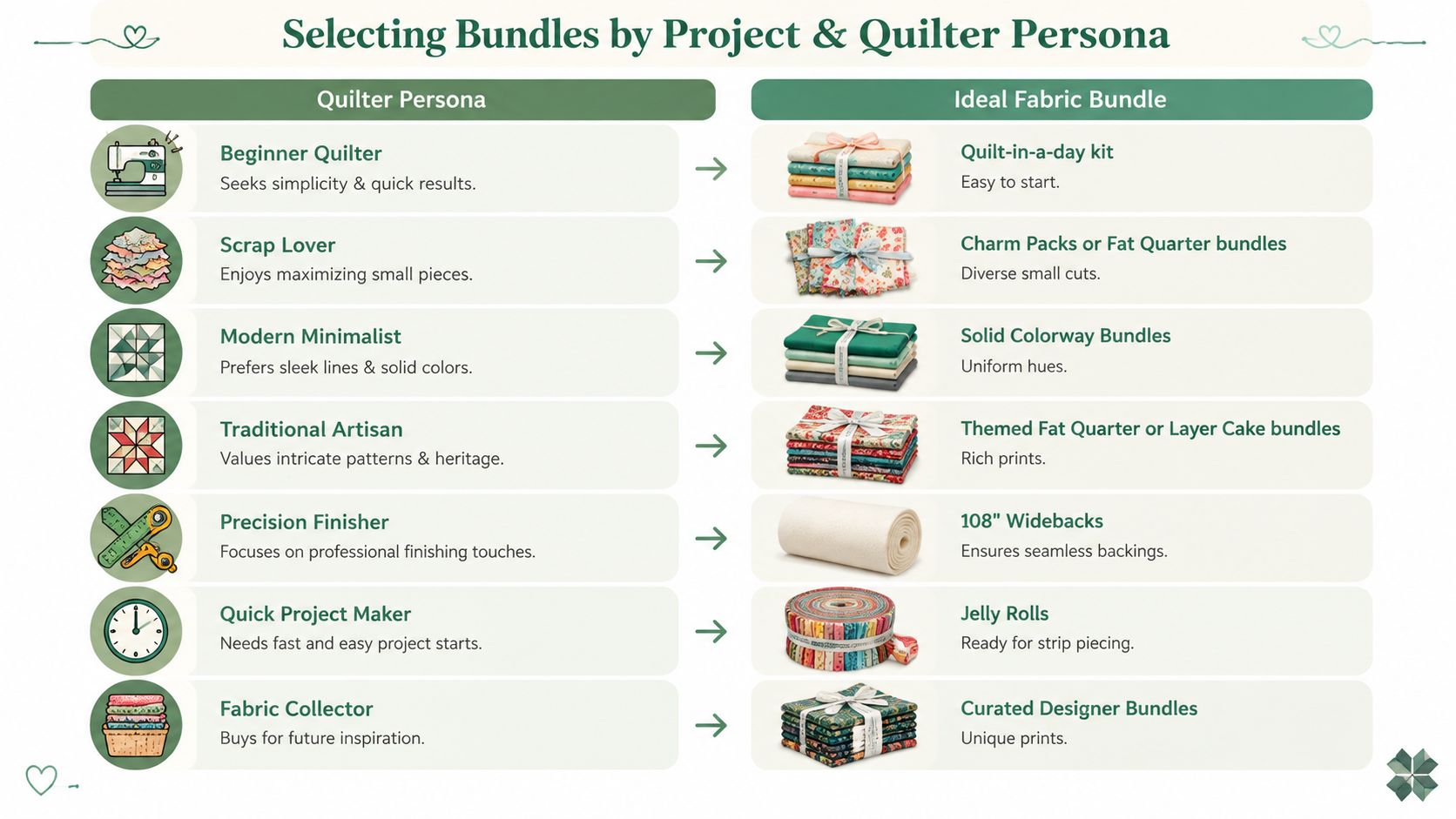
- Beginner quilter: Start with a quilt-in-a-day kit or a coordinated fat-quarter assortment. Look for clear cutting instructions, limited fabric handling, and a design that doesn't depend on complex color placement.
- Scrap lover: Choose charm packs or mixed fat quarters. Diverse small cuts give you variety while keeping the pieces manageable for scrappy blocks.
- Modern minimalist: Explore solid colorway bundles, especially for geometric or pixel quilts. Kona Cotton solids offer a controlled palette, while negative space can give the finished design visual breathing room.
- Traditional artisan: Select themed fat quarters or layer cakes with varied print scales. Marcus Fabrics can suit heritage-inspired arrangements where small florals, motifs, and tonal prints need to work together.
- Precision finisher: Prioritize the complete quilt system, not only the quilt top. A stable bundle, carefully squared patches, batting with the right loft, and a wideback can matter as much as the initial color selection.
- Quick project maker: Jelly rolls reduce the preparation needed for strip piecing. They're especially useful for runners, uncomplicated throws, and designs built from repeated strip units.
- Fabric collector: Curated designer bundles make sense when the purpose is future inspiration rather than an immediate pattern. Label the collection by colorway and collection name so it remains usable later.
Think beyond the piece count
A high-contrast bundle can create a strong pixel effect even when every fabric is a solid. An earthy assortment may work beautifully for a traditional block but lose definition if the prints share too similar a value. Material mixing can be intentional, but fabrics with different weights or surface behavior may require testing before they're combined in one block.
For collegiate fans, team spirit often depends on color accuracy and durability rather than a fashionable collection label. Licensed collegiate panels paired with supporting solids can create a meaningful graduation, dorm, or tailgate gift, but check the pattern requirements before cutting the panel.
The useful question isn't “Which bundle is most popular?” It's “Which bundle matches my design language, deadline, and tolerance for additional cutting?” Browse coordinated fat-quarter bundle options and compare them by project intent.
Pairing and Coordinating Bundles with Supplies
A quilt top doesn't exist in isolation. The bundle determines the color story, but batting affects loft and drape, backing affects seam bulk, and thread influences stitch definition.
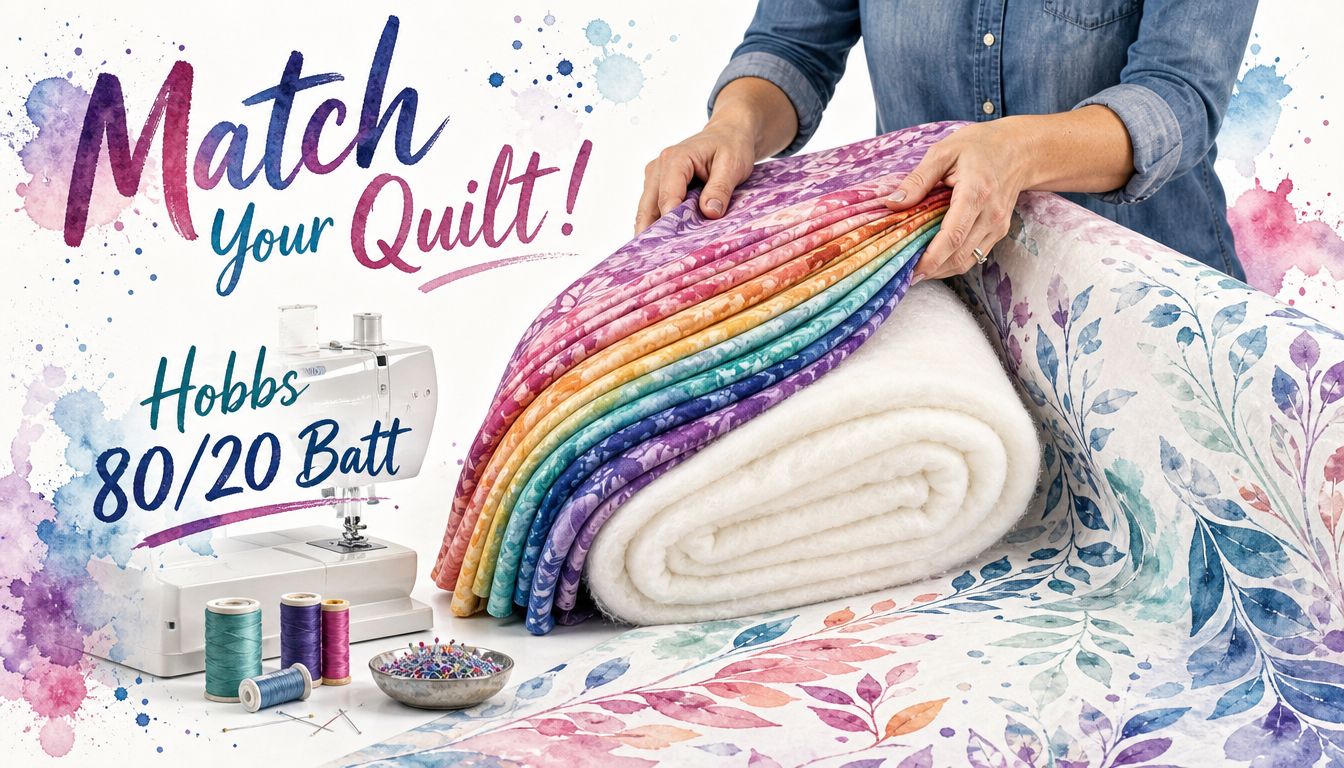
I've tested Hobbs 80/20 batting on a longarm and paid close attention to how the loft changed the quilt's hand after quilting. It offered a balance between a soft drape and enough body for stitch definition, while a thinner batting produced a flatter, lighter result. Your quilting density, intended warmth, and finishing method should guide that choice.
Build the layers deliberately
- Match the backing value: A neutral wideback can calm a colorful top, while a coordinated print can extend the bundle's theme across the reverse side.
- Check the width: Quilt backing marketed at 108 inches wide can cover a quilt back in one piece, reducing or eliminating the need to join multiple panels. The result is fewer seams, less bulk, and a smoother back. See how 108-inch quilt backing is positioned for single-piece coverage.
- Choose batting by feel: Low loft supports a flatter drape and clearer piecing texture. More loft can emphasize quilting lines, but it may require more careful tension control.
- Use stabilizers selectively: Pellon fusible options can help stabilize edges or support specific construction steps, but fusible products aren't automatically appropriate for every quilt top.
- Coordinate notions: A sharp rotary blade, a reliable quilting ruler, consistent thread, clips or pins, and a pressing tool all reduce interruptions once the bundle is open.
A wideback isn't only a convenience product. It changes the finishing workflow by reducing the number of seams you need to align, press, and quilt through. Use this beginner quilting supplies guide when assembling your supporting materials.
Before cutting, place the bundle beside the candidate backing and batting under the same light. A color that looks neutral in the shop may read warm, cool, gray, or bright beside the quilt top. The final combination should support the design rather than compete with it.
Storage and Care for Fabric Bundles
Quilting cotton needs protection from distortion, moisture, dust, and direct sunlight. Fold fat quarters consistently so the bundle stays easy to count, then store each colorway together in an acid-free container or another clean storage system that keeps the cuts flat.
Standard quilting cotton is commonly treated as a medium-weight woven fabric around 140 to 190 GSM, and many cotton fabrics can shrink about 3% to 5% after the first wash unless preshrunk. Review the fabric-care guidance on quilting cotton weight and shrinkage.
A simple care routine
- Decide before cutting: If you plan to wash the finished quilt, consider prewashing the fabric or buying extra yardage for fabrics that aren't preshrunk.
- Separate uncertain fabrics: Don't assume every print, solid, or mixed substrate will respond identically to washing.
- Press with control: Use a suitable temperature and pressing cloth when working with delicate prints. Test a scrap first, and avoid scorching the surface.
- Label the bundle: Record the collection, colorway, cut type, and intended pattern on a paper tag or storage label.
- Block direct light: Sunlight can fade exposed fabric, so keep stored bundles away from bright windows.
I've found that untreated cotton develops stubborn creases faster in humid rooms. A gentle press with the grain restores the fabric without stretching the cut, which matters when your pattern relies on accurate nesting seams and square patches.
Don't mix washed and unwashed pieces casually in one quilt top. Even a small difference in shrinkage can affect piecing accuracy and final quilt dimensions, particularly when blocks need to align across a large layout. Find additional fabric care instructions for quilting projects.
Buying Recommendations and FAQs
A useful purchase starts with the project, not the product category. For a fast seasonal runner, choose a ready-to-sew fabric kit with a clear cutting plan. For strip piecing, browse jelly roll quilting options and check the strip width and usable length before matching the pattern.
For larger block layouts, compare layer cake quilting bundles by print scale and contrast. If you're building a modern pixel quilt, explore curated pixel quilt kits that organize solids or coordinated colorways around a defined visual concept rather than a random assortment.
QuiltKit.com also offers ready-to-sew kits, precut fabric formats, quilting cotton, batting, widebacks, notions, and supplies from brands including Kona Cotton, Ruby Star Society, Marcus Fabrics, P&B Textiles, Hobbs, and Pellon. Shop curated fat-quarter fabric bundles when you want to compare coordinated cuts for a specific project.
People Also Ask
Are fabric bundles good for beginner quilters?
Yes, especially when the bundle includes coordinated fabrics and a pattern with clear cutting instructions. Fat quarters offer variety without requiring you to match every print from bolts, while ready-to-sew kits reduce the number of early purchasing decisions.
Should I buy extra fabric with a bundle?
Buy extra fabric when the pattern needs a separate background, border, binding, or backing. Also consider extra yardage when the fabric isn't preshrunk, because first washing can change dimensions.
Can I mix fat quarters and yardage in one quilt?
Yes. Use yardage for background, borders, or backing and reserve the fat quarters for blocks and feature patches. Check that the fabrics have compatible weight, weave, and care requirements before combining them.
What fabric bundle is best for a pixel quilt?
A curated solid colorway or a high-contrast assortment is usually a practical starting point. The key decision is value separation, because neighboring colors need enough contrast for the pixel design to remain readable.
If you're not ready to buy today, use the Email Sign-up Savings to stay informed about new kits, coordinated bundles, and supply offers while you decide which project belongs next on your cutting table.
QuiltKit.com offers ready-to-sew kits, coordinated precuts, quilting cotton, batting, and wideback fabrics for projects ranging from quick table runners to modern pixel quilts and collegiate gifts. Visit quiltkit.com to choose a bundle that matches your pattern, schedule, and preferred finish, then start piecing with less guesswork.