


Holiday Flannel Fabric Guide: Cozy Quilts and Runners
Holiday flannel fabric is typically a soft, brushed cotton available in lightweight to midweight ranges, most often sold as coordinated prints in classic reds, greens, and winter neutrals. Cotton flannel can shrink approximately 2–4% in width and 4–6% in length at 40°C, so washing and drying it before cutting is the safest way to keep a festive runner or quilt accurate (TextileTuts explains flannel shrinkage).
You've found the perfect plaid for a table runner, the tree is waiting, and guests are already asking when the house will look festive. Then the first wash turns a straight border wavy, or a snowflake print no longer sits squarely inside the block.
Holiday flannel fabric rewards a little preparation. Its brushed nap gives winter projects warmth and softness, but that same surface affects cutting, pressing, feeding, and visual alignment. The most successful fast projects begin by treating flannel as a distinct textile, not just as quilting cotton with Christmas colors.
What Makes Holiday Flannel Fabric Feel Different
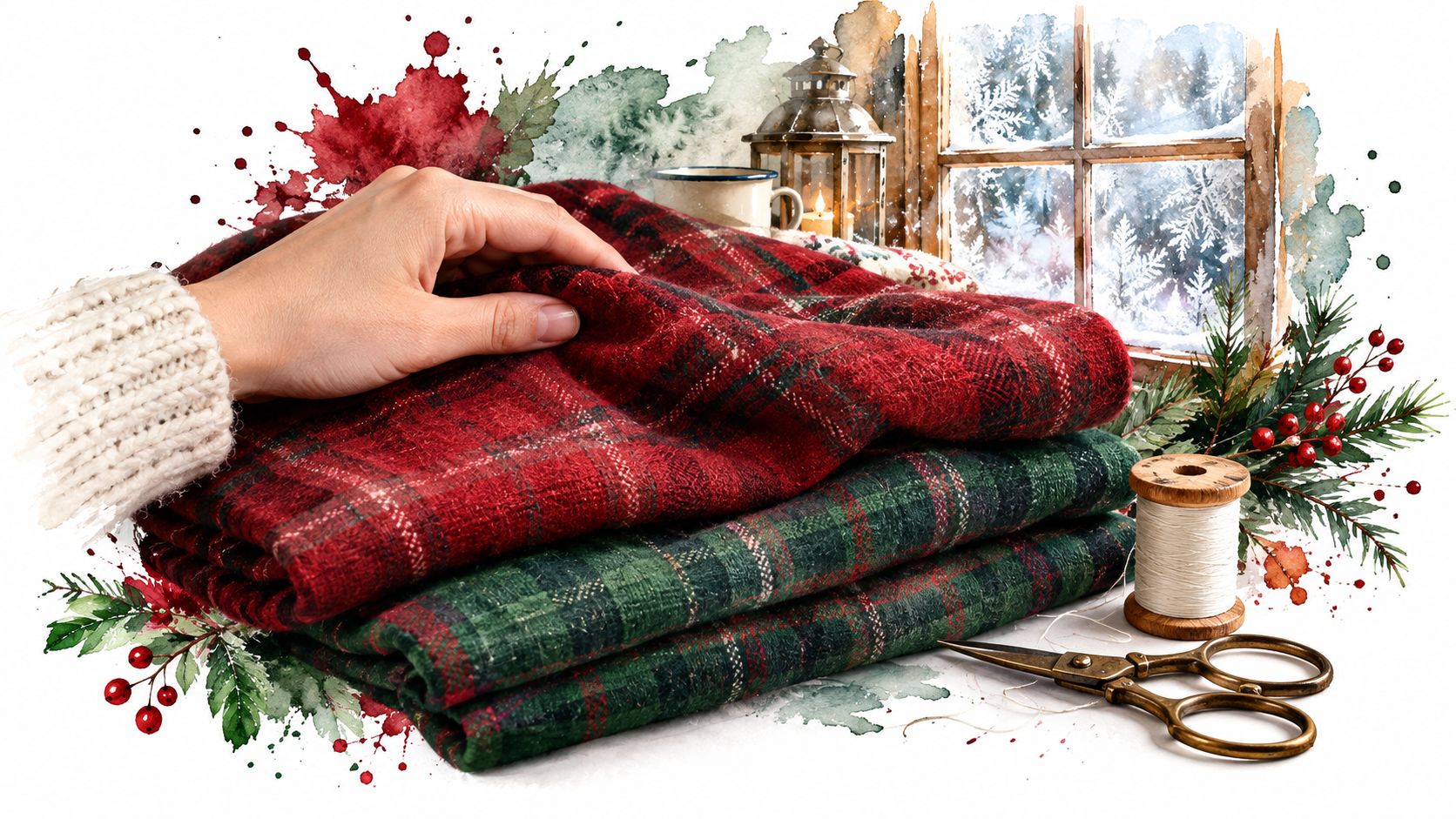
A bolt of holiday flannel fabric feels inviting before it ever reaches the cutting table. Run your hand across the surface and you'll notice a short raised nap, a slightly cushioned hand, and a softer response than standard quilting cotton. That nap may run in one direction, so a red plaid can appear subtly lighter or darker depending on how the pieces face.
The word flannel points to a textile tradition with documented Welsh roots dating to at least the 16th and 17th centuries. Early flannel was generally a plain- or twill-woven wool fabric with a raised finish, and the French term “flanelle” was in use by the late 1600s (historical background on flannel). Modern quilting flannel commonly uses cotton or synthetic fibers, but the association with warmth and winter textiles remains.
I check three things before buying fabric for a seasonal project:
- Nap direction: Brush the surface in both directions. If the color changes, mark the top of each pattern piece.
- Drape: Hold a folded length by one corner. A softer flannel collapses readily, while a firmer weave hangs with more structure.
- Edge stability: Rub the cut edge gently. Some brushed cottons shed lint but still hold a clean seam, while looser cloths fray during repeated handling.
For coordinated yardage and fabric education, the layer cake flannel guide is a useful companion. A coordinated bundle can save selection time, but it won't remove the need to inspect nap and shrinkage.
How Weight and Texture Change the Sewing Experience
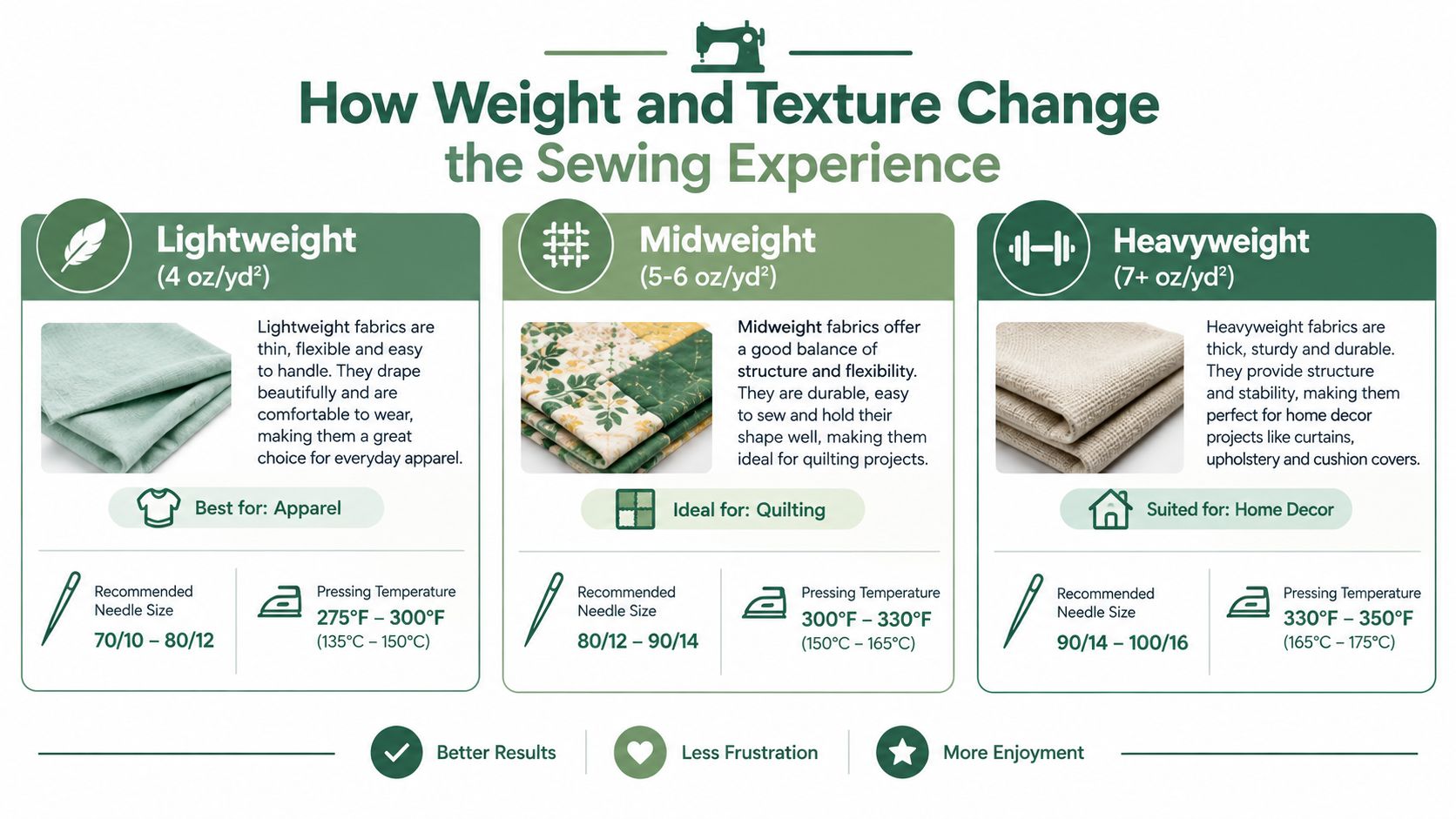
Weight changes the entire rhythm of sewing. Lightweight flannel folds easily and suits softer garments or delicate ornaments, while a midweight option gives a table runner or quilt top more body. A dense, tightly woven surface usually holds a precise seam better than a loose fabric whose brushed fibers shift under the presser foot.
When I test a new flannel, I sew a small seam, press it, and turn it right side out before committing to yardage. A tight weave keeps the seam allowance readable and the block edges controlled. The nap can hide tiny inconsistencies from a distance, but it won't correct a distorted cut or a stretched bias edge.
A few handling choices make a noticeable difference:
- Needle selection: Start with a sharp universal or quilting needle appropriate to the fabric's thickness. Replace it if stitches begin skipping or the nap pulls.
- Presser-foot pressure: If the fabric creeps, reduce pressure when your machine allows it, or use a walking foot for layered quilting.
- Pressing: Lift and lower the iron rather than dragging it across the nap. Excessive sliding can distort a soft edge.
- Seam testing: Sew through the actual number of layers your project will use. A single-layer test won't predict how a flannel top, batting, and backing will feed together.
The types of quilting fabric guide helps place flannel beside other quilting textiles. For precision piecing, the ideal fabric isn't necessarily the thickest or softest. It's the one with enough body to stay aligned and enough flexibility to press flat without fighting the pattern.
Prewashing, Shrinkage Control, and Cut Accuracy
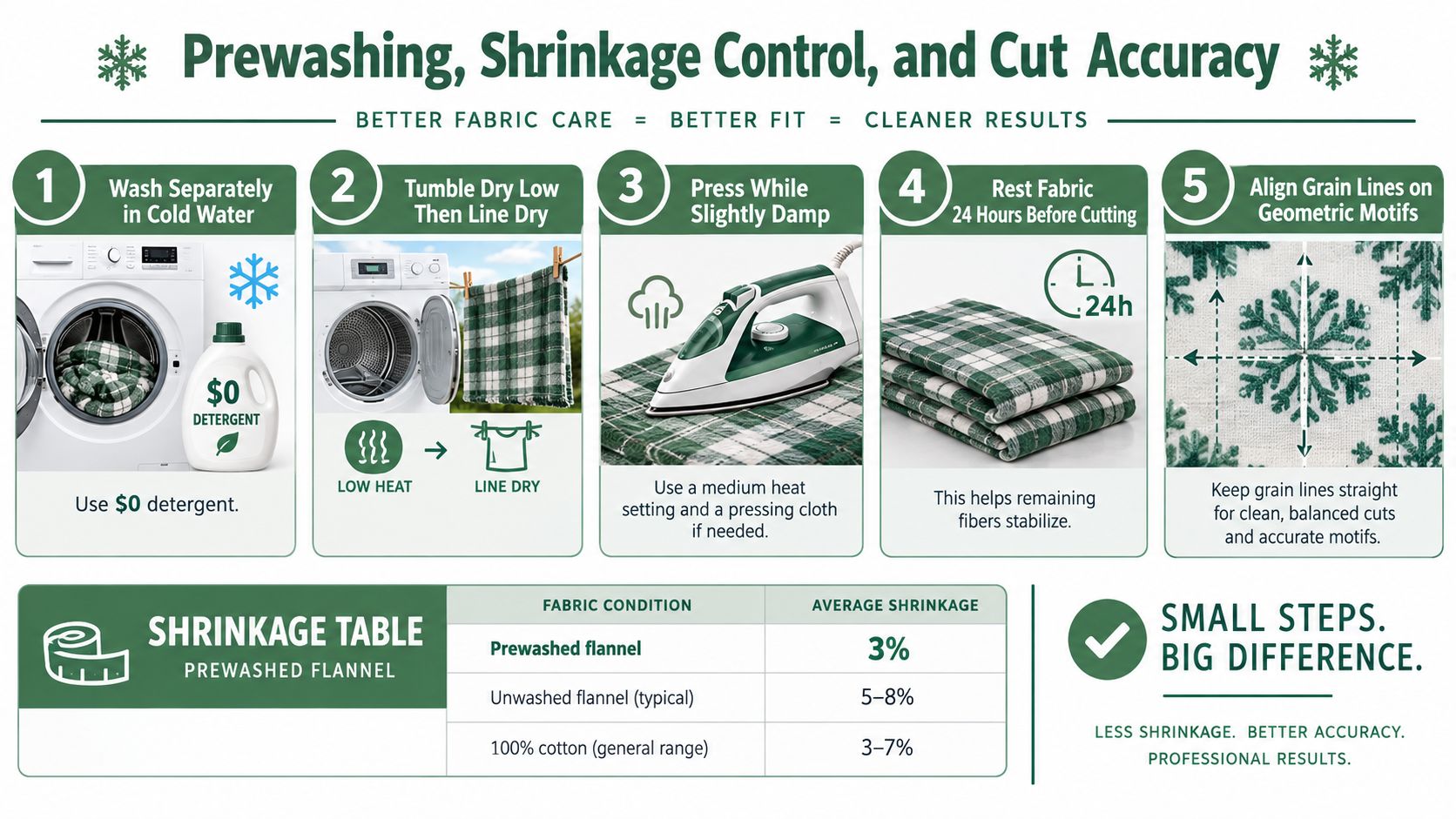
Before you cut, prove the shrinkage on your own yardage with a marked test swatch. Holiday flannel feels forgiving in the hand, but it can lose enough length in the wash to throw off a table runner, shift a plaid border, or leave a directional print looking slightly off once the project is quilted and washed.
Heat and agitation are what change the fabric. Cotton fibers swell, the finish relaxes, and the brushed surface settles into its washed shape. Under hotter laundering, reported shrinkage can climb to 4–7% in width and 8–10% or more in length. Hot washing with tumble drying can push that to about 7–10% in width and 10–15% in length. Those are big enough changes to matter on any project that needs to fit a specific surface or match across seams.
Use this order in the studio:
- Test a representative swatch. Mark a measured square with lengthwise and crosswise grain lines, then wash it exactly the way the finished item will be washed.
- Wash the yardage. Match the actual care routine, especially for gifts and table linens. If you are working with deep reds or greens, separate them when bleeding is a risk.
- Dry it fully. If the finished piece will go in the dryer, test that too. Drying often changes the final dimensions more than quilters expect.
- Press on grain. Smooth and press without dragging the iron across the nap. Pressing from the wrong side helps when the brushed surface crushes easily.
- Measure before cutting. Check usable width, square the edge, and align checks, plaids, or other geometric motifs before the ruler goes down.
That sequence saves rework.
For a rustic wall hanging, a little draw-up may not matter. For a runner that has to sit cleanly on a table, or blocks that need plaid lines to meet, skipping the test costs more time than it saves.
Practical rule: Treat “preshrunk” and “prewashed” as different claims. Verify residual movement on your own sample whenever finished size matters.
These fabric care instructions are a useful reference for setting wash and dry conditions. I keep that choice consistent across the whole fabric bundle, because mixed prep is one of the fastest ways to end up with a holiday project that washes unevenly.
Coordinating Holiday Prints and Seasonal Motifs
You spot a festive flannel on the bolt, cut fast, and only later realize the reindeer heads vanish inside a 4 inch block or the plaid fights every seam. Holiday prints need more than matching colors. They need a clear scale, a stable supporting cast, and motifs that still read once the pieces are cut and sewn.
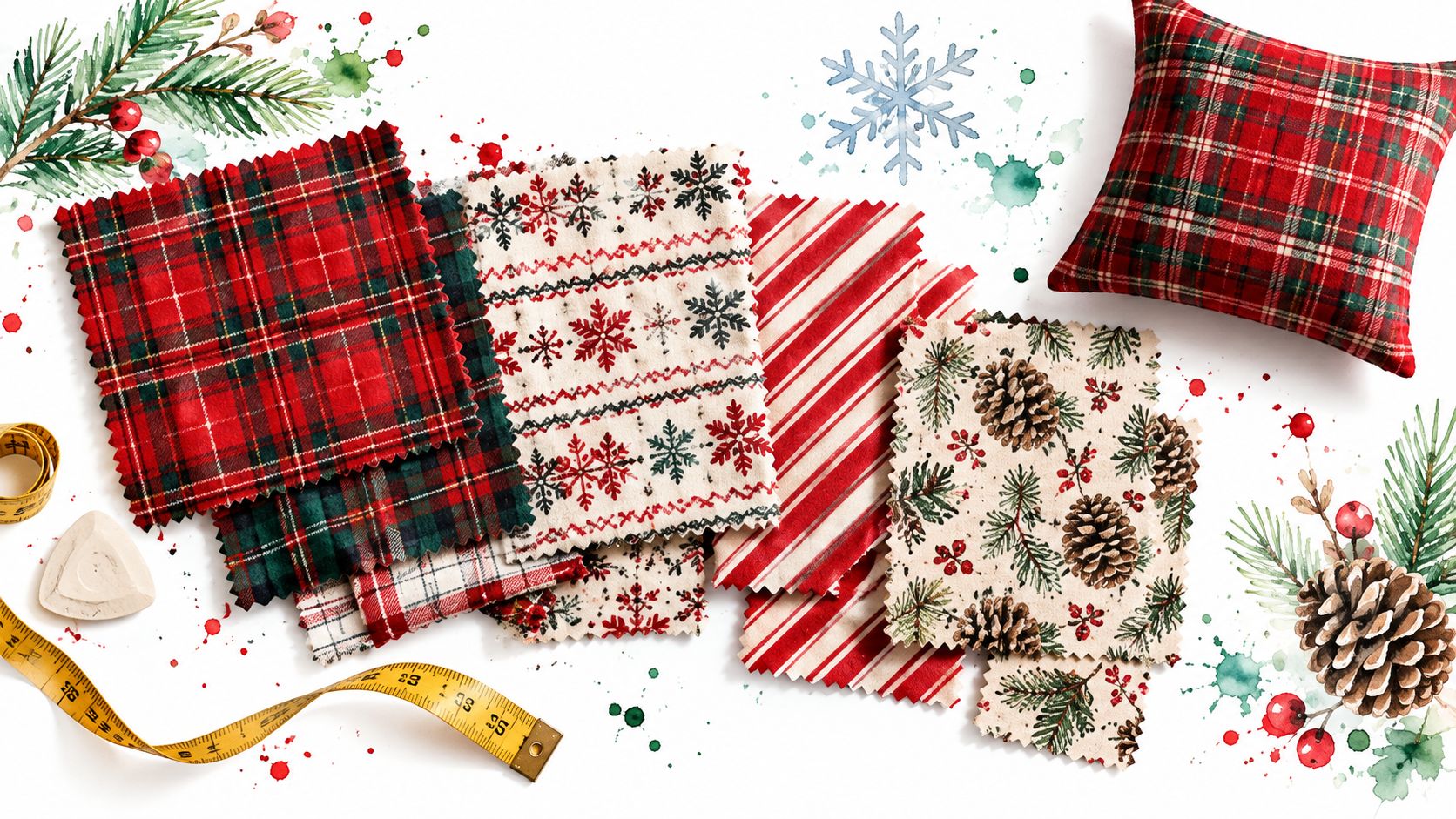
Holiday color sets the mood, but the quilt still needs hierarchy. Classic red, green, cream, and winter neutrals give a traditional result. A deep evergreen plaid can anchor a snowflake print, while a small dot or quiet stripe gives the eye a place to rest between busy motifs.
I start with one dominant print. That might be a large winter animal, a broad plaid, or a directional snowflake. Before buying yardage, compare the motif size to the finished block or runner width. If the main element gets chopped into fragments, save that print for a border, backing, stocking cuff, or a central panel instead of forcing it into tight piecing.
For a quick, coordinated selection:
- Choose one large-scale focal print for blocks, stockings, or a central panel.
- Add a medium-scale plaid or stripe that brings movement without introducing another theme.
- Use a quiet neutral such as cream, oatmeal, charcoal, or muted green around high-contrast motifs.
- Reserve bold directional fabric for pieces you can align deliberately, especially when nap and motif direction both need to run the same way.
A solid back can calm a lively top. Kona Cotton solids are a practical reference point for clean, stable color, while Ruby Star Society fabrics can bring in modern color and sharper graphics when a traditional holiday palette feels too predictable.
The Christmas fabric by the yard collection helps when you need longer cuts for backs, runners, or matching sets. Buy for the finished use, not just the bolt appeal. A print that looks charming folded on the shelf can turn visually crowded once it repeats across an entire quilt, and flannel's softer surface makes that crowding show up even faster.
Holiday Flannel Versus Other Seasonal Quilting Fabrics
You notice the difference as soon as the first units reach the ironing board. A holiday flannel runner feels warmer and softer in the hand than one made from standard quilting cotton, but that comfort comes with more stretch, more surface drag, and less forgiveness if your cuts are slightly off.
| Fabric Type | Warmth | Softness | Precision Piecing | Best For |
|---|---|---|---|---|
| Holiday flannel | High | Soft, brushed hand | Moderate, varies by weave | Cozy quilts, runners, pajamas, stockings |
| Standard quilting cotton | Moderate | Smooth to crisp | High | Detailed blocks, appliqué, structured décor |
| Wool blend | High | Lofty or textured | Moderate to low | Wool appliqué, rustic accents, insulated décor |
| Brushed synthetic | Moderate to high | Soft, sometimes slick | Variable | Budget décor, washable accessories, selected backings |
For fine patchwork, standard quilting cotton still gives the cleanest result. It cuts with firmer edges, feeds more predictably, and holds sharp points better under the presser foot. Holiday flannel earns its place when the project needs softness against the skin or a cozier drape across a table, bed, or sofa.
The trade-off shows up in assembly. Flannel's nap adds body and comfort, but it also encourages layers to creep, especially in small blocks or borders with many seams. I often pair a flannel top with a quilting cotton backing when I want the front to feel soft without letting the whole piece go loose and heavy.
Wool blends bring warmth and visible texture, though they ask for slower handling and usually make more sense in appliqué or accent work than in washable holiday table linens. Brushed synthetics can be useful for inexpensive seasonal décor or utility pieces, but their heat tolerance and stitch behavior vary enough that I would never skip a test seam.
A cozy surface and a precise surface are not the same. Choose flannel when the hand matters most, then cut carefully and stabilize where the project needs support.
In practice, fabric choice comes down to the job. Use holiday flannel for stockings, quilt backs, soft throws, and runners where touch is part of the appeal. Use standard quilting cotton for detailed piecing, crisp appliqué, and décor that has to stay square. If you want flannel's softness without the usual distortion, choose a sturdier cotton flannel, keep pieces simple, and avoid forcing tiny units to behave like plain quilting cotton.
Quick Holiday Projects and Ready-to-Sew Kit Workflows
Flannel is well suited to projects where touch matters as much as appearance. A table runner, stocking, ornament, wall hanging, pillow, or quilt back can show off the nap without requiring every seam to be miniature and exact.
For beginners, a ready-to-sew kit removes much of the decision fatigue. The key terms still matter:
- Precuts are fabric pieces prepared to a standard size, reducing repetitive cutting.
- Fat quarters are quarter-yard cuts made from across the width of fabric, useful for blocks and small accessories.
- Seam allowance is the fabric width between the cut edge and stitching line. Follow the pattern instructions exactly.
- Nesting seams means aligning opposing seam allowances so adjoining points meet cleanly.
- Coordinated bundles group fabrics selected to work together, though they still need nap and shrinkage checks.
A fast workflow looks like this:
- Read the pattern instructions before opening the fabric.
- Separate pieces by block or project.
- Prewash or test according to the finished item's care requirements.
- Cut with the nap and directional motifs facing consistently.
- Sew one test block before cutting every repeated unit.
- Press seams in the direction that reduces bulk.
- Confirm the finished measurements before adding borders or binding.
For time-crunched makers, a quilted table runner project is a sensible starting point. A runner is large enough to show the fabric story but small enough to finish before the holiday gathering.
Shortcuts can work when they remove repetition, not when they ignore construction. A coordinated kit, reliable thread, a fresh needle, and a walking foot can save time. Skipping the prewash on a fitted runner or cutting directional plaid without a test layout usually creates more work later.
QuiltKit.com offers ready-to-sew kits, seasonal table runners, fabric bundles, batting, widebacks, and supplies from brands including Hobbs, Pellon, The Warm Company, Kona Cotton, and Ruby Star Society. For a collegiate fan, a durable team-color quilt or tailgate panel can turn the same practical workflow into a gift with clear team spirit.
FAQs About Holiday Flannel Fabric Projects
Is holiday flannel fabric suitable for children's items
A soft holiday flannel blanket can feel perfect in the sewing room and still be the wrong choice if the project is not built for how children use it. Cotton flannel works well for washable blankets, soft ornaments, pajamas, and comfort items when the label matches the intended use and the construction is secure.
Check the basics before cutting. Fiber content, care instructions, colorfastness, seam security, and edge finish matter more than the print. A quilted blanket needs stable batting and a binding that can take repeated laundering. A toy or ornament needs reinforced seams and no loose pieces that can pull free.
Should busy holiday prints be stabilized
Busy prints do not automatically need interfacing. In practice, soft flannel often benefits from extra support in small parts that have to keep a crisp shape, such as appliqué, ornaments, and narrow stocking cuffs.
For pieced quilt blocks, start with cut accuracy and careful pressing. Those two steps solve more problems than adding structure too early. Stabilizer changes thickness, drape, and sometimes even how the seam folds, so test it with the exact batting and backing first. A firmer sample is not always a better one if the piece starts to feel stiff beside the rest of the project.
When can I skip prewashing
Skip prewashing only when the project is meant to relax after the first wash and every fabric in it will be treated the same way. That can work for a casual throw with a soft, crinkled finish.
For fitted work, prewash. A holiday runner that has to sit flat on a specific table, a border that has to stay straight, or a mixed-fabric quilt with different shrink rates can go wrong fast if you cut first and wash later. I have seen a runner finish square on the ironing board, then lose its fit after one wash because the flannel drew up more than the coordinating fabric. A test swatch gives a better answer than guesswork.
How do I keep several matching projects consistent
Buy fabric for all matching projects at the same time if you can, note the bolt or collection information, and wash and press the yardage together before cutting. Then sort each project into labeled stacks so pieces do not get mixed.
This matters for stockings, classroom sets, and gift bundles. Even identical prints can behave differently if one cut is washed hotter, dried longer, or pressed harder than another. With flannel, nap direction can also make two pieces from the same fabric look slightly darker or lighter when they are turned opposite ways, so keep that orientation consistent across the whole set.
Can flannel and quilting cotton be mixed in one quilt
Yes, but treat them like different materials, not interchangeable ones. Flannel and quilting cotton can look great together, yet they do not always shrink, drape, or feed through the machine the same way.
Prewash both if they will live in the same quilt. If the cotton is cut unwashed and the flannel is allowed to shrink later, borders can ripple and block sizes can shift after laundering. I also avoid placing flannel in areas that need the sharpest structure unless I have tested the combination first. Sashing, borders, and points show those differences quickly.
Is holiday flannel environmentally responsible
The label alone does not settle that. One overview reports that about 32% of global cotton production falls into some sustainable category, with much of that volume tied to Better Cotton rather than organic or recycled cotton (sustainable cotton overview). “Sustainable cotton” covers different standards, not one uniform material.
For holiday sewing, the more useful questions are practical. Will the fabric hold up for repeated seasonal use, wash cleanly, and stay worth storing from one year to the next? Look for clear fiber-content details, specific certifications where given, and fabric quality that matches the project. Recycled content can be a good fit in some cases, but the result still depends on fiber quality, finishing, and how the item is constructed. Quilting flannel is also a poor choice for heat-exposed items like potholders unless the batting and build are designed for that use.
Ready to make a seasonal project that stays square after washing? Explore the coordinated fabrics, ready-to-sew kits, batting, and finishing supplies at quiltkit.com, and join the Email Sign-up Savings list if you're planning your next holiday sewing session.