


Kona Cotton Solids Guide to Color, Care and Quilts
You're standing in front of a wall of printed cottons, pattern in hand, and nothing feels quite right. The quilt needs one calm, dependable fabric to make the piecing visible. Kona Cotton Solids often become that fabric, especially when a modern design needs clean color blocks instead of more pattern.
I've cut, washed, pressed, and pieced Kona for everything from tiny half-square triangles to large solid quilts. The fabric has a soft, buttery drape, but it's crisp enough to hold a fold and keep a seam under control. In this guide, I'll walk through its construction, color system, prewashing choices, cutting habits, project applications, and palette planning for quilts that need to stay visually organized after washing.
If you're building a modern stash, it helps to compare Kona with contemporary collections such as Ruby Star Society, then connect those choices to practical finishing supplies, ready-to-sew projects, and modern quilt ideas. The aim is simple: help you choose solids with confidence instead of relying on a color chart alone.
Introduction to Kona Cotton Solids and Why Quilters Love Them
You have a pixel quilt pattern open, a long color list beside it, and a practical worry: will those carefully chosen solids still look orderly after the first wash? Kona Cotton Solids are useful here because they give a quilt broad, consistent fields of color, while still offering enough variation to separate values and shapes.
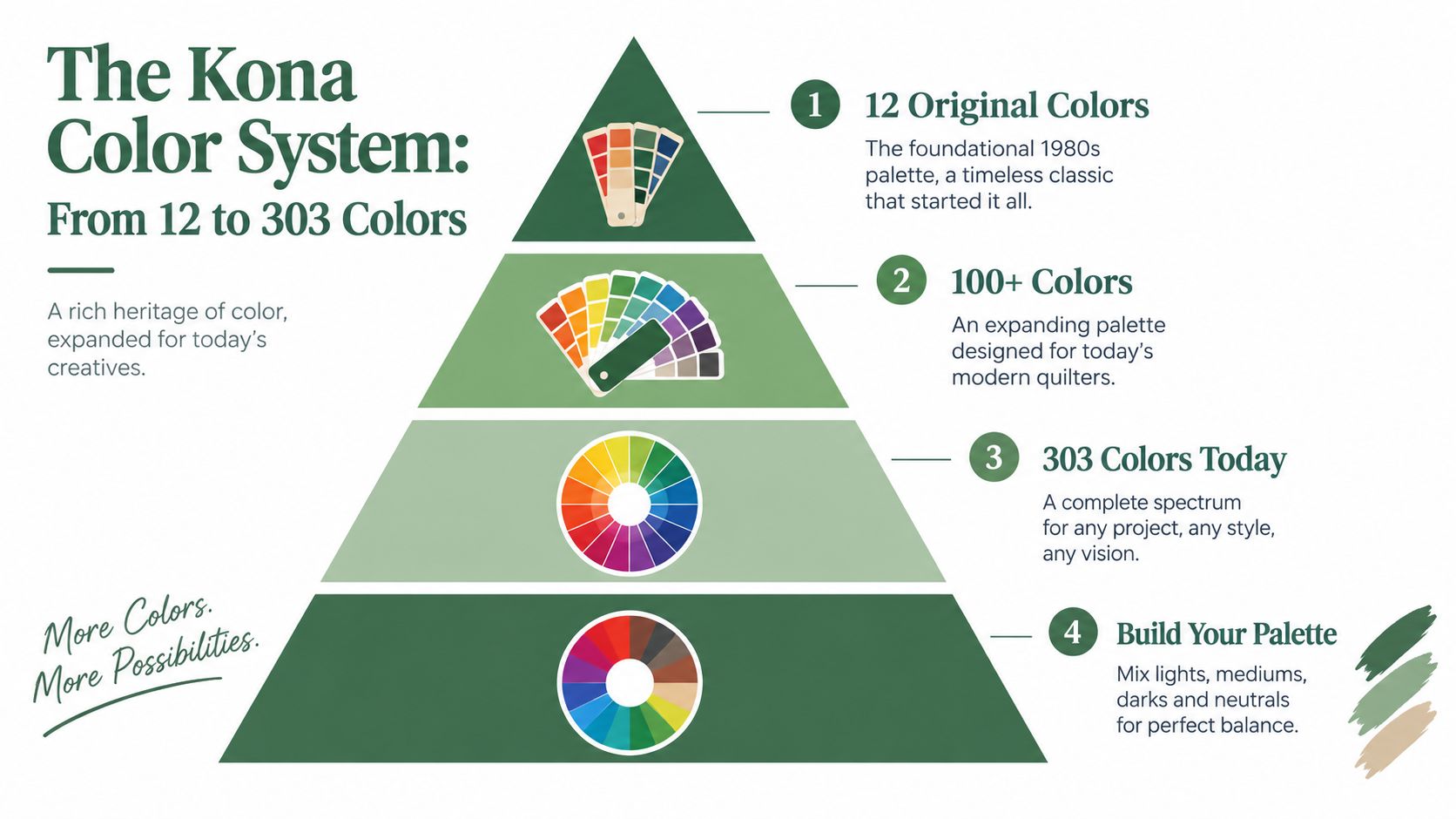
Robert Kaufman Fabrics introduced Kona Cotton Solids in 1984 as a solid companion to its existing Kona Prints collection. The first release contained a dozen colors and targeted the mid-1980s sportswear market before quilters made the line part of their regular vocabulary. In a 30-year retrospective, Robert Kaufman documented an expansion from 271 SKUs to 303 colors, adding 32 colors. The collection was also described as having 66 more colors than its closest competitor. Robert Kaufman's Kona retrospective records that history.
That range works less like a simple rainbow and more like a set of design roles. One solid can calm a busy print, another can establish the background, and a third can separate neighboring values. In a pixel quilt, those distinctions help the image read as a whole instead of dissolving into individual fabric squares.
Choose colors by their jobs, not only by how attractive each bolt looks alone. A dark value may define the outline, a light value may carry the open field, and a small accent can keep a modern composition from appearing flat. Hold swatches together in the intended arrangement. Colors that seem clearly different on a chart may merge once they sit beside one another.
A solid isn't the absence of design. It's the structure that lets the design speak.
Kona's quilting-cotton construction gives it enough body for controlled cutting and accurate seams without making the fabric feel stiff. Pressed units tend to stay manageable, which suits large modern quilts, ready-to-sew projects, and detailed piecing where clean points matter.
Color charts cannot answer every handling question. For a large palette, test saturated or very dark colors for bleeding, decide which fabrics need prewashing, and keep a small washed sample before cutting the full quilt. These checks, along with practical modern quilt ideas, help a broad Kona palette remain coherent through construction and washing.
What Kona Cotton Solids Are Made Of and How They Feel
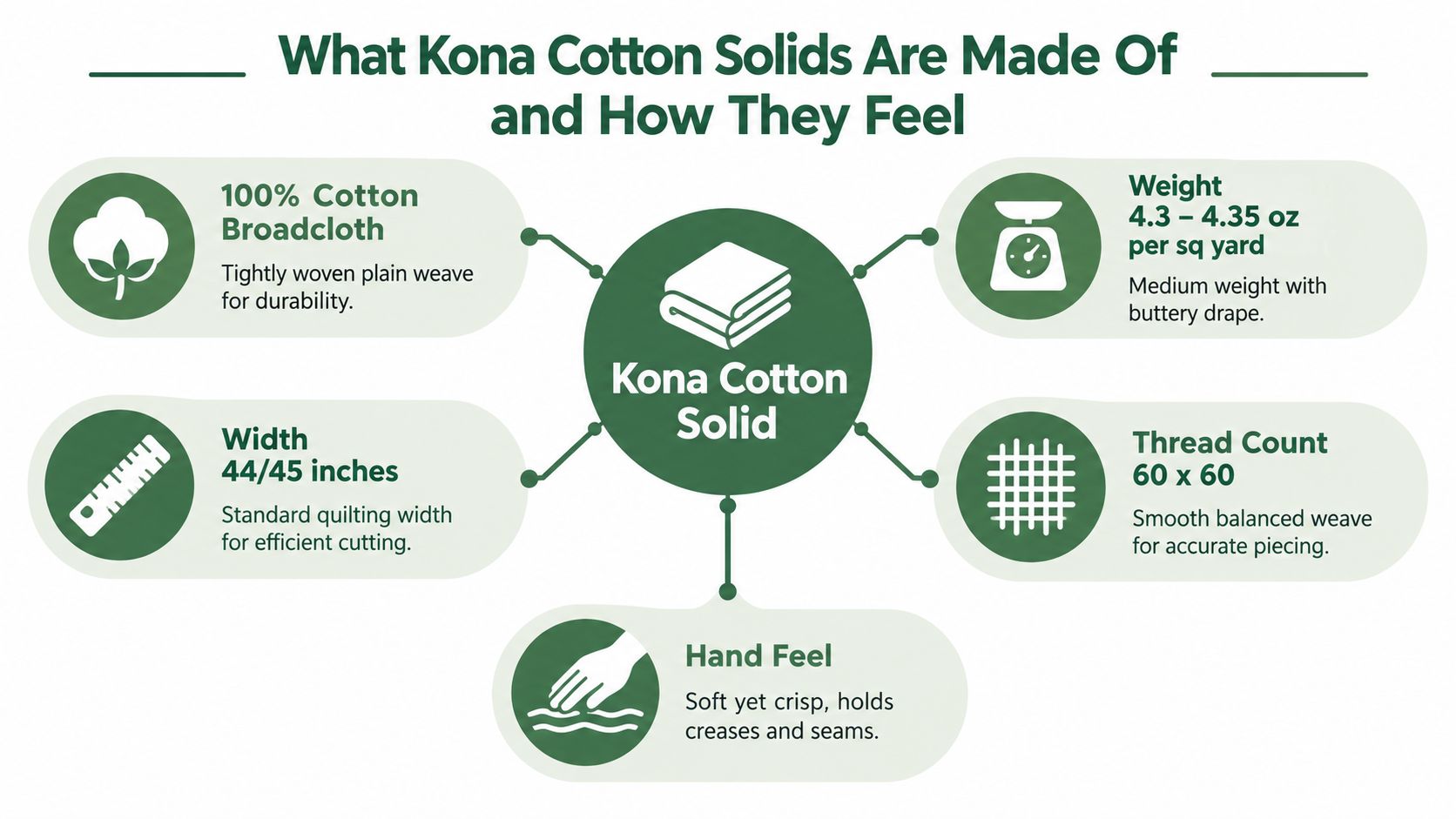
You cut a Kona strip, press it, and pick it up by one corner. It stays orderly rather than collapsing in your hand, yet it does not feel stiff or board-like. That balance comes from its quilting-cotton construction: 100% cotton broadcloth or quilt fabric, weighing about 4.3 to 4.35 ounces per square yard and measuring roughly 44/45 inches wide, according to this Kona fabric specification listing.
The hand is soft yet crisp. It folds without resistance, takes a clean pressed crease, and has enough body to help a block remain square while you assemble the next one. A heavier utility cotton feels firmer and more rigid. Kona has a dependable shirt-weight presence, although its usefulness for patchwork comes from the combined effect of weave, weight, and finish, not drape alone.
Why the weave affects piecing
A quilting-specific measurement records 60 threads in one direction by 60 in the other, or 120 total threads per square inch, with a weight of 4.35 ounces per square yard, or 150 gsm. The measurement report provides technical context for comparing Kona with other quilting cottons.
That balanced weave gives the fabric enough resistance for small piecing adjustments. Half-square triangles are easier to align because the cloth does not collapse as diagonal edges meet. In modern solid layouts, pressed seams sit flatter, while dense quilting can show clear stitch definition without making the quilt top unnecessarily bulky.
The cut edge still deserves care, especially on the bias. Even so, ordinary marking, trimming, and repositioning will not immediately turn it into fringe. Consistent seam allowances let beginners bring pieces together cleanly, while experienced quilters can use the same stability for nested seams, controlled tension, and accurate points.
Kona's feel also matters when you plan a large pixel or modern quilt. A broad palette may include saturated or very dark colors, so wash a small sample from each color family before committing to the full top. Some fabrics may release excess dye or change slightly in hand after washing. A washed test tells you more than a color chart about bleeding, shrinkage, and whether neighboring values still separate clearly.
The top is only one layer of the finished quilt. Stable Kona pairs naturally with 100% cotton batting, 80/20 blends, or wideback cottons, depending on the drape and quilting density you want. For a broader foundation in fabric terminology and selection, consult this guide to types of quilting fabric.
Understanding the Kona Color System and How to Build Palettes
With 303 colors on the shelf, treat Kona as a system rather than a shopping list. The practical question is not which shades look attractive in a chart. It is which fabrics will hold their roles after cutting, washing, and piecing, especially in a large pixel or modern quilt.
Begin with value first, hue second, and saturation third. Value is how light or dark a fabric appears in grayscale, and it usually determines whether a pixel image remains readable. Hue identifies the color family, such as blue, green, coral, or violet. Saturation describes how clear and intense that hue feels, from dusty to vivid.
Two swatches that look nearly identical on a screen may separate sharply beside a pale background, or merge when placed next to a dark accent. Compare physical fabric whenever possible. A grayscale photograph is also useful because it removes the distraction of color and exposes weak value steps before you cut the full palette.
A practical palette method
Assign each fabric a job before adding another attractive shade. A broad palette can still feel organized when every color supports the composition.
- Light field: Choose a pale neutral or softened hue to create breathing room around the design.
- Mid-value structure: Select related colors for the main shapes, with enough value separation to keep neighboring pieces distinct.
- Dark anchor: Use the deepest value for outlines, shadows, sashing, or strong contrast.
- Accent note: Add a saturated color sparingly when the rest of the quilt already contains several competing hues.
For a pixel quilt, lay the palette out as a value ladder before sorting it by hue. For a modern minimalist quilt, limit the number of roles and let negative space carry more of the design. In a scrappy quilt, vary the hue inside each role while keeping the light, medium, and dark structure consistent.
| Quilt Style | Palette Strategy | Kona Tip |
|---|---|---|
| Pixel quilt | Separate light, medium, and dark values clearly | Photograph or view swatches in grayscale before cutting |
| Modern minimal quilt | Limit the palette and let negative space carry weight | Test the background against every major color |
| Scrappy build | Keep a consistent value structure while varying hue | Group fabrics by role, not just by color family |
Ruby Star Society collections provide a useful modern contrast because coordinated prints and contemporary palettes approach color differently. Kona gives you finer control when one value needs adjustment without adding another motif.
Judge the palette at the size it will occupy in the quilt. Large swatches can make a shade feel more dominant than it will appear in repeated squares, while tiny pieces may lose subtle differences. The guidance on scale and proportion helps relate each swatch to the visual space it will fill.
Wash testing belongs in this decision, too. Test the darkest and most saturated colors, particularly deep teal, red, navy, and similar shades, with a pale scrap or white cloth. Look for dye transfer, a change in intensity, shrinkage, and altered hand. Keep fabrics from the same planned batch together when possible, then reassess the value pattern after washing. A palette that looks balanced dry should still separate clearly once the quilt has been laundered.
How to Prewash Handle and Cut Kona for Accurate Piecing
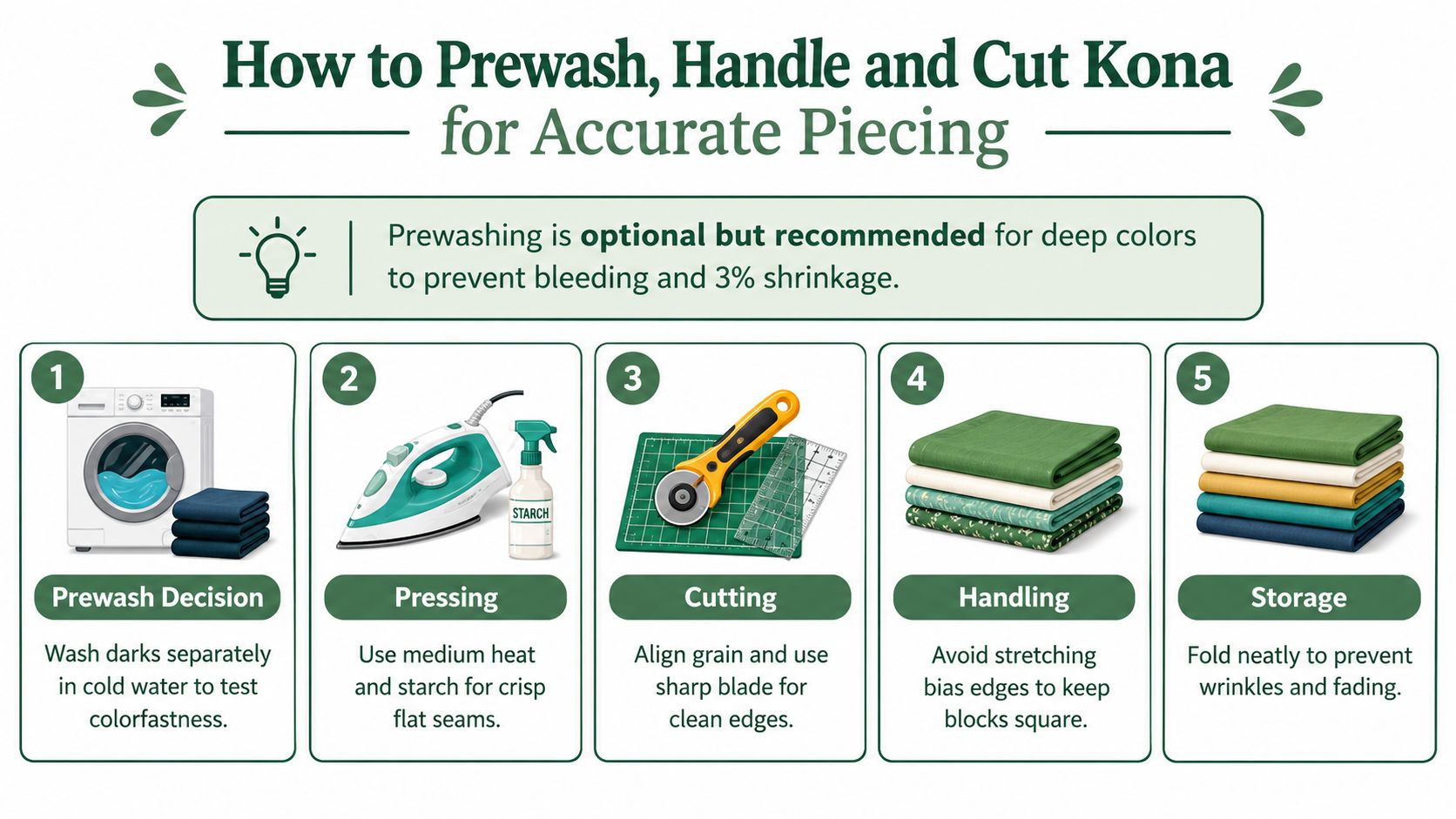
You have a dark navy, deep red, or saturated teal ready for a pixel quilt, and the cutting plan depends on every square keeping its size. Prewashing Kona is optional, but I recommend testing and prewashing deep or highly saturated colors. Cotton quilting fabric can shrink on its first wash, and dark dyes may bleed, so a small swatch is safer than assuming every color behaves alike. This preshrinking guide supports testing fabric before committing the yardage.
Choose the method that suits the finished quilt and your washing routine. Prewashing gives you a smoother, more predictable surface before precision cutting and helps reveal how a large palette will behave together. Skipping it preserves the texture created when the completed quilt is first washed, provided every fabric follows the same plan and you allow for dimensional change.
Test before committing the yardage
I do not wash an entire palette without testing it. For a dark teal, deep red, navy, or another saturated Kona shade, cut a small swatch and wash it with a pale scrap or white cloth. The test shows both shrinkage and dye transfer while leaving the remaining yardage untouched.
Use the same routine you expect for the finished quilt:
- Separate the test: Wash deep colors apart from pale fabrics, using the planned water temperature and detergent.
- Measure the change: Compare the swatch before and after washing. Treat the result as information about that fabric and batch, not a rule for every Kona color.
- Check the rinse: Look for color in the water or transfer onto the light cloth.
- Press while damp or nearly dry: Smooth the fabric with the grain aligned, then let it dry completely before measuring or cutting.
- Record the result: Note the color name, batch, washing method, and observed behavior for future yardage.
The available guidance is not perfectly uniform. Retailer and marketplace information estimates shrinkage at about 3% to 5%, while quilting-focused testing cites roughly 2% shrinkage and strong colorfast performance after repeated hot-wash cycles, as reported by this Kona Cotton Solids care listing. That spread is why a swatch is more useful than a blanket rule. It also helps when assembling a large, wash-stable palette for pixel or modern quilts, where a small change repeated across many pieces can affect alignment.
Pressing and rotary cutting
After washing, press from the wrong side if shine concerns you. Use enough heat to flatten the cloth, but do not drag the iron across the grain, since that can stretch the fabric. A light application of starch can steady the surface for small pieces and half-square triangles.
Align the grain before folding. Smooth the fabric instead of pulling it, and use a sharp rotary blade so the edge stays against the ruler. Bias edges need especially careful handling because woven cotton can distort when pushed or stretched.
Cut prewashed fabric only after it is fully dry and pressed. For an unwashed project, apply the same washing strategy to every fabric. Consistency protects block dimensions and reduces the chance that a carefully nested grid will shift after laundering.
For a tested starting point, consider this Kona Cotton Solids fabric option and apply the swatch method before cutting a full palette. Review these fabric care instructions before choosing how the finished quilt will be washed.
Kona Cotton Solids Compared to Other Quilting Solids
Kona is a useful baseline, though the best solid depends on the quilt. At the cutting table, compare weave stability, hand, fraying, color range, width, and how reliably fabrics match after washing. Those details matter more than a color chart when a design contains repeated seams or large areas of one shade.
Kona's measured 150 gsm weight and 120-thread count, covered earlier, set the baseline. Its moderate body usually lies flat without feeling stiff, which suits narrow strips, half-square triangles, and pixel layouts where small shifts become visible.
Other solids change the experience in your hands. Ruby Star Society solids often have a contemporary color direction and may feel different in softness or surface from Kona. Their width and construction can also vary by collection, so check the product details before cutting a mixed-brand quilt. Choice Fabrics solids offer another palette and hand, but the individual fabric specification should guide your decision.
| Solid | Practical comparison | Best For |
|---|---|---|
| Kona Cotton Solids | Moderate quilting weight, steady hand, and a broad palette | Precision piecing, pixel quilts, modern layouts, and large color studies |
| Ruby Star Society solids | Check the collection for width, construction, and hand | Contemporary palettes and quilts organized around current color groupings |
| Choice Fabrics solids | Review each fabric before combining it with another line | Projects led by a particular color, availability, or surface feel |
Choosing by project rather than reputation
For precision work, choose fabric that lies flat, resists excessive stretching, and does not add unnecessary bulk at intersections. Kona works well when you need consistent handling across many colors, especially in a large grid. Its measured weight gives you a practical starting point for comparing other solids, rather than treating brand names as interchangeable.
A large pixel quilt exposes differences that a small block may hide. Compare a few candidate fabrics by placing them side by side, washing them together, and checking value, width, shrinkage, and surface texture afterward. A mixed-brand top can succeed when the fabrics share a similar scale and the finishing plan remains consistent.
Scrappy quilts allow more variation, but use a test block before committing to the full palette. Dark and saturated solids can behave differently from pale ones, so judge the washed samples under the same light. This overview of popular quilting fabric brands can help you set priorities before buying. For an alternative, compare Ruby Star Society quilting solids or Choice Fabrics solids by the exact color and cut.
Best Quilt Projects and Techniques for Kona Cotton Solids
Kona's construction becomes most useful when a pattern depends on repetition. A stable hand helps pieces stay aligned, while the moderate quilting weight keeps intersections from becoming overly dense. The fabric is also comfortable for hand sewing, machine piecing, and quilting with a range of batting lofts.
Trend coverage shows that solid collections continue to expand, including a 2025 launch featuring 300 colors in one line, while 2026 fabric guides emphasize checking shrinkage, wash fastness, and light fastness instead of relying on brand reputation alone. The solids trend coverage reflects why hands-on testing matters for large, color-rich designs.
Practical rule: In a solid quilt, color placement carries the movement that prints usually provide.
Projects that suit the fabric
- Half-square triangle toppers: Press seams consistently, trim units after sewing, and use the fabric's stable body to keep diagonal points controlled.
- Pixel quilts: Sort fabrics by value before hue. Kona's broad color system lets you build an image from small, repeatable squares without adding print scale to the design.
- Modern solid layouts: Use a neutral background, a small group of contrasting values, and negative space to make geometric blocks feel intentional.
- Seasonal table runners: The fabric's clean surface works well for simple piecing where quilting lines, binding, and color placement provide the decoration.
- Collegiate tailgate panels: Team colors can create durable, giftable quilts for game days, graduations, dorm rooms, or alumni spaces. Test strong darks beside light backgrounds before cutting.
Seam allowance remains the quiet foundation. A consistent quarter-inch seam matters more than a particular brand, especially in a grid where small errors accumulate. I like to sew a short sample, press it in the direction the pattern recommends, then check whether adjoining seams nest without forcing the block.
For quilting, pair the top with batting from brands such as Hobbs or Pellon, selecting loft according to the texture and stitch definition you want. After quilting, a 108-inch wideback can simplify backing joins on larger quilts, while a standard-width backing may suit runners, wall hangings, and smaller gifts.
For makers who want the color planning and cutting already organized, Kona pixel quilt kits offer a direct route from palette to piecing. The important check is still the same: confirm the color roles, follow the care plan, and keep your seam allowance consistent.
Where to Buy Kona Cotton Solids and How to Choose Your Next Kit
Buying Kona Cotton Solids requires more than matching a color name. Online screens and lighting can shift how a swatch appears, so check whether the retailer clearly identifies the fabric format, available cut sizes, and color information. For a large pixel quilt or modern solid palette, request a physical swatch before ordering full yardage. Place the swatch beside your background, darkest anchor, and nearby colors in daylight. A screen can suggest a relationship, but fabric shows the actual value and undertone.
A fat quarter is a quarter-yard cut divided lengthwise and crosswise, giving you a wider, shorter piece than a standard quarter-yard cut. It suits appliqué, small blocks, and scrappy layouts. Precut strips or squares can save cutting time when a pattern uses repeated units, while yardage gives more control over grain direction and larger pieces.
What to check before ordering
- Color representation: Compare the online swatch with a physical card or fabric sample when matching matters.
- Cut format: Confirm whether you need yardage, fat quarters, strips, or squares.
- Batch consistency: For a large background or dark anchor, order enough from one listing when possible.
- Swatch testing: Check the sample beside your planned palette, especially before committing to many colors.
- Care information: Read the washing guidance and decide whether the whole project will be prewashed.
- Finishing compatibility: Plan batting, thread, binding, and backing before cutting.
For a wash-stable palette, test the actual colors you plan to use rather than assuming every dye will behave identically. Wash and dry the swatch as you intend to treat the finished quilt, then compare it with an unwashed piece. This simple test can reveal changes in hand, scale, or color before those differences spread across a large design.
A curated store helps when you want coordinated bundles, repeatable materials for a guild project, or a ready-to-sew pattern and fabric selection. Individual yardage works well when you are building a precise value sequence. A kit reduces sourcing and color-matching decisions, which can leave more time for cutting and piecing.
You can compare Kona precut rolls for strip-based projects or choose a ready-to-sew Kona quilt kit. QuiltKit.com also offers quilting fabric, precuts, batting, widebacks, notions, and project kits, allowing you to assemble related supplies in one place. If you are still planning, its Email Sign-up Savings can provide updates about fabric and kit opportunities.
You do not need a 303-color stash to start. Choose one manageable project, test the darkest fabric and background together, then let the first block show whether the contrast survives your chosen wash and lighting.
QuiltKit.com brings together Kona Cotton Solids, coordinated precuts, ready-to-sew quilt kits, batting, and wideback options. Visit quiltkit.com to choose a solid-fabric project and begin stitching.