


Modern Quilt Fabric Bundles: A Complete Buyer's Guide
You're standing in front of a wall of coordinated fabric bundles, holding one palette against another and wondering whether the pretty stack in your hands will work once it reaches the cutting table. That hesitation is justified. Modern quilt fabric bundles aren't interchangeable piles of color. Their cut size, usable grain, weave density, and internal palette determine which blocks you can make without buying extra yardage.
A bundle can save preparation time, but it can also create waste if its pieces don't fit your pattern. After handling dozens of precut collections, I've learned to judge the geometry first, the color story second, and the fabric hand third. That order prevents the most common buying mistake, choosing a bundle for its photograph rather than for the project it needs to support.
What Modern Quilt Fabric Bundles Actually Are
A modern quilt fabric bundle is a coordinated collection of quilting cottons that has already been cut into a consistent precut format. The fabrics usually share a designer-led color palette, print language, or solid color family, so the bundle gives you a starting assortment without requiring you to select every bolt individually.
The format grew out of the broader precut-fabric movement. An academic review traces that foundation to three earlier innovations, the sewing machine, kit quilts, and rotary cutters, before identifying 2006 as the year Moda Fabrics introduced the first major commercial precut fabric bundle (academic market review of quilting cotton). Within 15 years, precuts had become widely adopted by quilters, according to the same review, which helps explain why bundles moved from a specialty convenience to a mainstream way to buy fabric.
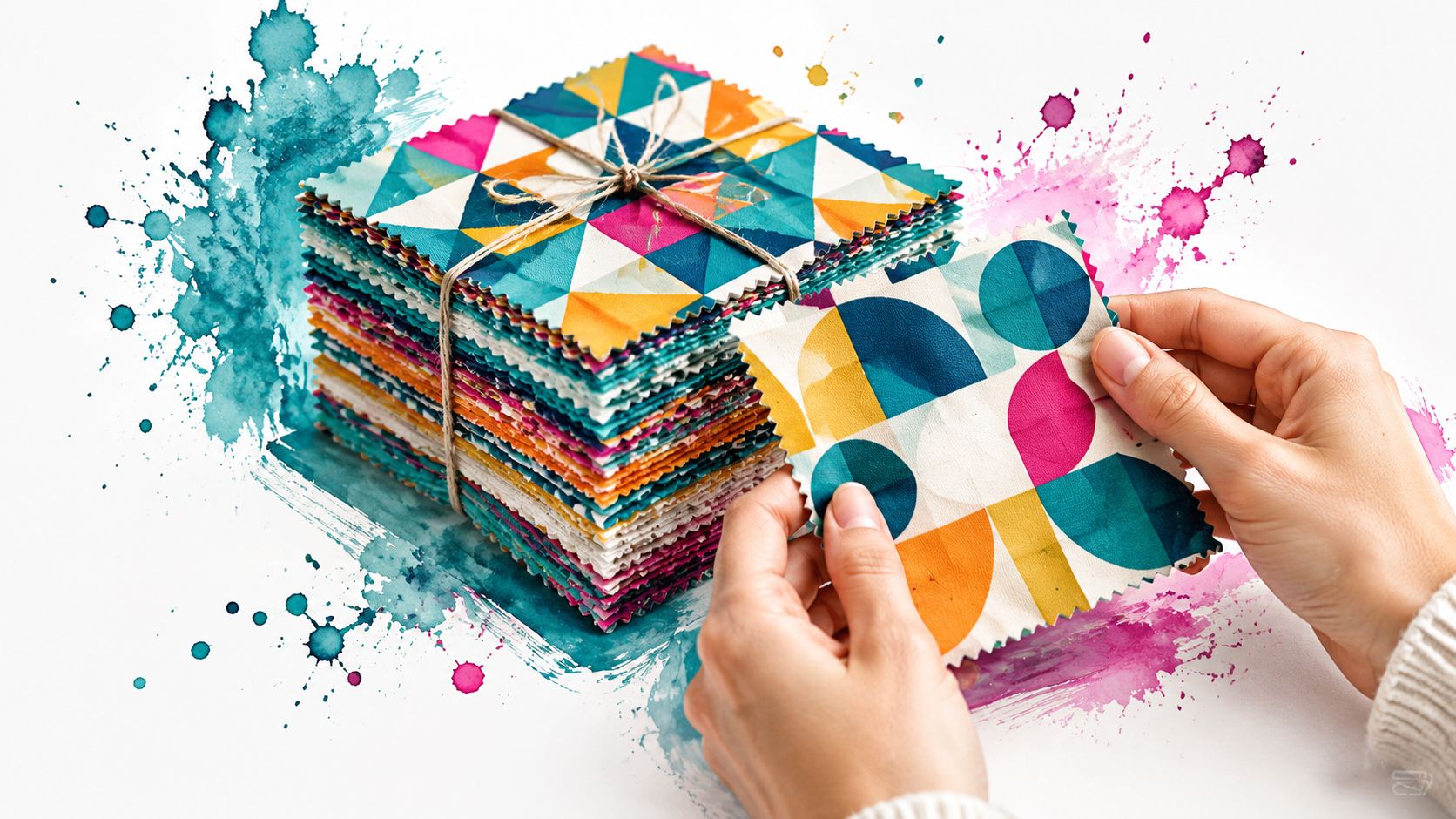
The useful definition is more practical than visual
The important question isn't whether the fabrics coordinate. It's whether the pieces are cut to a size your pattern can use and whether the collection includes enough value contrast for the design to read clearly.
A modern bundle may contain bold geometric prints, low-volume blenders, tonal textures, or solids. The word “modern” describes the visual direction, not one universal cut size. A minimalist collection might rely on a few quiet neutrals and one saturated accent, while a contemporary scrap-style bundle may include many contrasting prints.
When I unboxed a Ruby Star Society bundle, the first things I noticed were the tight weave, consistent color registration, and even folds across the stack. Those details mattered more at the cutting table than the product photography did. The prints stayed visually clean beside one another, and the fabric didn't feel loose or unstable under the rotary cutter.
Practical rule: Treat the bundle as a preselected design system, but inspect every piece as fabric. Coordination doesn't guarantee that the cut dimensions or weave suit your pattern.
For a closer look at how precut formats fit into a cutting workflow, use this guide to pre-cut fabric squares. It's especially useful if you're new to charm packs, layer cakes, and other terms that experienced quilters often use without explaining.
Types of Bundles and Their Yardage Equivalents
The cut size determines what a bundle can do at the cutting table. A fat quarter leaves room for block construction and deliberate motif placement. A charm pack offers uniform squares with little preparation. Neither format gives more value automatically. Match the bundle to the largest finished unit in the pattern.
A fat quarter is typically about 18 x 22 inches, while a standard quarter-yard cut is about 9 x 44 inches (precut dimensions guide). That wider fat-quarter envelope makes it more useful for block-based piecing, fussy-cutting, and small-project kits. It also changes how much fabric remains after removing seam allowances, so the listed dimensions should not be treated as guaranteed usable area.
Compare the formats before you buy
These yardage equivalents are approximate. Counts vary by bundle, and precuts include cutting allowances rather than one continuous length of fabric.
| Bundle Type | Piece Size | Typical Piece Count | Approximate Total Yardage |
|---|---|---|---|
| Fat quarter bundle | About 18 x 22 inches | 6 to 20+ pieces | About 0.69 to 2.53 yards |
| Charm pack | 5 x 5 inches | Collection-dependent | Less than 1 yard |
| Layer cake | 10 x 10 inches | Collection-dependent | About 2.08 yards for 42 pieces |
| Jelly roll | About 2.5 x 44 inches | Collection-dependent | About 2.75 yards for 40 strips |
| Mini bundle | Collection-dependent | About 6 pieces | Depends on cut format |
Bundle sizes are not standardized. Mini bundles may contain 6 pieces, while full-line bundles can contain 20 or more pieces. Check the actual listing before assuming every fabric in a collection is included. A product page for layer cake fabric bundles can help clarify how the larger square format is assembled, but the listed piece count still controls your usable selection.
Why fat quarter geometry matters
Patterns labeled “fat quarter friendly” are built around the 18 x 22 inch envelope. That geometry can hold shapes and strip sets that fit poorly inside a narrow quarter-yard cut. It also gives you more room to center a directional motif or preserve a medallion, though rotation and seam allowances still reduce the final placement options.
Charm packs suit pixel quilts and other designs built from uniform small squares. They become restrictive with larger half-square triangle blocks because the starting squares leave less room for trimming. If a pattern needs larger triangle units, choose fat quarters or yardage rather than forcing a small precut beyond its practical geometry.
The buying question is simple: can the piece envelope hold the pattern's largest cut shape?
Fabric Quality and Thread Count Considerations
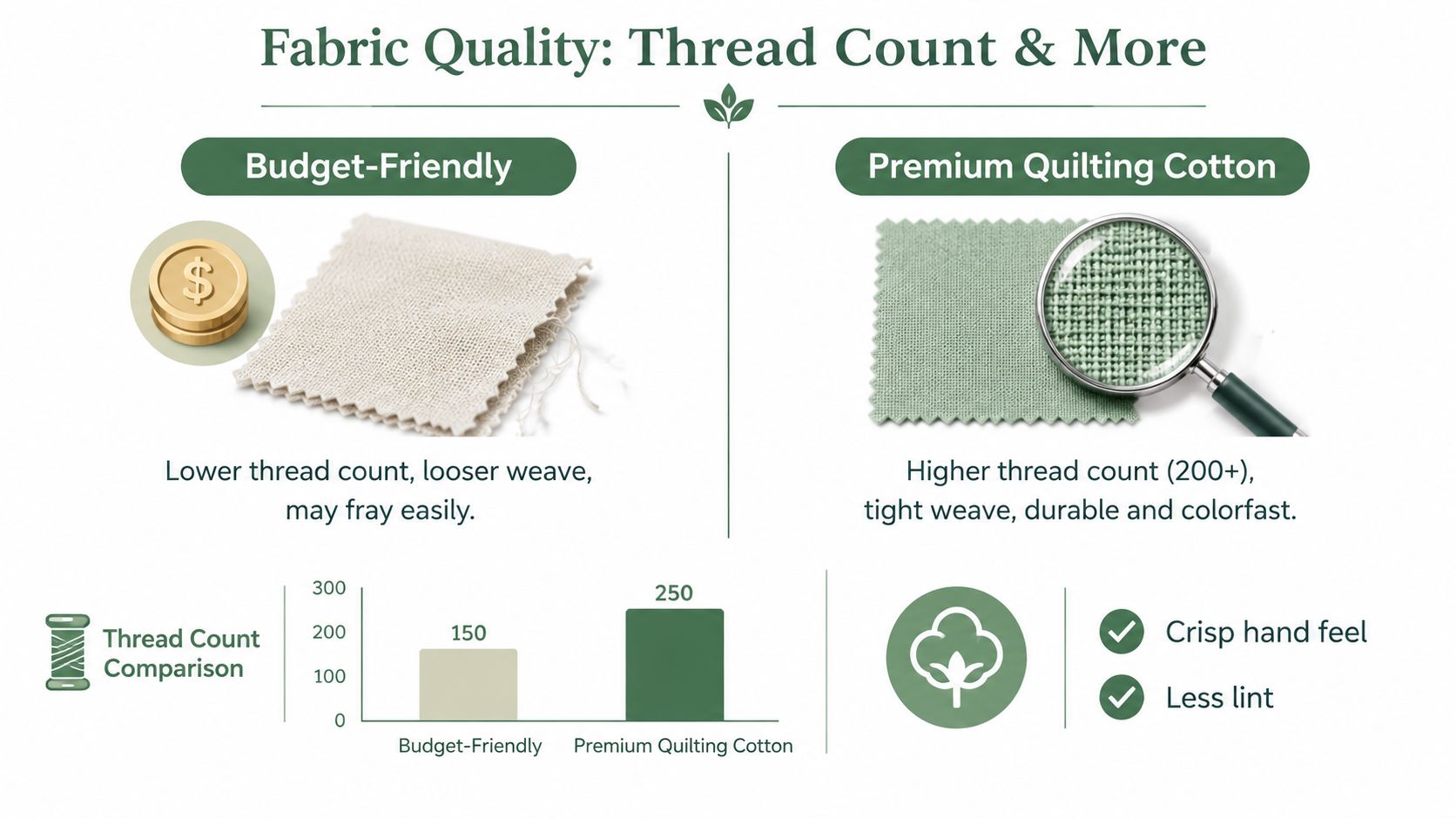
A bundle can look coordinated on the shelf yet behave poorly at the cutting table. Thread count offers one useful quality signal. Modern quilting cotton commonly falls around 60 to 75 threads per inch, while some higher-end solids measure between 132 and 142 threads per inch (comparison of solid quilting fabrics). A tighter weave generally holds its shape more reliably during rotary cutting and piecing, which matters when blocks depend on sharp points and precise value changes.
The trade-off is handling. Dense cloth can resist needle penetration during hand sewing, while mid-range quilting cotton often feels easier during chain piecing, repeated pressing, and multiple needle passes. Thread count also affects the hidden geometry of a fat quarter. A loosely woven cut may distort at the edges or stretch slightly on the bias, changing the effective size of pieces that were already limited by their 18 x 22 inch format.
Match density to construction method
Denser solids work well for precision piecing because they provide a firm, even surface for graphic blocks and quiet backgrounds. Kona Cotton solids are a practical example. In testing, I found a buttery drape and minimal fraying after three wash cycles, a useful combination when printed fabrics need clear separation.
A crisp hand does not have to mean stiffness. Sew a scrap, inspect the cut edge, and watch whether the weave shifts as you handle it. Fraying can reduce usable seam allowance and make small units harder to trim accurately. Print clarity matters too. Blurred registration or uneven color can undermine a modern design even when the fabric feels stable.
Shrinkage affects coordinated blocks
Prewashed quilting cotton typically shrinks only about 2 to 3 percent. That change remains relevant in a geometric quilt, especially when several fabrics must retain matching block dimensions after washing. Consistent shrinkage behavior helps preserve alignment between patches, sashing, and points.
Choose one preparation method for the bundle whenever possible. Prewashing one fabric while leaving another untreated creates different starting conditions. That may suit a deliberately textured project, but it introduces avoidable movement into a quilt built on orderly geometry.
A technical demonstration can help compare fabric behavior before cutting a large project.
Before buying, assess weave, hand, print clarity, fraying, and edge stability alongside fiber content. Use this quilting fabric brands guide to compare the brands and lines in your bundle shortlist.
Matching Bundles to Specific Modern Projects
Project type should determine bundle format, not the other way around. A bundle that's perfect for a small pixel arrangement may be inefficient for a large half-square triangle quilt, even if both projects use modern prints.
Pixel quilts need uniform small pieces
Pixel quilts depend on repeated squares and clear value placement. Charm packs are practical because the squares arrive at a consistent size, and mini bundles can work when the design uses a limited number of colors.
For a pixel project, sort the fabrics by value before sewing. A bundle with attractive prints can still produce a muddy image if several fabrics have the same lightness. Ruby Star Society is a strong fit for makers who want graphic modern prints, but the design should decide how much visual noise the quilt can carry.
Table runners favor strips
Jelly rolls are efficient for strip-based table runners. Their narrow, consistent strips reduce preparation and make it easier to build rail fence layouts, strip sets, and repeated linear motifs.
They're also useful for seasonal decor, especially when you want a finished project without committing to a full quilt. Keep the binding and border decisions in mind before cutting. A bundle may supply the central piecing but not the calmer fabric needed to frame it.
Half-square triangles need room
Fat quarter bundles are the safer choice for larger half-square triangle units. The 18 x 22 inch shape gives you more flexibility for diagonal cuts, trimming, and directional prints than small square precuts.
Kona Cotton solids can provide a controlled background, while Ruby Star Society prints can supply contrast and movement. Calculate the pattern's required pieces first, then check whether each print has enough usable area after removing selvages and avoiding damaged edges.
Pattern yardage is only the starting point. Reserve additional fabric when a directional print must be aligned, when borders need continuity, or when the design depends on fussy-cut placement.
For any project, separate the bundle into three roles before cutting:
- Primary blocks: The prints or solids that carry the design.
- Background and negative space: The quieter fabric that lets the geometry read.
- Borders and binding: The finishing materials that may need continuous length rather than small pieces.
That approach prevents a common disappointment, discovering that the bundle contains enough attractive pieces for blocks but no suitable fabric for borders, binding, or pattern matching. For ready-to-sew options, QuiltKit's coordinated modern quilt kits connect fabric selection with pattern requirements instead of leaving the entire calculation to the buyer.
Pairing Bundles with Widebacks and Batting
A quilt top can be pieced accurately and still disappoint if the backing or batting fights the design. Choose both according to the quilt's weight, quilting density, and intended use. Cutting a fat quarter bundle too close leaves no room for a practical backing, and piecing together small scraps may create seams you could have avoided.
108-inch wideback cotton reduces the number of joins needed behind a quilt. Wideback collections are organized around that width, making coverage easier to check (108-inch wideback collection). This is particularly useful after a bundle has been divided among blocks, borders, and binding. The remaining fat quarters can stay available for future piecing instead of becoming a patchwork backing.
Choose batting with the finished texture in mind
100% cotton batting gives a natural, relatively low-profile finish and works well when the quilt needs soft drape. An 80/20 blend offers a different balance of loft, stability, and stitch definition, which can suit longarm quilting or designs that depend on visible texture.
QuiltKit.com carries batting from Hobbs Bonded Fibers, Pellon, and The Warm Company, including 100% cotton, 80/20 blends, fusible batting, black batting, and roll-by-the-yard formats. Read the product specifications before comparing brands. Dark modern prints may show light fibers through the weave, so black batting can be a practical choice. Pale minimalist quilts generally pair more cleanly with light batting.
I tested 80/20 batting on a longarm and watched the loft, stitch definition, and how evenly the needle traveled through the layers. It gave the quilting enough body to register clearly without making the pieced top feel rigid.
Plan the whole sandwich before cutting
Use the bundle's palette to guide the backing without matching every print. A quiet wideback gives a busy top room to breathe, while a stronger backing can add completion to a restrained modern design.
Check these points before ordering:
- Backing width: Confirm that the fabric covers the quilt with as few joins as possible.
- Batting density: Match loft and drape to the quilt's use and quilting pattern.
- Color interaction: Check for show-through beneath dark prints and light solids.
- Remnant strategy: Keep suitable pieces for binding, labels, or later scrappy work.
For larger finishing jobs, batting by the roll can simplify sizing and reduce the need to join smaller pieces. The fabric bundle, wideback, and batting should read as one deliberate set from the first cut through the final stitch.
Care Storage and Smart Stash Building
A modern fabric stash should help you start projects, not make you excavate a closet. Store bundles where you can see the color families, identify the collection, and pull a useful combination without unfolding every stack.
Prewashing is a personal choice, but consistency matters. If you prewash, test colorfastness and use the same approach across the fabrics that will share a quilt. If you leave the bundle unwashed, account for that choice when selecting batting, backing, and the quilt's intended care routine.
Build for flexibility rather than novelty
Trend coverage for 2026 emphasizes earthy neutrals, richer clay tones, designer-led color stories, digital printing, and custom kits (quilting fabric market forecast). Those directions can be appealing, but a highly themed bundle may become difficult to use once your current project is finished.
A mixed bundle that combines solids with accent prints often has more long-term utility. Neutral-modern fabrics can serve as backgrounds, sashing, borders, or low-volume pieces across multiple patterns. That flexibility may reduce waste for busy creators, guild buyers, and educators who need materials that can move between projects.
Measure value in three ways:
- Yardage: Useful when the pattern needs larger cuts or borders.
- Palette cohesion: Valuable when you want the design work largely solved.
- Refresh flexibility: Important when fabrics need to serve more than one pattern.
Avoid stocking up because a palette is fashionable. Buy when you have a project, a complementary background, or a clear role for the fabric in your existing stash.
For folding, washing, and long-term organization, follow these fabric care instructions. Keep bundles away from direct sunlight, label the fabric line, and rotate older collections into current projects before buying another similar palette.
Starter Projects for Every Skill Level
A good first project should finish before your attention does. Choose a pattern whose cuts fit the bundle's shapes, then check whether the fabric presses flat and holds a seam without excessive fraying. Modern bundles save selection time, but they do not remove the need to match geometry, thread count, and fabric behavior to the project.
Beginners and time-crunched makers
Start with a table runner made from a jelly roll or charm pack. Strips and squares reduce measuring, while the runner teaches seam allowance, pressing direction, and seam nesting without the commitment of a full-size quilt. Lower thread-count fabric can shift more during sewing, so starch lightly or use a shorter section of chain piecing when accuracy starts to drift.
A simple pixel design using charm-pack squares offers another manageable entry point. Arrange the pieces on a design wall or clean floor, then photograph the layout before sewing. Similar colors can merge once the blocks are assembled, so sort by value as well as hue.
The Spring Quilted Table Runner Kit Bundle suits makers who want coordinated materials selected for a defined project instead of an open-ended fabric search.
Intermediate quilters
Fat quarter bundles work well for half-square triangles and modern geometric patterns because their broad shapes allow larger cuts, directional placement, and controlled contrast. Check the cutting diagram before buying. A bundle may contain attractive pieces that cannot yield the pattern's largest units without awkward piecing or waste.
Thread count affects that work. Tightly woven cotton generally gives more stable edges and cleaner points, while looser cloth may stretch at bias edges and fray during repeated handling. Press, trim, and measure the first block before cutting the entire bundle. That test can reveal whether the fabric and pattern are compatible.
Kona Cotton solids provide a consistent background, while Ruby Star Society prints can supply a sharper contemporary accent. Reserve fabric for borders and binding before treating the remaining pieces as available scraps.
Advanced makers and precision finishers
Experienced quilters can turn a fat quarter bundle into a complex pixel quilt, value-gradient layout, or large-format geometric design. These projects reward careful sorting, accurate trimming, consistent tension, and a finishing plan made before the quilt top is complete. For large blocks, verify that the usable area after squaring and trimming still meets the pattern requirements.
Team-color bundles and licensed tailgate panels apply the same precision skills to gifts for dorm rooms, graduations, and game-day spaces. Seasonal decorators can use a strip-based runner or wall hanging to give a palette a clear purpose without starting a long project.
The Father Christmas pixel quilt kit with Kona Cotton Solids fits a more structured project. If you are not ready to purchase, join the Email Sign-up Savings list to watch for bundle deals and plan around a useful palette rather than an impulse stack.
People Also Ask
Are modern quilt fabric bundles worth buying?
They are useful when the precut size fits the pattern and the palette has enough value contrast. A bundle reduces selection and cutting decisions, but you still need to plan the background, borders, binding, batting, and backing.
What's the difference between a fat quarter and a regular quarter yard?
See the yardage table above for the standard dimensions. The fat quarter's wider, shorter shape often suits blocks, fussy-cutting, and small kits, while a regular quarter yard favors long strips and continuous cuts.
Should quilting cotton be prewashed?
Prewashing can expose colorfastness problems and let you account for shrinkage before piecing. Use one consistent method for fabrics sewn together, and allow for the modest dimensional change that follows washing.
Which bundle works best for a pixel quilt?
Charm packs and mini bundles suit patterns built from uniform small squares. Sort the pieces by value before sewing. Coordinated color alone may not create the light-to-dark separation needed for a readable image.
Do I need a 108-inch wideback?
Use a wideback when its width fits the quilt and you want to avoid extra seams in the backing. It can leave bundle remnants available for blocks, binding, or future scrappy projects. Check the backing plan before cutting the top.
QuiltKit.com offers coordinated quilt kits, modern solids, Ruby Star Society fabrics, precuts, widebacks, and batting from brands including Hobbs Bonded Fibers and Pellon. Visit quiltkit.com to choose a bundle that fits your project geometry, then use the Email Sign-up Savings option to plan a purchase around upcoming bundle deals.