


Patriotic Quilt Kits: A Buyer's Guide for Every Skill
You've found the perfect red, white, and blue pattern, but the fabric choices, backing, batting, and skill level still feel like a puzzle. A patriotic quilt kit can remove much of that guesswork, whether you're making a first flag throw, a gift for a service member, or an Americana accent for your home during the 2026 U.S. 250th anniversary celebrations.
I've learned that the most successful project starts before the first cut. You need a kit whose format suits your room, whose techniques match your practice, and whose fabric and batting will behave well after washing.
What Counts as a Patriotic Quilt Kit
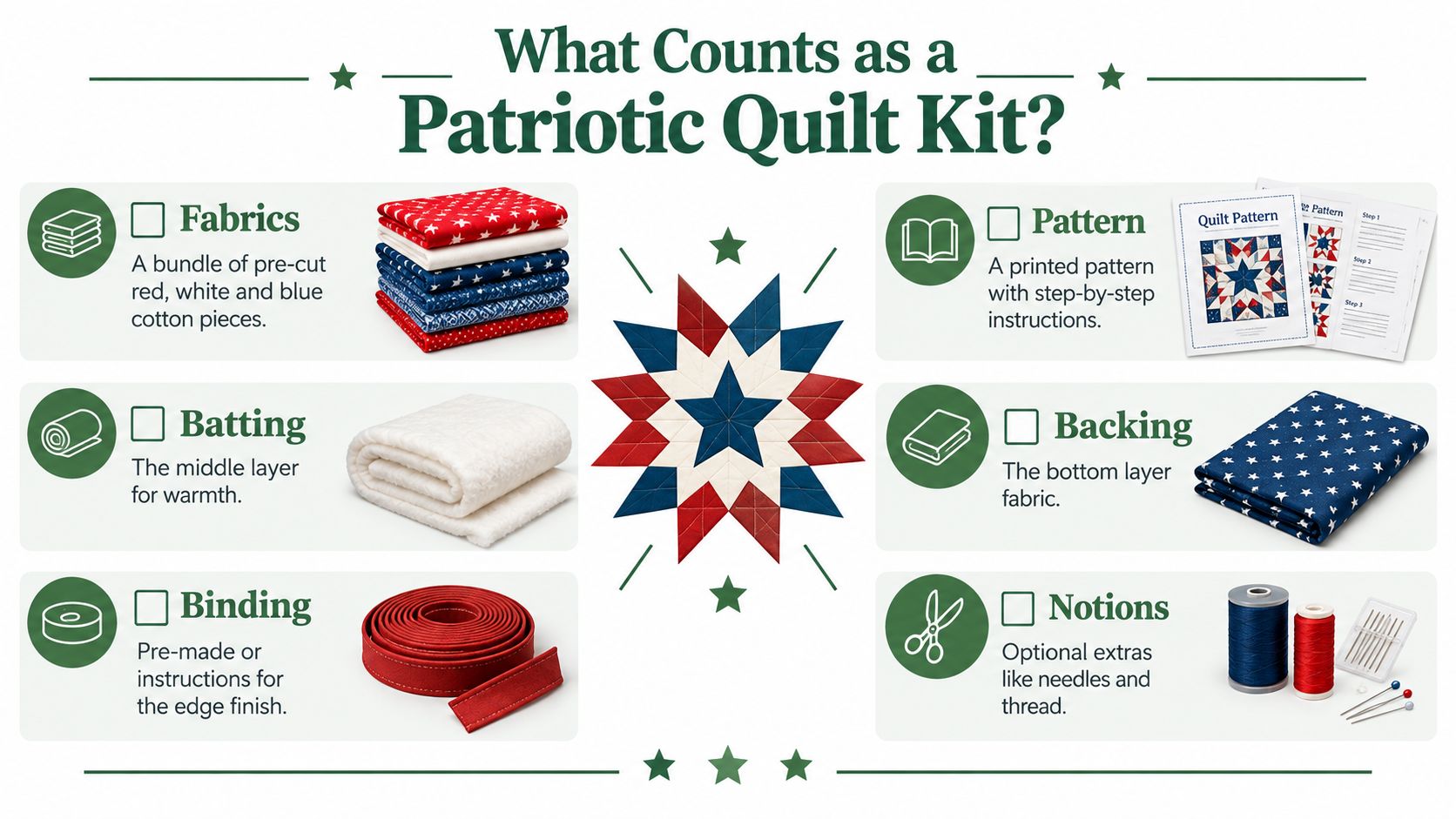
A patriotic quilt kit is a coordinated project bundle built around recognizable Americana themes, such as stars, stripes, eagles, flags, and red, white, and blue color families. The exact contents vary, but a useful kit should make clear what you'll receive and what you'll still need to supply.
The usual components include:
- Fabric: Pre-cut pieces, yardage, a printed flag panel, or a combination of red, white, blue, and neutral cottons.
- Pattern: Printed pattern instructions with cutting diagrams, assembly order, and finishing guidance.
- Batting: The middle layer that adds warmth, loft, and stitch definition.
- Backing: The fabric on the underside of the quilt, sometimes included as a coordinated wideback.
- Binding: Pre-cut strips or enough fabric and instructions to create the finished edge.
- Notions: Optional extras such as thread, needles, templates, or specialty paper pieces.
Why coordinated bundles help
A kit saves you from matching separate dye lots, calculating every cut from scratch, and wondering whether the border fabric will compete with the center. Precuts can also shorten the preparation stage. A bundle of 2.5-inch strips or 5-inch squares, for example, lets you begin piecing sooner and keeps the color story consistent.
The instructions matter just as much as the fabric. Look for a pattern that explains row assembly, pressing direction, backing seams, and the intended finished size. Quilting guidance commonly recommends placing fabrics right sides together, aligning edges carefully, and pressing seams open or to one side for a flatter surface, as described in this guide to backing, batting, and basting.
Patriotic quiltmaking has a long visual history. Patriotic quilts appeared during the Revolutionary War era, and the eagle became a popular motif from the late 1780s through the 1840s. During the Civil War, women in both the North and South made fundraising quilts and warm bedcovers, while the flag became a chief patriotic motif in folk art, according to this history of patriotic quilts.
For a 2026 Semiquincentennial project, that continuity gives the kit more meaning. A star-and-stripe design isn't just seasonal decoration. It belongs to a visual language that has remained familiar for more than two centuries.
If you want a printed pattern rather than a full fabric bundle, the Love of Liberty quilt pattern paper print version offers a focused starting point for planning your own coordinated palette.
Popular Patriotic Kit Formats and Sizes
A single printed flag panel can become several different kinds of project. I've seen makers choose the wrong format not because the pattern was difficult, but because they hadn't decided where the finished quilt would live.
A flag-panel kit works well when the printed image should remain the star. The panel becomes the center of a throw or wall hanging, while borders and simple strip piecing add structure around it. This format is friendly to a new quilter because the panel provides visual impact without requiring every star or stripe to be pieced from small units.
Table runners serve a different purpose. A narrow runner with miniature flags, stars, or appliqué can dress a buffet, porch table, or entry console without committing you to a large quilt. It's also a practical choice for a maker who wants a finished patriotic project quickly.
Mini quilts are useful when your display space is limited. A small piece can hang on a door, rest on a shelf, or act as a mug rug during the 2026 anniversary year. Pixel and mosaic kits sit at the other end of the spectrum. They may use many tiny squares to create an abstract flag or eagle, so the finished effect depends on accurate cutting, consistent seam allowance, and patient pressing.
| Format | Finished Size | Best Use |
|---|---|---|
| Flag panel quilt | Panel-centered throw or wall hanging | Mantel, entryway, summer display, or gift |
| Table runner | Narrow table accent | Buffet, porch table, or outdoor entertaining |
| Mini quilt | Small decorative piece | Door hanger, shelf art, or mug rug |
| Pixel or mosaic quilt | Larger design made from many small units | Advanced project or heirloom-style display |
A lap quilt is often the middle ground between a decorative mini and a full bed quilt. Before buying, compare the pattern dimensions with your intended chair, sofa, or display surface using this guide to lap quilt sizing.
For collegiate fans, a tailgate panel or team-color bundle needs to do more than look good on the cutting table. Choose a format that folds easily, tolerates regular handling, and can be gifted for graduation, game day, or a dorm room. The same red, white, and blue design may work as home décor, but a sturdy throw or table runner usually serves an active fan better than a delicate wall hanging.
Matching Kits to Your Skill Level
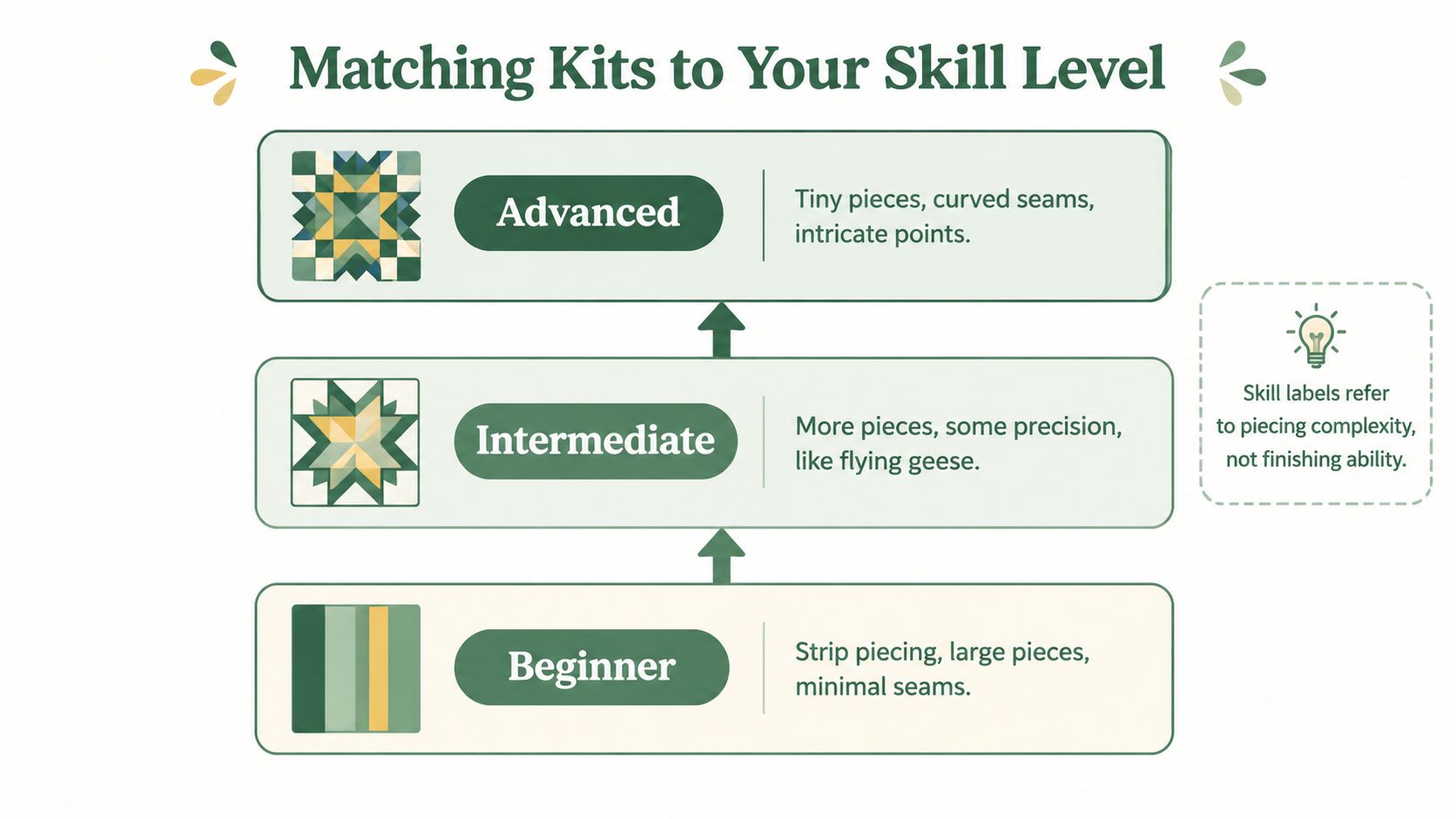
Kit labels describe the complexity of the piecing, not your overall worth as a quilter. Someone who has finished several quilts may still prefer a beginner-friendly pattern when learning a new technique, while a newer maker with strong sewing experience may be ready for more precision.
Start by looking past the label and asking what your hands will do.
- Beginner kits: Large pieces, strip piecing, simple borders, or a printed panel. These designs are forgiving because fewer seams create fewer opportunities for points to drift.
- Intermediate kits: More units, accurate half-square triangles, mitered borders, or repeated star blocks. You'll need to match points and maintain a dependable scant quarter-inch seam.
- Advanced kits: Paper piecing, curved seams, turned-edge appliqué, tiny units, dense quilting, or complex binding. These projects reward control more than speed.
A scant quarter-inch seam is slightly narrower than a full quarter inch, by no more than 1/16 inch, and can help preserve the finished dimensions of pieced units, as explained in the American Quilter's Society quiltmaking essentials. Test your seam on scraps before cutting into the kit.
A panel quilt with wide borders is a sensible first patriotic project. It lets you practice rotary cutting, straight seams, pressing, basting, and binding without asking you to construct an eagle from dozens of small pieces.
A pixel design is a better fit if you already enjoy repetitive precision. Tiny squares magnify small inconsistencies, especially when white units meet navy or red. That contrast can make a minor alignment problem visible from across the room.
The pre-cut quilt kits for beginners can also help new makers understand how coordinated pieces reduce preparation without removing the satisfaction of assembling the top.
Before ordering, handle the decision carefully. Pick the technique you've practiced, not the technique you hope to master while racing toward a holiday deadline.
Choosing Batting and Backing That Last
Batting and backing determine how a patriotic quilt feels in your lap, how much it changes after washing, and how easily you can quilt it without puckers. The bright contrast of red, white, and navy also makes distortion more noticeable, so these choices deserve attention before assembly.
Comparing batting fibers
100% cotton batting commonly shrinks about 3% to 5%, producing the familiar crinkled surface and a soft, traditional drape. An 80/20 cotton-poly blend usually shrinks about 1% to 3%, so it holds its dimensions more steadily and tends to remain flatter after laundering. These figures are summarized in this batting comparison guide.
Cotton feels breathable and relaxed in the hand. An 80/20 blend often feels a little more stable, with enough loft for stitch definition while remaining manageable under a domestic sewing machine. I prefer cotton when the post-wash texture is part of the design, and I reach for an 80/20 blend when the quilt needs a cleaner surface or more predictable size.
Cotton and cotton-blend battings are generally quilted at 4 inches or closer to control fiber migration and help the batting retain its loft through repeated washing. Always follow the specific manufacturer's instructions because loft, scrim, and fiber content affect the permitted spacing.
Understanding wideback efficiency
Standard quilting cotton is usually 42 to 44 inches wide, while wideback fabric is woven at 108 inches, making it about 2.5 times wider. That width can eliminate seams for many throws and larger projects, reducing alignment errors and avoiding a seam running behind a pale white field.
A throw backing that needs 5 yards can lose 7 to 8 inches to cotton shrinkage alone, so pre-wash the backing or include the expected shrinkage in your cutting plan, as explained in this quilt backing calculator. With strong red borders or navy stripes, even modest post-wash tension can show at the edges.
| Material | Shrinkage | Best For | Skill Level |
|---|---|---|---|
| 100% cotton batting | About 3% to 5% | Traditional drape and crinkle | Beginner to advanced |
| 80/20 cotton-poly batting | About 1% to 3% | Dimensional stability and flatter finishes | Beginner to advanced |
| Standard quilting cotton backing | Fabric-specific | Prints and pieced backing plans | All levels |
| 108-inch wideback cotton | Fabric-specific | Fewer seams and faster finishing | Intermediate to advanced, though beginners can use it |
A wideback can also reduce yardage. One independent calculator lists a king-size 108-inch by 108-inch quilt at 6 1/2 yards using 108-inch wideback, compared with 9 3/4 yards in 42-inch-width panels, as shown in this wideback yardage example.
For backing and batting options from Hobbs, Pellon, and related finishing suppliers, the guide to the best batting for quilts is a useful place to compare construction needs.
Fabrics and Brands for the Look You Want
Color alone doesn't decide whether a patriotic quilt looks modern or traditional. Print scale, weave, surface texture, and contrast all shape the final impression.
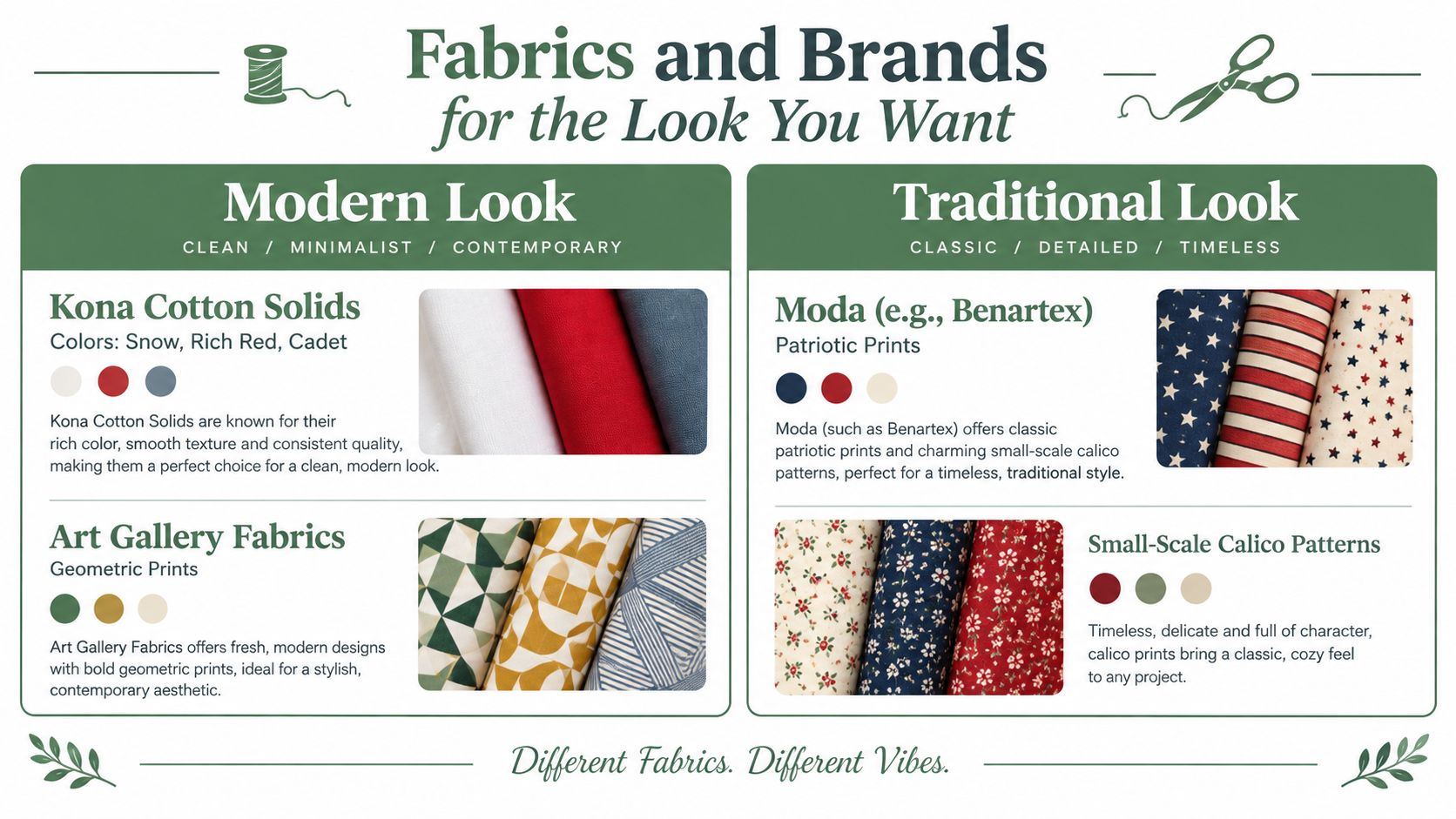
For a clean, contemporary project, start with solid fabrics. Kona Cotton Solids in Snow, Rich Red, and Cadet create crisp fields with no competing motif. The weave feels dependable under a rotary cutter, and the lack of print makes seam placement easier to read. Art Gallery Fabrics brings a smoother, lightly peached hand to modern projects, while Ruby Star Society prints can add playful geometry without making the quilt feel old-fashioned.
Traditional Americana has more visual conversation. RJR Fabrics, Moda reproduction lines, Marcus Fabrics patriotic panels, and Wilmington Prints stars-and-stripes motifs can create a layered, familiar surface. Small calicos, tiny stars, and softly aged reds work especially well when you want the quilt to feel collected rather than digitally matched.
Let scale set the mood
A bold 1-inch star print reads as cheerful and kid-friendly, especially in a throw or playroom quilt. A tone-on-tone stripe looks quieter and more refined, making it easier to use the quilt as living-room décor beyond the summer season.
I always inspect reds and indigo prints before cutting. Crimson is a common source of dye bleed, and a white star can lose its crisp edge if the red fabric isn't colorfast.
- Modern direction: Solids, restrained geometry, strong negative space, and a small number of color families.
- Traditional direction: Calico, reproduction texture, layered stars, flags, and varied patriotic motifs.
- Year-round direction: Navy, cream, muted red, and low-contrast prints that don't announce a single holiday.
A tight weave helps pieces hold their shape during precision piecing. If the fabric frays heavily at the cut edge or feels loose and unstable, reserve it for a low-stress accent rather than a small-unit pixel design.
Best Occasions for Patriotic Quilt Kits
A patriotic quilt doesn't need to spend the year folded in a closet. The trick is choosing a format and palette that suit the occasion rather than treating every project as a Fourth of July decoration.
For everyday Americana décor, a flag wall hanging or small mini can sit above a mantel from Memorial Day through Labor Day. Outside that period, you can move it to a sewing room, entryway, or covered porch, especially if the design uses muted navy and cream instead of bright novelty prints.
Gifting calls for a different calculation. A medium throw can honor a retiring service member, welcome someone to a new home, or mark a housewarming that happens nowhere near a national holiday. The recipient may value the story and workmanship more than overt seasonal styling, so a classic star pattern often travels better than a highly literal flag panel.
Match the project to the setting
A table runner suits outdoor entertaining because it adds color without requiring a large surface for display. A coordinated picnic throw or tailgate quilt serves collegiate fans in a more practical way, offering team spirit alongside durability and easy folding.
| Occasion | Suitable Format | Design Direction |
|---|---|---|
| Everyday Americana | Wall hanging, mini, or pillow cover | Balanced palette with moderate contrast |
| Service or housewarming gift | Throw quilt | Stars, eagles, or restrained flag motifs |
| Tailgate or outdoor gathering | Table runner or picnic throw | Durable cottons and clear team-color contrast |
| 2026 anniversary display | Mystery quilt, sew-along project, or heirloom top | Commemorative stars, stripes, and Americana details |
The same panel can change character depending on its finish. Framed with narrow borders, it becomes wall art. Expanded with soft batting and a practical backing, it becomes a lap quilt. Quilted into a smaller project, it can become a conversation-starting table accent.
Think about laundering, sunlight, and handling before selecting the kit. A porch quilt needs a different construction plan from a protected bedroom wall hanging, even when both use the same patriotic color family.
Finishing and Quilting Tips That Hold Up
A well-pieced quilt top can still disappoint if the layers shift, the backing pulls, or the binding twists around the corners. Finishing is where a patriotic project becomes a dependable household quilt rather than a decorative top waiting for attention.
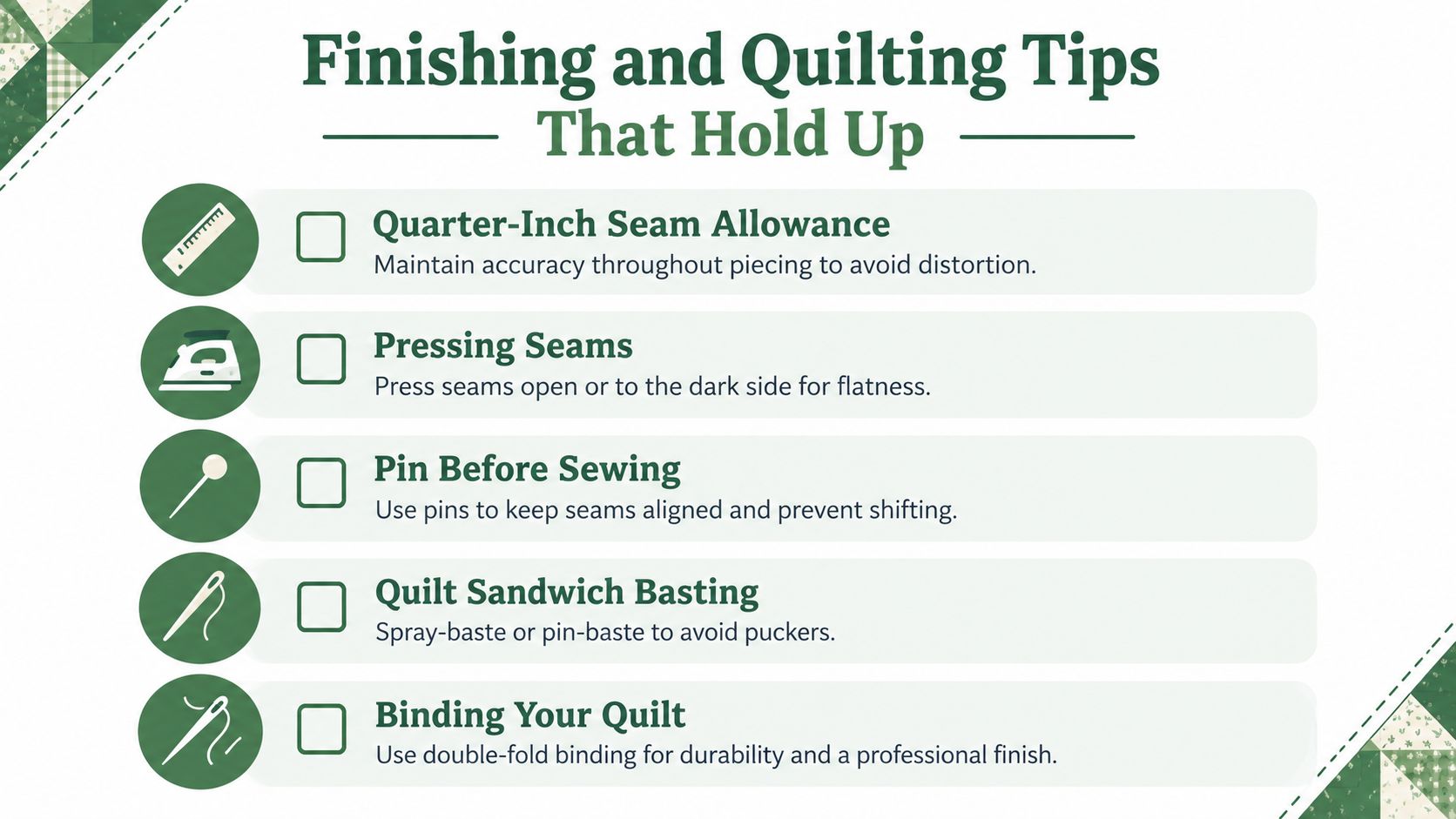
Begin with an accurate 1/4-inch seam allowance. Check the measurement on a scrap unit, then keep your needle position, presser foot, and fabric guide consistent. Pressing matters too. Press seams open when the pattern calls for a flat intersection, or press them to one side when nesting seams will help adjoining units line up.
Practical rule: Measure the first sewn unit before making the rest. A small seam error repeated across many pieces changes the finished dimensions.
Build a stable quilt sandwich
Spray basting is fast and keeps a large flag panel smooth, but use ventilation and follow the product directions. Pin basting gives you adjustable control, while fusible batting can simplify a small wall hanging. On a busy panel, place pins or adhesive so they don't obstruct the key printed details or interfere with your quilting path.
For flag panels, straight-line channel quilting, crosshatch quilting, and simple echo quilting reinforce the graphic design without burying the print. A common target is 8 to 10 stitches per inch, but your machine, thread, batting, and chosen quilting style should determine the final setting.
Finish the edge deliberately
Double-fold straight-grain binding is a durable choice for everyday quilts. Bias binding follows curves more smoothly, which makes it useful around rounded appliqué or star points. At each corner, stop the stitching the proper distance from the edge, fold the binding to form a clean miter, and restart along the next side.
Before washing, check the following:
- Colorfastness: Test red and indigo scraps or pre-wash them separately.
- Seams: Inspect corners, borders, and backing joins for weak stitches.
- Quilting: Confirm that the layers are secure and that no area has excessive looseness.
- Binding: Run your fingers around the edge to find skipped stitches or thin spots.
- Care label: Follow the batting and fabric manufacturer's washing guidance.
The quilt finishing guide can help you work through the final steps in order, especially if this is your first complete quilt.
Buying Framework and Frequently Asked Questions
A good purchase begins with use, not color. Decide whether the finished quilt will decorate a room, serve as a gift, travel to tailgates, or mark the 2026 U.S. 250th anniversary. Then choose the format, complexity, fabric personality, batting, and backing that support that use.
Patriotic quilting has repeatedly gained attention during major commemorative periods. The 1876 centennial and 1976 bicentennial brought renewed patriotic quiltmaking, and one bicentennial contest recorded 9,954 entries from all fifty states, according to this history of commercial quilt kits. The same source describes the growth of commercially prepared fabric components and notes that standardized kit characteristics became common in the 1920s and 1930s.
| Use Case | Recommended Kit Format | Skill Level | Best Batting |
|---|---|---|---|
| Small seasonal accent | Mini or table runner | Beginner | Low-loft cotton or blend |
| Everyday Americana décor | Wall hanging or restrained throw | Beginner to intermediate | Cotton for drape or 80/20 for stability |
| Service or housewarming gift | Medium throw | Intermediate | 80/20 for dimensional stability |
| Tailgate or collegiate use | Durable throw or runner | Beginner to intermediate | Cotton blend for regular handling |
| 2026 heirloom project | Pixel, mosaic, or detailed star quilt | Intermediate to advanced | Choice based on quilting density and desired hand |
People Also Ask
Are patriotic quilt kits cheaper than buying yardage?
Not always. A kit may cost more than assembling fabric from a sale bin, but it includes coordinated materials, pattern instructions, and pre-calculated cutting information. Compare the included yardage, backing, batting, binding, and precuts rather than judging only the package price.
Do flag panels include permission for resale?
A purchased panel doesn't automatically answer every resale or licensing question. Personal, educational, and patriotic use are generally distinguished from commercial reproduction concerns in independent quilting guidance, but you should read the fabric maker's terms and avoid assuming that a flag image grants permission to reproduce a branded design.
Can a beginner finish a 60-by-80 kit in a weekend?
That depends on the pattern, cutting already completed, your sewing experience, and whether quilting and binding are included in that time. A simple panel or strip-pieced top is a more realistic weekend goal than a fully quilted, bound project with many small units.
What batting works for a wall hanging?
A low-loft cotton or stable cotton-poly blend usually keeps a wall hanging manageable and helps the design lie flat. Choose based on the desired texture, quilting distance, and the hanging method rather than using a thick batting by default.
What should I buy first?
Choose the intended display or recipient, then select a format that fits that purpose. For a first project, a coordinated precut bundle or panel kit with clear pattern instructions is usually less frustrating than a tiny pixel design.
QuiltKit.com offers ready-to-sew kits, precut bundles, Kona Cotton Solids, Ruby Star Society fabrics, 108-inch widebacks, and batting from brands including Hobbs, Pellon, and The Warm Company. Browse quiltkit.com to find a patriotic kit that fits your skill level, choose finishing supplies for the feel you want, and join the Email Sign-up Savings list before you start shopping.