


Ruby Star Society Fabric Guide
You've got a fresh bundle of Ruby Star Society fabric on the cutting table, and the prints look perfect together. Then the practical questions arrive. Will the lighter cotton hold a sharp seam? Is that large-scale print suitable for a small block? Should you buy yardage, a coordinated bundle, or a ready-to-sew kit?
Those decisions matter more than the label alone. Ruby Star Society pairs a highly recognizable modern aesthetic with a quilting cotton substrate that behaves differently from heavier utility fabrics. Once you understand the hand, width, print scale, and relationship between core basics and seasonal collections, you can buy less randomly and sew with more confidence.
The Evolution of Modern Quilting Aesthetics
A modern quilt can look carefully designed before the first seam is sewn. Ruby Star Society fabric supports that effect through unexpected color combinations, oversized graphics, and small blenders with enough character to hold their own beside a focal print. For a simple block, print placement often supplies the visual interest, leaving the construction precise rather than complicated.
That approach grew from five designers, Melody Miller, Alexia Marcelle Abegg, Rashida Coleman-Hale, Kimberly Kight, and Sarah Watts. After leaving Cotton+Steel, they formed Ruby Star Society with Moda Fabrics in 2018. The brand's account of its history also records that the five had already joined together as a business in 2013, giving the group several years of shared work before the Ruby Star Society launch (Ruby Star Society's history).
Why the origin still matters
The collections read as a group without becoming interchangeable. Each designer brings a distinct illustration style, while the broader range keeps returning to bold graphics, unusual palettes, and fabrics that can serve as focal pieces or practical coordinates.
Moda's February 2019 announcement introduced the first Ruby Star Society fabric release, with shipments divided between July and August (Moda's debut announcement). The launch featured five designer collections plus one coordinating basic. That six-part structure established variety from the beginning, rather than presenting one fixed look as the whole brand.
For fabric selection, the distinction between a collection and a basic matters. A seasonal line can provide the quilt's personality, while a basic such as Speckled can handle backgrounds, sashing, bindings, and gaps between stronger prints. Retailer information identifies Speckled as Ruby Star Society's newest basic line (Ruby Star Society fabric collection information). In practice, that makes it a useful stash-building partner for collections that may be harder to replace later.
Practical rule: Treat Ruby Star Society as a family of design voices and fabric roles, not as one uniform print collection.
A bundle can coordinate beautifully on the shelf and still create problems in a small patchwork pattern. Too many large motifs or high-contrast prints can crowd narrow pieces, obscure a block's geometry, or make seam matching harder to judge. For small blocks, add quieter blenders and reserve the largest motifs for borders, alternate blocks, or areas where the full design can remain visible.
The same visual strength serves larger, simpler layouts well. Pixel quilts, modern medallions, and restrained grids let fabric placement carry the design, reducing the need for elaborate construction. Ruby Star Society's lasting appeal comes from that balance: strong direction for a quick project, with enough variation for a carefully edited quilt that does not look mechanically coordinated.
Understanding the Premium Cotton Substrate
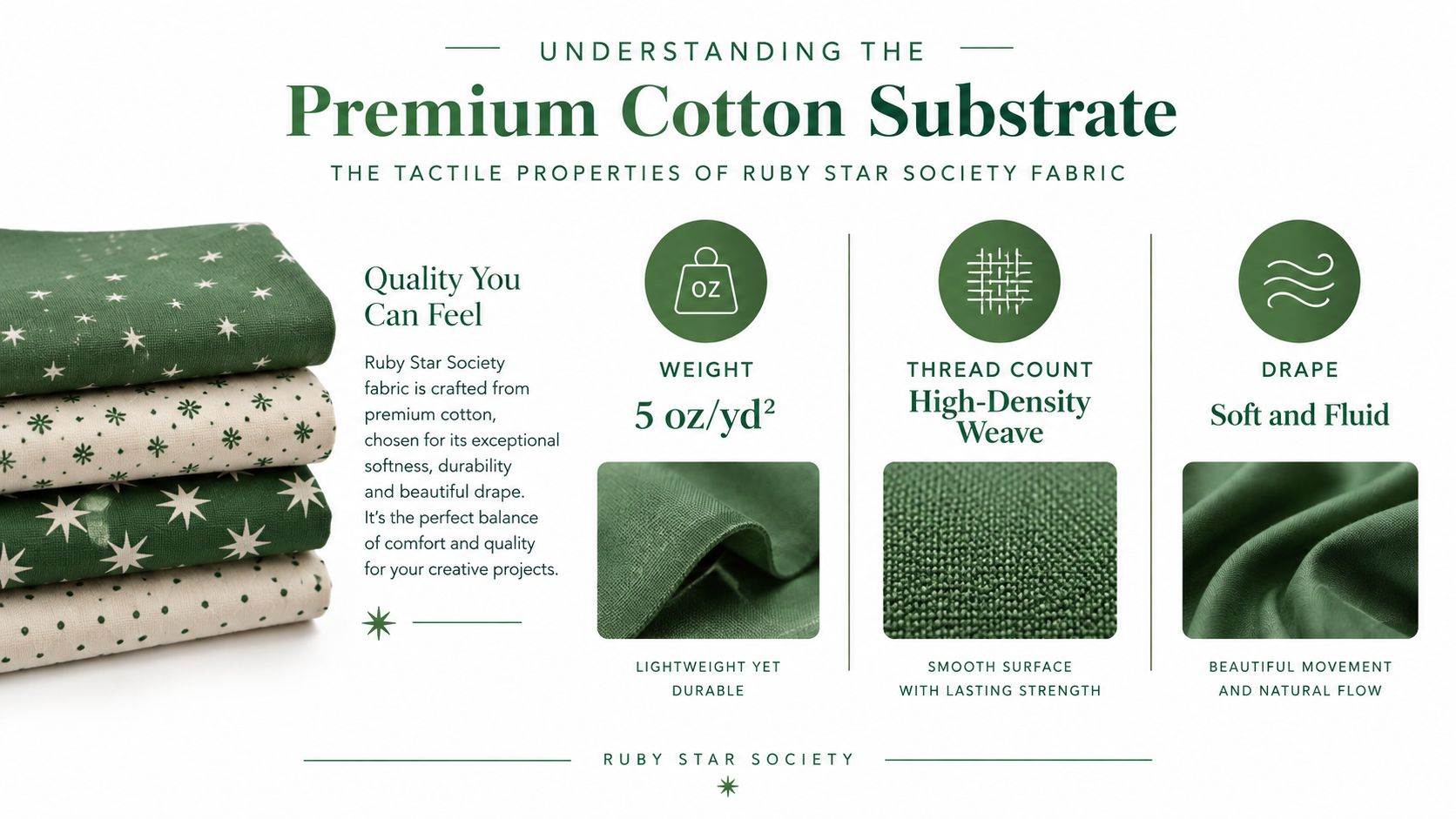
Ruby Star Society's core quilting cotton is 100% premium quilting cotton, generally listed at about 44 inches or 112 cm wide and near 115 gsm, according to a retailer specification for the Speckled line (Ruby Star Society cotton specifications). The fabric is slightly lighter than many standard quilting cottons, with a smooth finish, soft hand, and more fluid drape.
That specification changes how the cloth feels under a rotary cutter and presser foot. It isn't flimsy apparel lawn, but it also doesn't have the rigid body of a heavy utility cotton. The result is fabric that settles cleanly when pressed and moves comfortably when used in garments, bags, or quilted home projects.
What the numbers mean at the machine
A widely used quilting-cotton reference places plain-weave quilting fabric around 110 to 160 gsm, with a thread-count sweet spot near 68 by 68 for stability and clean piecing (quilting cotton weight and weave reference). Ruby Star Society's approximately 115 gsm position sits toward the lighter side of that broad quilting range.
In practice, the lighter substrate gives the needle an easier path through multiple seam intersections. Small units don't develop the same bulky ridge you may notice with a stiffer fabric, and a hot iron can produce a crisp fold without making the piece feel board-like. The trade-off is equally important. The fabric has less rigid support, so inaccurate cutting, aggressive handling, or a stretched bias edge will show sooner.
I notice that difference most clearly in small half-square triangles and narrow strips. The cloth presses beautifully, but it rewards a sharp rotary blade, a stable cutting surface, and restraint when moving pieces to the machine. If you pull a bias edge into alignment instead of easing it gently, the soft drape can work against you.
For garment sewing, that fluidity is an asset. For traditional bedding, it creates a quilt top with a pleasant hand, especially when paired with a low-bulk batting such as an 80/20 blend from Hobbs. Your final drape still depends on batting, quilting density, and thread tension, so fabric weight alone doesn't determine how the finished quilt will hang.
Why widebacks change the finishing workflow
Ruby Star Society also offers wideback fabrics around 108 inches wide. The same cotton quality at backing scale can remove piecing seams from a large quilt back, which reduces alignment work and eliminates a visible structural seam across the most prominent backing layer (Ruby Star Society Speckled wideback).
That matters on a longarm. A single wideback gives you a cleaner loading surface and fewer seam intersections for the rollers and quilting foot to negotiate. It also makes design placement easier because you're not trying to center a front across a back assembled from multiple narrower cuts.
For a large modern quilt, I'd rather spend attention on backing grain and centering than on matching a long horizontal seam. A 108-inch option won't solve every loading issue, but it removes one variable that can create ripples, shifting, or an awkward line through dense quilting.
You can also compare the substrate and construction choices with this guide to types of quilting fabric before deciding whether your project needs quilting cotton, a wideback, a lighter drape, or a different material altogether.
Matching Fabric Lines to Your Best Projects
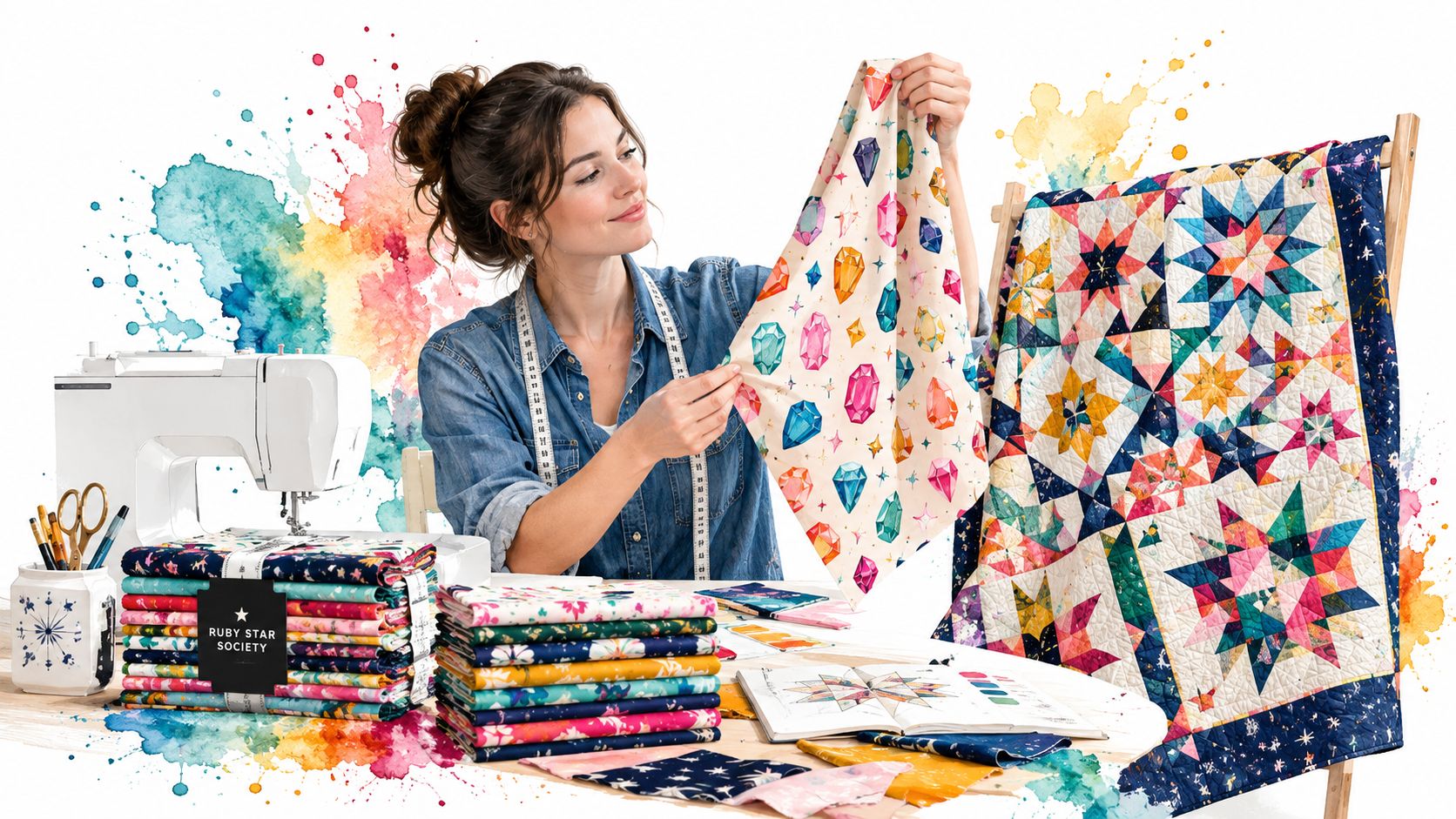
The right Ruby Star Society print depends less on whether you love it and more on where the print will land. A tiny blender can disappear in a large quilt, while a dramatic motif can become unreadable after being cut into small squares.
Start with the block size
For a beginner making a table runner, choose a coordinated group with a clear light, medium, and dark relationship. Speckled-style basics and restrained coordinates are forgiving because they provide texture without competing with simple squares or rectangles.
A beginner-friendly charm-pack project is another sensible entry point. Charm packs supply precut five-inch squares from a fabric line, so you can test the collection's contrast before committing to a large yardage purchase. The Charm Pack Stars pattern uses one charm pack for its small throw and two for its large throw, according to the designer's project notes (Charm Pack Stars pattern and fabric details).
For half-square triangle toppers, inspect the print density before cutting. A high-contrast graphic may create a strong secondary pattern, but a directional motif can rotate unpredictably unless you plan its orientation. Use low-volume pieces or quieter basics beside busy prints so the triangle points remain visible.
Reserve visual drama for larger shapes
Advanced quilters working on pixel quilts, large stars, or minimalist layouts can use seasonal prints more aggressively. Large motifs have room to breathe in broad rectangles, panel-style sections, and wide borders. They also work well as a backing feature when the front uses restrained piecing.
The same print may fail in a tiny nine-patch and succeed in a large patchwork block. Before cutting, place a paper window over the fabric and view only the finished-size area. If the visible section looks muddy or loses its focal detail, save that print for a larger unit.
A practical project match looks like this:
- Simple table runner: Use basics, low-volume prints, and medium-scale coordinates that remain legible in rectangles.
- Half-square triangle topper: Pair one strong print with calmer fabrics so the diagonal seam creates structure instead of visual noise.
- Pixel quilt: Build around consistent low-volume backgrounds and reserve high-contrast prints for recognizable color blocks.
- Large modern quilt: Let one or two seasonal prints occupy broad shapes, then control the surrounding palette with basics.
- Longarm finish: Choose a backing with enough visual calm for the quilting pattern to remain readable.
Watch the video below for additional visual context before you commit a dramatic print to a complex layout.
If you're comparing collections, this overview of quilting fabric brands can help you place Ruby Star Society alongside Kona Cotton, P&B Textiles, Marcus Fabrics, and other options without treating every project as a single-brand exercise.
Strategic Colorway Coordination and Stash Building
A useful Ruby Star Society stash isn't a pile of complete collections. It's a working library of focal prints, blenders, neutrals, and dependable solids that can support projects you haven't designed yet.
Start by assigning each purchase a job. One fabric should attract attention, another should create movement at a quieter scale, and a third should give the eye somewhere to rest. This simple three-part relationship is more practical than trying to match every color perfectly.
Build around roles, not labels
Kona Cotton solids make strong partners for Ruby Star Society prints because they can absorb visual noise without competing with the illustration or pattern. A saturated solid can pull out a color from a seasonal print, while a pale neutral can separate two dense motifs.
For each bundle or yardage purchase, ask:
- What is the focal print? This is the fabric that carries the strongest graphic, contrast, or emotional character.
- What is the blender? Look for a small-scale texture or scattered mark that adds color without creating a new focal point.
- What is the rest fabric? This may be a solid, low-volume print, or quiet neutral used for backgrounds and spacing.
I like to check print density before checking the selvage name. Hold the fabrics at arm's length or take a quick phone photo in grayscale. If every piece becomes the same gray value, the bundle may need a lighter or darker addition even if the hues appear different in person.
Make seasonal fabric earn its place
Seasonal releases can bring energy to a stash, but they're less flexible when every fabric has a strong personality. Pair one seasonal focal with a core basic and a familiar solid instead of buying an entire group without a project in mind.
That approach also helps time-crunched makers. You can pull a quick table runner from the stash without waiting for a perfect collection to reappear, and you can build a kit around one memorable print rather than forcing every print into the same quilt.
Fat quarters are especially useful here. A fat quarter is a quarter-yard cut made across the full width of fabric, giving you a squarer piece that works well for blocks, appliqué, and small bags. For practical guidance on using them as coordinated groups, see this fat quarter bundle resource.
The premium price question depends on use. If you're buying for a one-off beginner kit, coordinated color and reduced decision-making may matter more than collecting every print. If you're building a long-term stash, prioritize basics and versatile blenders, then add seasonal pieces when you already know whether they'll become a focal block, binding, or backing accent.
Precision Piecing and Fabric Care Techniques
The lighter Ruby Star Society substrate cuts cleanly, but it doesn't forgive careless handling. A smooth weave helps with accurate rotary work and crisp pressing, while the softer hand means you should avoid dragging cut pieces across the table or tugging them into alignment.
I've found that a fresh rotary blade makes a bigger difference than adding pressure. Let the ruler and blade do the work, and keep the fabric flat as you cut. For small pixel units, cut in manageable stacks rather than building a tall pile that can shift along the fold.
Keep seams stable
Before sewing, confirm that your machine is feeding the fabric evenly. A clean ¼-inch seam allowance matters because a slightly wider or narrower seam can accumulate quickly across many small units. Test on a scrap that includes both a light and dark print, then inspect the seam for puckering and thread tension.
Pressing direction depends on the block. Pressing seams open can reduce bulk in dense assemblies, while pressing to opposite sides helps seams nest. Nesting seams means placing two seam allowances in opposite directions so they lock together at an intersection. Pin or use a stiletto when several points meet, especially in half-square triangles.
For extra control, use a light starch alternative or pressing spray sparingly. Don't soak the fabric. Excess moisture can distort a bias edge before it reaches the machine, while a controlled press helps the lighter cotton hold a precise fold.
At the cutting table: Stabilize the fabric before you cut, and stabilize the seam before you press. Most accuracy problems begin before the needle reaches the cloth.
The weave supports clean stitching, but small pieces can still fray when handled repeatedly. Shorter fabric journeys help. Cut, organize, sew, and press in batches rather than moving the same units around the room.
Decide whether to pre-wash
Pre-washing is a preference, not a universal rule. It can remove excess dye and reveal how the fabric will behave after laundering, but it also changes the texture and can introduce wrinkles that require careful pressing.
For a gift quilt or a project combining several saturated colors, I prefer testing a small scrap first. Check for color transfer, edge distortion, and changes in hand. If you skip pre-washing, use a color-catching laundry product during the first wash and give the finished quilt room to move instead of forcing it through an overloaded machine.
The approximately 115 gsm weight and smooth weave provide a concrete basis for expecting a lighter, fluid hand, but they don't guarantee identical behavior across every colorway or finish. Treat each new bundle as a small test when the project includes intense colors or very small pieces.
Once blocks are assembled, this guide to squaring up quilt blocks is useful for correcting accumulated variation before joining rows or loading a longarm.
Smart Buying Advice and Ready-to-Sew Kits
Ruby Star Society fabric is worth the premium when it solves a problem you have. The value may come from the tactile substrate, a print you can't replace with a generic coordinate, a wideback that removes a backing seam, or a curated kit that eliminates hours of color selection and cutting math.
For a beginner, the strongest case for a ready-to-sew format is reduced uncertainty. You get a defined fabric plan and a pattern relationship instead of buying attractive yardage that later proves too busy, too directional, or too small for the intended blocks.
Choose the format that fits the job
Use yardage when you need control over print placement, borders, binding, or garment panels. Choose precuts when you want to sample a collection and move quickly into piecing. A coordinated bundle makes sense when you already understand the pattern's fabric requirements and want flexibility in how the colors land.
A practical shopping decision can follow this order:
- Define the finished project. Decide whether you're making a table runner, a beginner quilt, a pixel design, or a large quilt headed to a longarm.
- Check the cutting plan. Confirm whether the pattern needs fat quarters, strips, charm squares, background yardage, or a wideback.
- Match print scale to finished units. Don't buy a large motif for tiny units unless you're comfortable losing most of its artwork.
- Reserve the backing separately. A front bundle rarely provides the correct backing quantity or width.
- Buy the missing role. If your stash already has focal prints, add solids, low-volume coordinates, or binding rather than another focal.
QuiltKit.com offers ready-to-sew quilt kits, precut fabric rolls, modern quilt kits, Ruby Star Society and Kona Cotton fabrics, plus finishing supplies from brands such as Hobbs, Pellon, and The Warm Company. Its catalog also includes 108-inch wideback cottons, including a Calathea Deep Moss wideback listed as Ruby Star Society fabric.
You can compare the time-saving structure of curated projects in this guide to modern quilt kits. For advanced finishing, a wideback paired with suitable batting can reduce pieced-backing decisions, while a roll-by-the-yard batting option can keep the project moving once the top is complete.
Email sign-up savings can also help stash-builders who aren't ready to purchase immediately. Use that pause to compare the fabric roles, backing width, and required cuts instead of adding a bundle just because the colors look good together.
Frequently Asked Questions About Ruby Star Society
Is Ruby Star Society fabric made by Moda Fabrics?
Ruby Star Society formed with Moda Fabrics in 2018, after five founding designers left Cotton+Steel and created a new brand. Moda announced the first Ruby Star Society fabric release in February 2019, with shipments split between July and August (Ruby Star Society and Moda history).
For quilters, the practical point is distribution. Moda's network makes designer collections easier to find, while the fabrics still vary in print scale, color balance, and substrate feel. Check the specific collection before pairing it with a pattern that depends on controlled contrast or repeated motifs.
Is Ruby Star Society cotton suitable for clothing?
Yes. The soft hand, smooth finish, and drapey behavior can suit shirts, skirts, aprons, and accessories better than a stiffer quilting cotton. Its approximately 115 gsm weight contributes to that lighter feel (Ruby Star Society fabric specifications).
Treat it as woven cotton, not rayon, lawn, or dedicated apparel fabric. Before cutting, wash a sample and assess opacity, movement, and shrinkage. For quilting, the lighter substrate can also make pieced sections easier to handle, but it may benefit from careful pressing and accurate seam allowances.
How can I tell core basics from seasonal releases?
Look for collection descriptions that identify a basic, blender, or continuing coordinate. Speckled is identified by a current retailer as Ruby Star Society's newest basic line (Ruby Star Society basics and collections).
Basics are useful for backgrounds, bindings, sashing, and low-volume areas where you may need a dependable coordinate later. Seasonal prints are better stash purchases when you already know their role. A large motif can lose its impact in small units, while a directional print may require extra cutting and layout attention.
Is Ruby Star Society fabric worth the premium?
The answer depends on the project and the construction demands. Its lighter cotton substrate, smooth finish, and distinctive modern prints can justify the cost for precision piecing, clothing, or a quilt headed to a longarm. The same premium matters less for practice blocks or a project where fabric will be heavily trimmed.
A coordinated kit can also save time by reducing color-matching decisions. Compare the fabric's job, required yardage, and finishing plan before buying. A visually attractive bundle is not automatically the right kit for the pattern.
What batting works with Ruby Star Society quilts?
Choose batting based on the intended drape and quilting texture. Hobbs 80/20 batting gives a balanced quilted hand, while 100% cotton produces a different loft and shrinkage profile. Make a small sandwich before longarming, then check thread tension, stitch density, and the finished texture.
A moderate batting often preserves the movement of this soft-hand substrate better than a bulky option. Wideback fabric can also simplify finishing by avoiding a pieced backing, provided its width and required quantity match the quilt.
QuiltKit.com lists Ruby Star Society fabric, Kona Cotton solids, precuts, ready-to-sew modern quilt kits, batting, and widebacks. Visit quiltkit.com to compare project formats, and check for Email Sign-up Savings before building a coordinated bundle.