


Halloween Fat Quarter Bundle Guide for Quick Décor
Halloween spending reached a record $12.2 billion in 2023, and 77% of Halloween celebrants planned to buy decorations, making a Halloween fat quarter bundle a practical starting point for handmade seasonal décor. The right bundle can become more than a stack of prints: its usefulness depends on the cut, the scale of the motifs, and the projects you plan to finish.
It's a familiar late-season dilemma: a coordinated bundle is sitting in your cart, the calendar is shrinking, and you're trying to picture what it will become before checkout. A small table runner, a wall hanging, or a set of appliquéd pumpkins can feel achievable; a large quilt may not. Halloween spending figures describe the wider U.S. holiday market, not quilting-fabric sales, but they do reflect the substantial audience for decorations and handmade projects. The National Retail Federation's 2023 Halloween survey reported the spending and decoration figures above.
This guide turns bundle jargon into project decisions. You'll get a clear picture of what a fat quarter's dimensions allow, how piece count affects realistic project capacity, which quick makes suit different bundle sizes, and how testing and storage can keep useful prints in rotation beyond Halloween.
What a Halloween Fat Quarter Bundle Is and Why It Matters
With the holiday approaching, a coordinated stack of Halloween fabric can make a small décor project feel manageable. A Halloween fat quarter bundle is a group of fabric precuts selected to work together by color, print, or collection. For a busy maker, its value depends on whether the pieces suit a project that fits the available time and materials.
A few prints may cover mug rugs or pumpkin appliqué; a larger selection can support a scrappy runner or small wall hanging. The bundle gives you a coordinated starting point, not a complete kit. Check whether you also need background fabric, batting, backing, or binding before you cut.
As noted in the introduction, Halloween decorations draw substantial consumer interest. The NRF's 2019 Halloween home-decoration figures offer market context, but they do not measure quilting-fabric sales. For a maker, the practical payoff is the chance to turn seasonal prints into décor that can come out again next year.
A bundle earns its space when the prints suit the project and leftover pieces have a likely use. Consider four points before buying:
- What's the actual cut size? The usable dimensions determine which shapes you can cut without piecing. The next section explains what those measurements allow.
- How many pieces are included? Piece count gives you more prints to combine, but it does not by itself tell you how much finished décor the bundle will yield.
- What can you make from it? Choose a runner, wall hanging, or smaller accents, then account for the added materials and sewing time.
- Will you use the leftovers? Solids and versatile motifs may suit autumn projects or everyday sewing, extending the bundle's usefulness beyond one Halloween.
Fat Quarter Sizing and What 18 by 22 Inches Really Means
A fat quarter is typically cut to approximately 18 × 22 inches. A conventional quarter-yard cut is about 9 × 42–44 inches. Both represent roughly the same amount of fabric by area, but the wider fat-quarter shape makes it easier to cut squares, broad rectangles, and appliqué motifs without joining narrow strips. The dimensions are approximate, not a promise of the final usable area. A quilting guide to fat quarters explains the standard cut and its common uses.
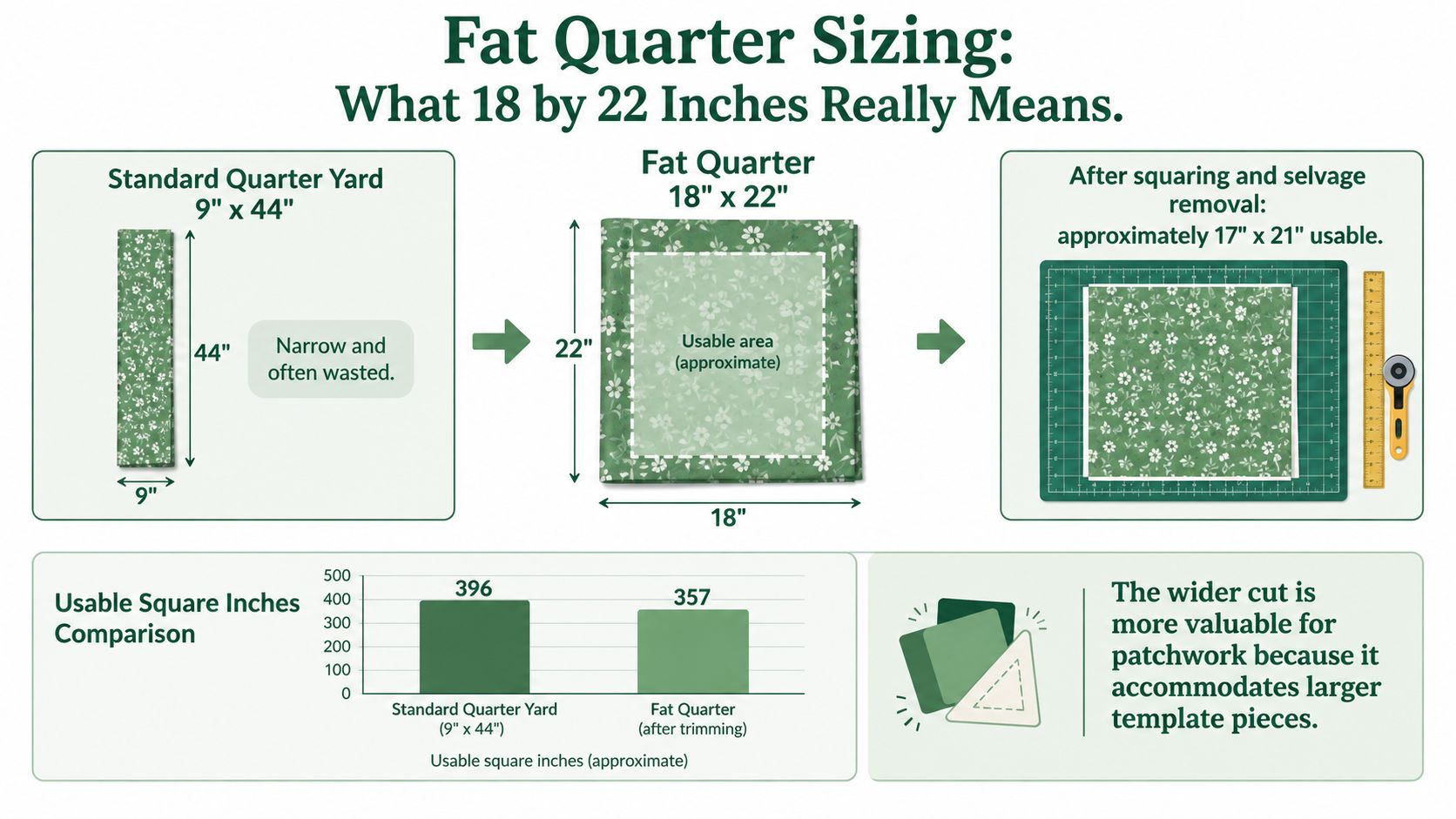
Before you plan a block, square the fabric and remove the selvage. The cut can lose usable area during that preparation, and bolt width or store cutting tolerances may reduce it further. Four fat quarters equal roughly a yard by area, but they don't behave exactly like one continuous yard: grain, selvage, and print direction affect what you can cut.
I've squared bundles on the cutting mat and found the practical difference quickly: a wide piece gives a pumpkin, bat, or other directional motif more room to sit intact. A narrow quarter-yard may leave you piecing strips where you'd rather cut one larger shape. For small squares, the fat-quarter width can also make layout more flexible, but exact yields depend on the true cut and your ruler's usable margins.
Plan from usable dimensions, not the label
A single fat quarter often suits common precut shapes, including 5-inch squares, but don't assume an exact count before checking the fabric. 10-inch squares take more space and may compete with one another, while 2.5-inch strips can be efficient for patchwork but may waste the scale or direction of a large motif. Seams, squaring, and layout all change the cut plan.
Practical rule: Treat 18 × 22 inches as your starting rectangle, square the piece, then lay out the largest shapes first. Use the remaining area for smaller blocks or appliqué.
That's the simplest way to judge a precut on the fly. For fussy cutting, preserve the motif first and calculate the leftovers second.
How Many Pieces Come in a Typical Bundle
A piece count tells you how many coordinated cuts you're buying, not how large the finished project will be. An eight-piece assortment can provide enough variety for small accents, while a larger bundle gives you more options for a scrappy runner or wall hanging. But there's no reliable finished yield without knowing cut dimensions, print direction, pattern requirements, and what extra yardage the project needs.
A bundle described as prints only may offer several motifs but no calm fabric for contrast. An assortment that includes a Bella Solid or Kona Cotton can provide a useful blender or sashing fabric, though you'll still need to check whether there's enough solid for the pattern. Novelty prints with large pumpkins, bats, or characters can also reduce efficient yield: cutting them into small pieces may chop up the design, while preserving a full motif uses more fabric.
| Bundle count | Typical yield | Good for |
|---|---|---|
| 8 fat quarters | A compact selection for mug rugs, appliqué, or accent blocks, with extra background fabric needed for many patterns | A small project or first seasonal bundle |
| 12 fat quarters | A broad mix for a simple scrappy runner or sampler-style project, depending on pattern cuts | A maker ready for a more varied décor piece |
| 18 fat quarters | More print options for a small wall hanging or larger set of coordinated blocks | A project that needs a wider palette |
| 20 fat quarters | Room for a generous mix, but layout and motif scale still determine usable yield | A scrappy project with several print roles |
| 24 fat quarters | A larger selection for a small hanging or runner, subject to the pattern's fabric requirements and extra materials | A maker who wants variety and leftover options |
These are planning categories, not guaranteed project counts. Washing can cause shrinkage, seam allowances consume fabric, and directional prints may need to face a particular way. A “24-piece” bundle may therefore yield fewer usable blocks than expected if several prints have large motifs or a one-way design.
For help distinguishing different precut formats before choosing a pattern, use this guide to precut fabric squares. A beginner-friendly rule is to choose a smaller bundle for a handful of accents, a mid-sized bundle for a runner, and a larger assortment when you need several distinct blocks. Then compare the pattern's fabric requirements against the usable cuts rather than relying on piece count alone.
Coordinating Colorways for Spooky but Stylish Palettes
Orange and black read as Halloween immediately, but a bundle built only around those colors can look harsh or flat in a small project. Add a range of dark values and a few softer companions: charcoal beside black, cream for breathing room, and purple, moss green, or rust to move the palette toward autumn.
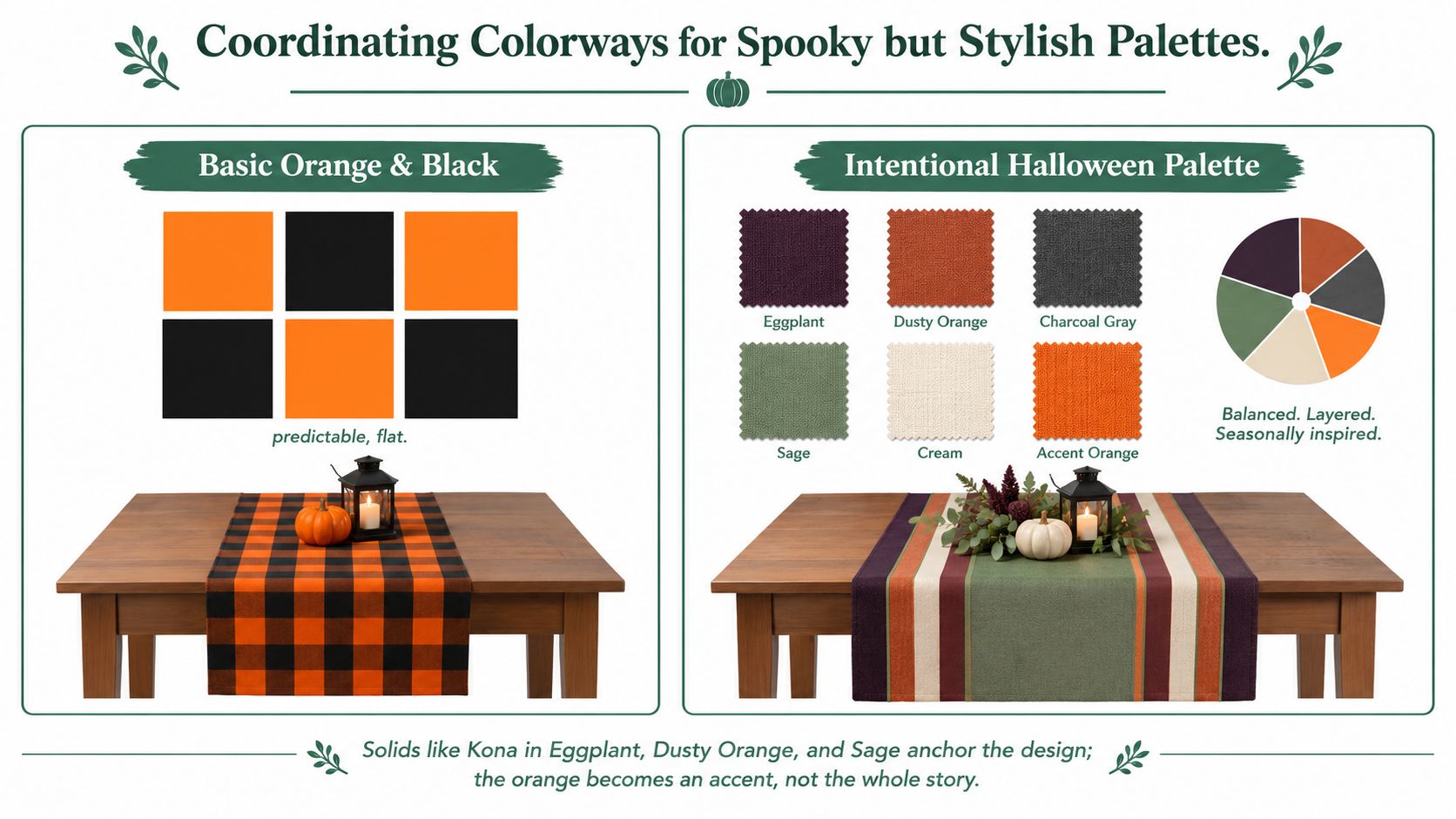
Solids help prints work together rather than compete. Kona Cotton can give you a blender or sashing option, while Bella Solid is another solid partner to consider. Prints from Ruby Star Society may bring whimsical or celestial character, and collections from Marcus Fabrics or Blank Quilting can offer other traditional or designer-scale choices. Brand names don't guarantee that every fabric in a set will match your project, so compare the actual prints and value contrast before cutting.
I find that the buttery drape of a quilting cotton like Kona feels noticeably different from a heavy metallic novelty print. That difference matters when you sew them side by side: a heavier print can make a seam feel bulkier, and high-saturation black or orange can dominate a quieter companion. Keep the seam allowance even and press carefully so thicker areas don't distort the block.
Build around a few anchor prints
Start with three to five prints that set the character, then add a coordinating solid. For example, choose a moon print, a small-scale star, a charcoal blender, a muted rust, and one bright orange motif. The solid creates a resting place; novelty scraps add punctuation rather than taking over every block.
For a broader approach to using mismatched or leftover prints, see these ideas for making scrappy quilts. When choosing fabric for a small runner or hanging, also consider print scale: a large-scale design may look striking as a fussy-cut center but turn into visual clutter when sliced into tiny pieces.
Fast Halloween Project Ideas Worth Starting Tonight
Small Halloween projects work well when you choose a format first and cut around it. Before starting, check whether your bundle has enough contrasting fabric for the background and whether you have batting and backing on hand. The bundle supplies the visual variety; it doesn't automatically include the materials that give a project structure.
Choose a format that fits the fabric
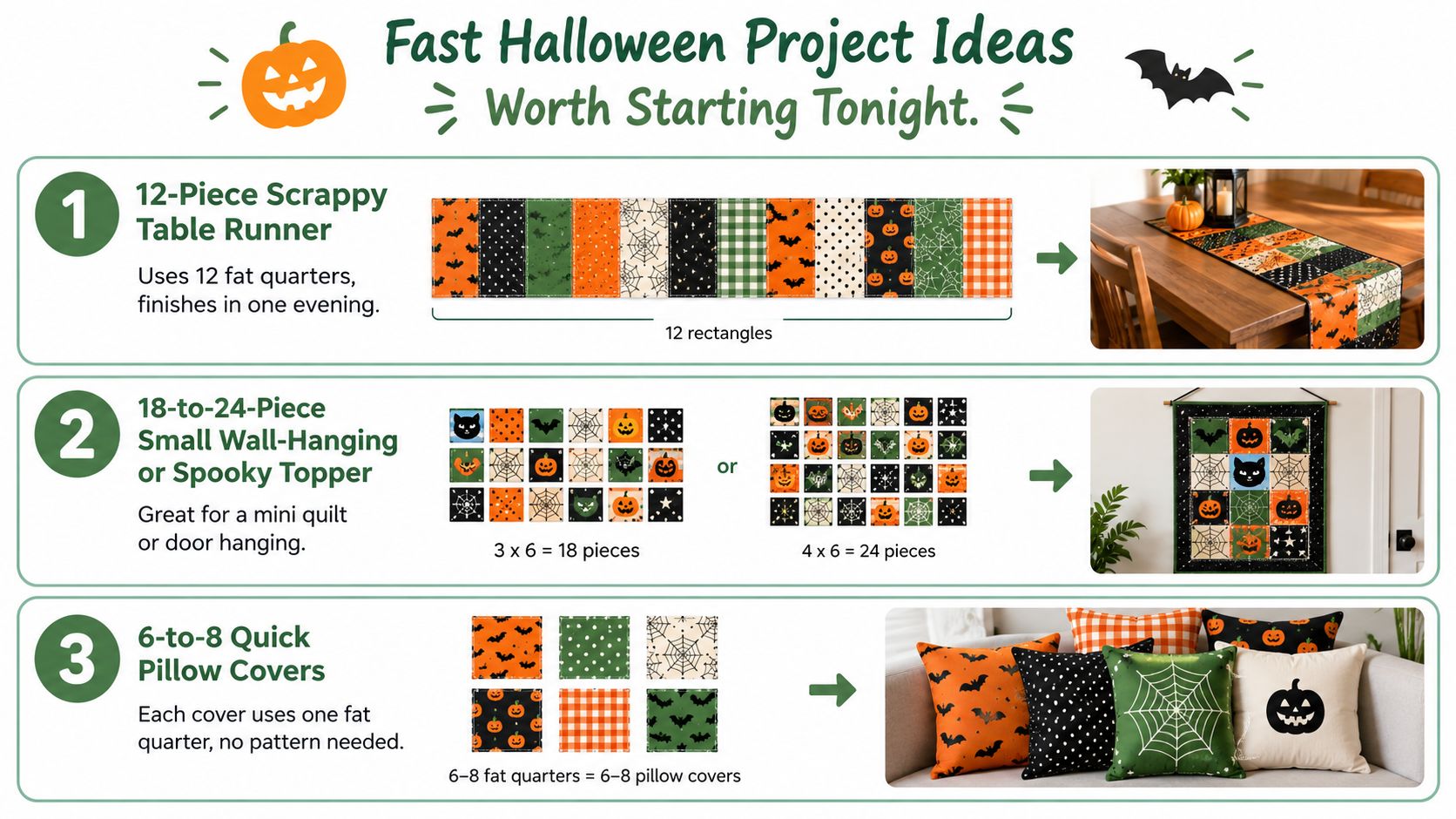
A scrappy table runner can use a selection of fat quarters arranged as alternating rectangles. Cut 2.5-inch strips for a simple strip-pieced look, but first confirm that the pattern and finished dimensions suit your fabric. Add background or border fabric if the design calls for it, plus batting, backing, and binding. This is a manageable choice for a beginner who has time to sew straight seams, but the exact finished size and sewing time depend on the pattern and construction.
A small wall hanging or spooky topper gives a larger bundle more room to show its range. Try a layout of 5-inch squares if the prints are small enough to remain legible, or use larger blocks to preserve a pumpkin or character motif. You'll need background fabric where the pattern calls for it, along with batting and backing. Lay the blocks out before sewing so you can spread dark and bright prints across the design.
Mug rugs or appliquéd pumpkins and bats make use of a handful of fat quarters or scraps. Fussy-cut irregular shapes to keep a motif intact, then add a background, batting, and backing for each small piece. This format suits a short sewing session, though curves and appliqué may take longer for a first-time maker than simple patchwork.
Pairing precuts with Halloween fabric panels can also simplify a seasonal project when you want a printed focal point rather than a fully pieced design. A ready-to-sew table runner kit or seasonal quilt kit may reduce the time spent choosing coordinating materials.
For a visual overview of seasonal quilting ideas, play the following video:
Before cutting dark novelty prints, test for color transfer. Nebraska Extension recommends dampening fabric with plain water, or a detergent solution if relevant, then blotting it with a white cloth or paper; visible transfer is a warning that wet cleaning may be unsafe. Test a dark print against a light companion, wash separately if needed, and use a cold, color-safe process. Nebraska Extension's fabric colorfastness guidance also describes crocking tests, in which wet or dry white cotton is rubbed against dyed fabric to assess color transfer.
Buying, Testing, and Storing a Bundle Beyond One Halloween
A bundle earns its place in the stash when its prints suit more than one project. Solids, moons, stars, plaids, dots, and low-volume prints can work in autumn décor, gothic or celestial designs, and everyday sewing. Check how much of each print a pattern uses: a large motif may look coordinated on the bolt yet leave little usable fabric after fussy cutting.
Test and store with care
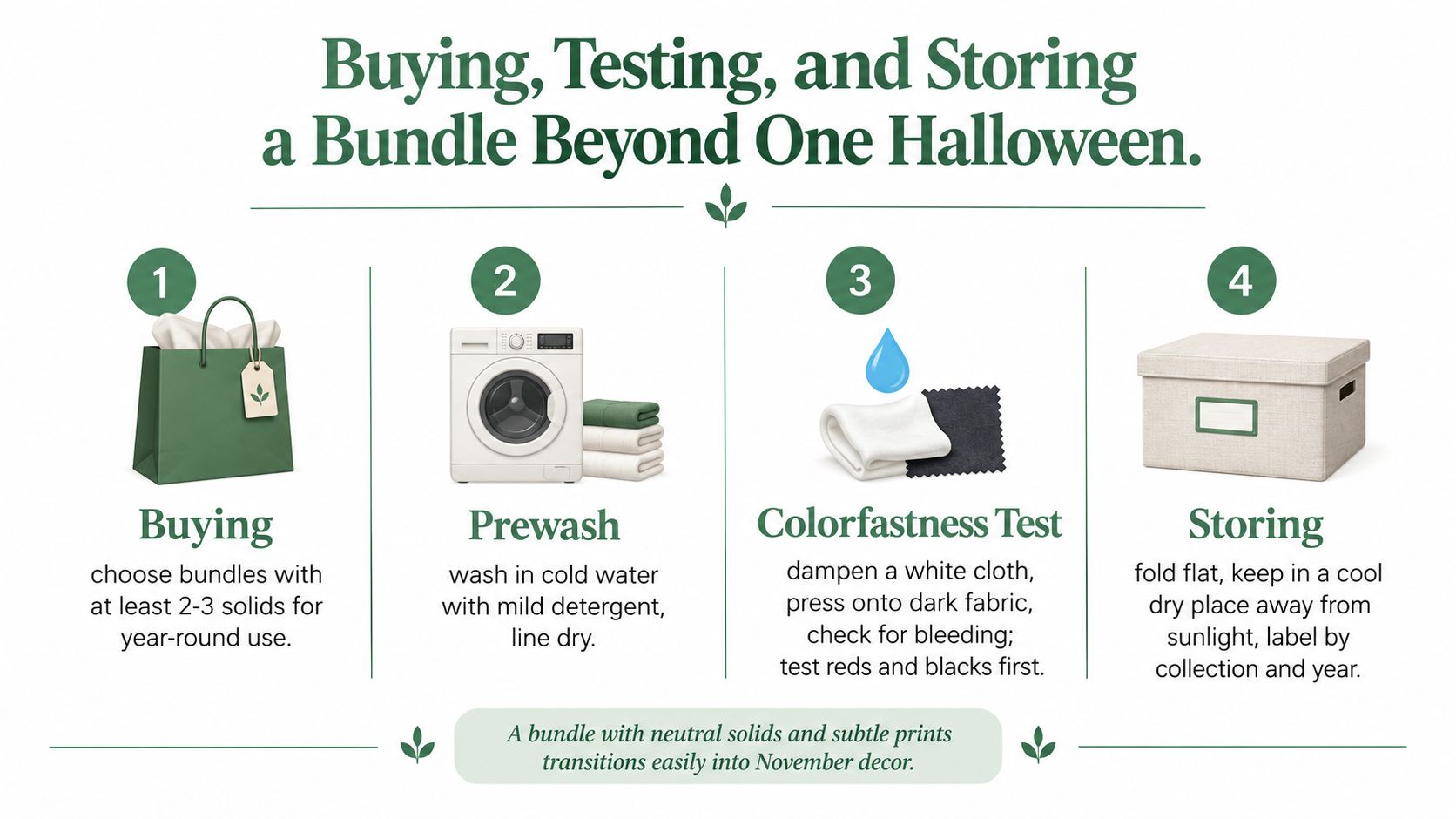
Run the blot test described above on the darkest print before prewashing. Then decide how to prepare the fabric: follow the pattern's instructions and consider how the finished piece will be cleaned. Prewashing can suit a project that will be laundered, while appliqué may call for the firmer feel of unwashed fabric. See these fabric care instructions for practical guidance.
Once the fabric is dry, keep it clean and easy to identify. Fold it loosely rather than pressing sharp creases into the cuts. Label leftovers with the collection and fiber content, if known, so you can judge whether they suit a future project. Store them in a lidded plastic container or a clean fabric bin, away from direct sunlight and damp areas. In a humid room, check stored fabric periodically for musty odors or signs of moisture before using it.
A reversible table runner, removable pillow cover, or modular block can extend a seasonal print's use without requiring a whole new project. Choose the construction with care: removable covers are easier to store between seasons, while fixed décor needs protected storage.
Buy prints you will reuse rather than extra fabric marketed as reusable. Before paying for a bundle, compare the cuts with projects you are likely to sew and the remaining fabric those projects will leave. If you are building a stash across seasons, compare bundle deals and email sign-up savings, then choose prints that earn their storage space. For more home décor ideas, browse fall table runner patterns.
Your Quick Halloween Bundle Checklist and Next Steps
Before cutting, confirm the nominal fat-quarter size is about 18 × 22 inches, then square each piece and plan from the usable area. Choose a bundle count that suits the project, pick three to five anchor prints with a coordinating solid, and set aside background fabric, batting, backing, and binding where needed.
- Match the count to the project: A few accents need less variety than a scrappy runner or small wall hanging.
- Plan around the prints: Keep large or directional motifs intact when they're the feature.
- Test before washing: Check dark fabrics against a light companion and follow the pattern's preparation instructions.
- Store for another season: Label useful leftovers and protect them from sunlight and moisture.
When I test and store a seasonal bundle with care, the leftover prints are much easier to use again for autumn décor or everyday sewing. Choose one project you can finish, and gather its extra materials before you start cutting.
People Also Ask
What can I make with a Halloween fat quarter bundle?
A bundle can supply prints for patchwork runners, small wall hangings, mug rugs, appliqué, or accent blocks. The exact yield depends on piece count, usable dimensions, motif scale, and the pattern's extra fabric requirements.
Are fat quarters the same as quarter-yard cuts?
No. A fat quarter is typically about 18 × 22 inches, while a conventional quarter-yard cut is about 9 × 42–44 inches. They contain roughly similar fabric area, but their shapes suit different cutting plans.
Should I prewash Halloween quilting fabric?
Test dark prints for color transfer first, then follow the pattern's preparation and care instructions. Some fabrics may need separate cold-water washing, while particular appliqué methods may work better with unwashed fabric.
How should I store leftover Halloween fabric?
Fold it without forcing hard creases, label scraps by collection and known fiber content, and keep them away from direct sunlight and moisture. Store usable pieces where you can find them for autumn or later projects.
Browse ready-to-sew kits and seasonal table runners at quiltkit.com if you'd like to skip part of the cutting and coordinating work. Sign up for email savings to hear about seasonal bundles and find a project that's ready when your sewing time opens up.