


Jelly Roll Batiks: A Practical Guide for Quilters
You've brought home a jelly roll batik, unrolled a few strips, and immediately noticed that it doesn't feel quite like the printed cottons in your stash. The colors look deep from edge to edge, the cloth feels dense in your fingers, and the strips seem to hold their shape instead of collapsing softly.
That difference matters once you start sewing. Jelly roll batiks combine a standardized precut format with wax-resist dyed cotton, so their weave, color depth, pressing response, and relationship with solids all affect project planning. I'll walk you through the format's history, compare batik with printed cotton, cover sewing-room mechanics, identify suitable projects, explain solid pairings, and finish with buying guidance and practical answers for first-time makers.
Meet the Jelly Roll Batiks
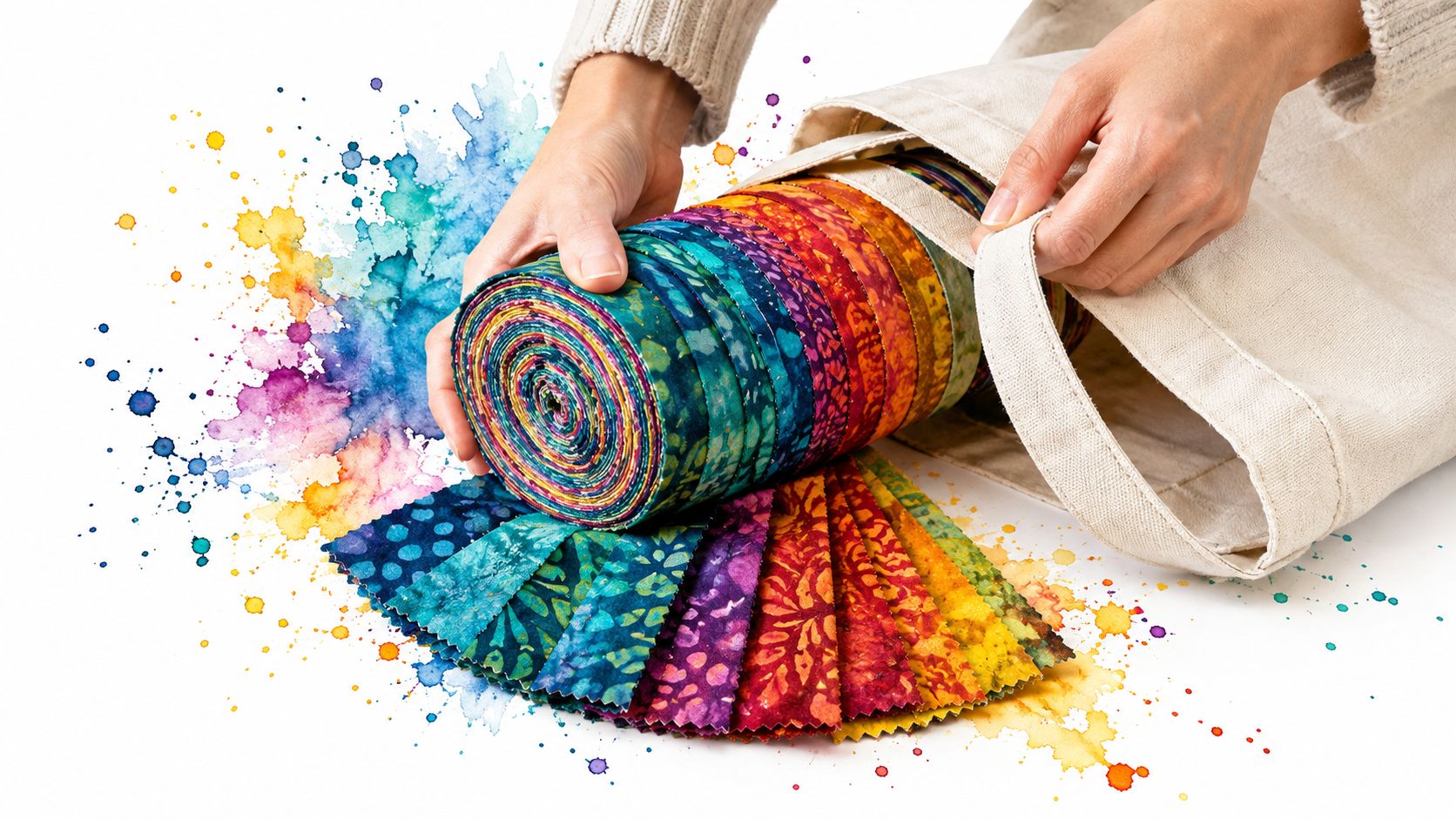
At a fabric shop or swap, a first bundle often arrives tightly rolled, with 2.5-inch strips arranged like a compact color library. Before planning a quilt, handle one strip. Batik cotton may feel firmer, show stronger saturation, and carry a faint waxy scent from its dyeing process.
Those sensations point to how the cloth may behave. Wax-resist dyeing lets color move through the fabric, while the cotton is commonly woven tightly. The result is minimal fraying, little bias stretch, and a crisp surface, unlike the more distinct right and wrong sides often found in surface-printed quilting cotton.
Look beyond the color
The practical question is what will these strips do under a rotary cutter, iron, and presser foot? Batiks tend to remain stable in long strip sets and hold a crease clearly. Their denser hand can also make them feel stiffer and resist pressing seams fully open. That firmness means a strip may hold its crease with less steam, but it can need extra pressure when you press seams open.
A quick fabric check is more useful than an online color chip. Fold a strip across the grain, inspect both faces, and gently rub the cut edge. Batik usually keeps strong color on both sides. Printed cotton more often has a clearer right side and a paler wrong side, a difference that affects how you orient pieces in a design.
A practical path for beginners
Narrow strips supported efficient piecing in the nineteenth century, with documented strip-quilt practices dating to about 1830 in this history of jelly roll quilts. Modern jelly roll batiks adapt that scrap-saving approach into a coordinated bundle, while the wax-resist process gives the strips their own handling requirements.
Use the bundle as both a color collection and a technical material. Stable strips suit designs built from long units, and deliberate pressing helps control the denser fabric. Pair the batik's undertone with a solid that leaves its motifs clear rather than competing with them.
What Makes a Jelly Roll and Why Batiks Fit the Format
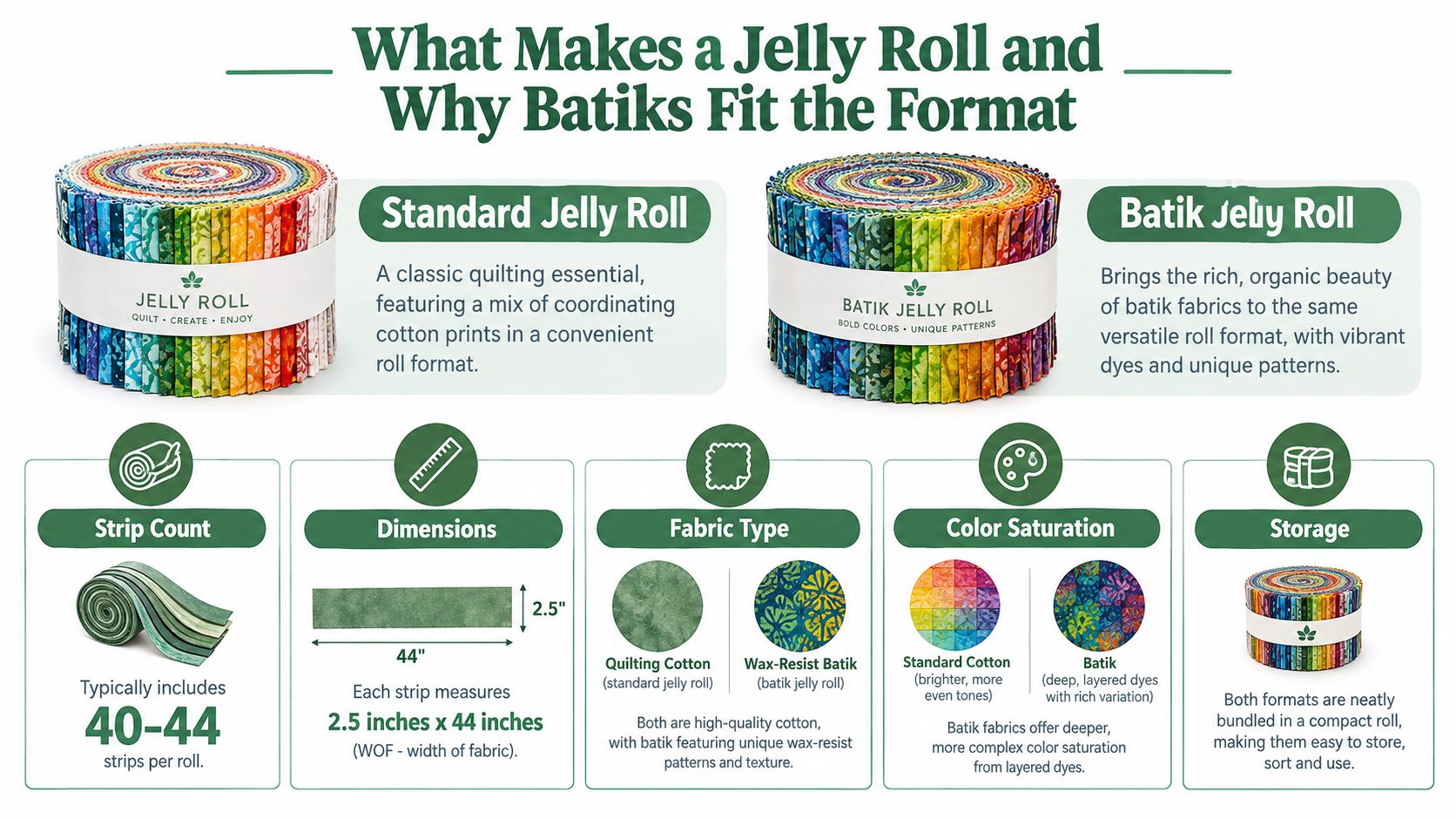
For a first project, a rolled bundle of long, coordinated strips can feel like a shortcut through the cutting stage. A standard jelly roll contains 40 to 42 strips, each 2.5 inches wide and about 42 to 45 inches long, in a format documented by Handmadelytics. Because the strips are already cut and rolled together, you can begin choosing a palette without cutting every piece from yardage.
Moda Fabrics helped popularize the format in the mid-2000s. The term jelly roll was coined around 2006, the first jelly rolls reached stores in 2007, and Moda designated the third Saturday in September as National Jelly Roll Day in 2017.
Where batiks belong in the precut family
Jelly roll batiks sit beside charm squares, layer cakes, fat quarter bundles, honey buns, and mini jellies. Their defining feature is the long, narrow cut, which suits strip piecing, binding, rail-fence layouts, log cabin variations, and other patterns built from extended units.
Batik also carries a distinct textile tradition. Indonesian batik, particularly Javanese batik, has been recognized by UNESCO as Intangible Cultural Heritage since 2009. Its wax-resist dyeing process gives a jelly roll more than coordinated color. The fabric's denser feel can affect how strip sets sew, press, and pair with solids.
Why the width works
The fixed width leaves enough room for repeated motifs to remain visible while keeping cutting efficient. After standard quarter-inch seam allowances, a strip finishes at about 2 inches, which makes the format useful for both piecing and binding according to this strip-piecing calculator.
Because batik strips are often denser than printed cotton, that standard width can stay stable during long chain-pieced strip sets. It may also hold a crease firmly, so press with the pattern in mind rather than assuming every seam will open easily.
For a clear explanation of what a jelly roll quilt is, start with the relationship between precut shape and block design. Batik strips reduce cutting work while giving the quilt a coordinated field of color and wax-resist texture.
Batik Strips vs Printed Cotton Strips
Batik and printed cotton can share the same fiber content, but they don't behave identically. Batik is colored through a wax-resist process, while printed cotton receives its design primarily on the surface.
The tighter weave common in batik gives it a denser hand and firmer body. Deep dye penetration often leaves little obvious wrong side, and the saturated color can look layered or slightly mottled. Printed cotton usually feels softer and more flexible from the start, with a clearer distinction between front and back.
| Characteristic | Batik Strips | Printed Cotton Strips |
|---|---|---|
| Surface | Layered, saturated color with resist texture | Surface-printed motifs with crisp pattern edges |
| Hand | Often denser and slightly firmer | Usually softer and more drapey |
| Wrong side | Often shows strong color | Commonly appears lighter |
| Fraying | Tighter weave can reduce raveling | Fraying varies by weave and finish |
| Pressing | Holds creases but may resist opening | Often presses open more easily |
| Stretch | Very little bias stretch in typical strip cuts | Depends more noticeably on weave and handling |
For a broader fabric vocabulary, review these types of quilting fabric. The distinction helps you choose based on construction, not only appearance.
What the dye process changes
Wax blocks or resists portions of the cloth while dye reaches the exposed areas. Repeated dyeing can build strong color, and the resulting cloth often has a visible depth that printed fabric doesn't replicate in quite the same way.
That density can help long strip sets stay orderly, but it can also make the fabric feel less fluid. A batik runner may have more body than the same design made with a soft printed cotton, which can be useful for table décor or a structured bag.
Choosing deliberately
Use batik when you want color intensity, subtle surface variation, and stable strip piecing. Choose printed cotton when a softer hand, clearer directional motif, or more relaxed drape matters more.
I don't treat one as automatically superior. For a quilt with a lot of flowing appliqué or a gentle drape, printed cotton may be the easier choice. For a graphic strip quilt where color carries the design, batik often earns its place.
Working with Batik Jelly Rolls in the Sewing Room
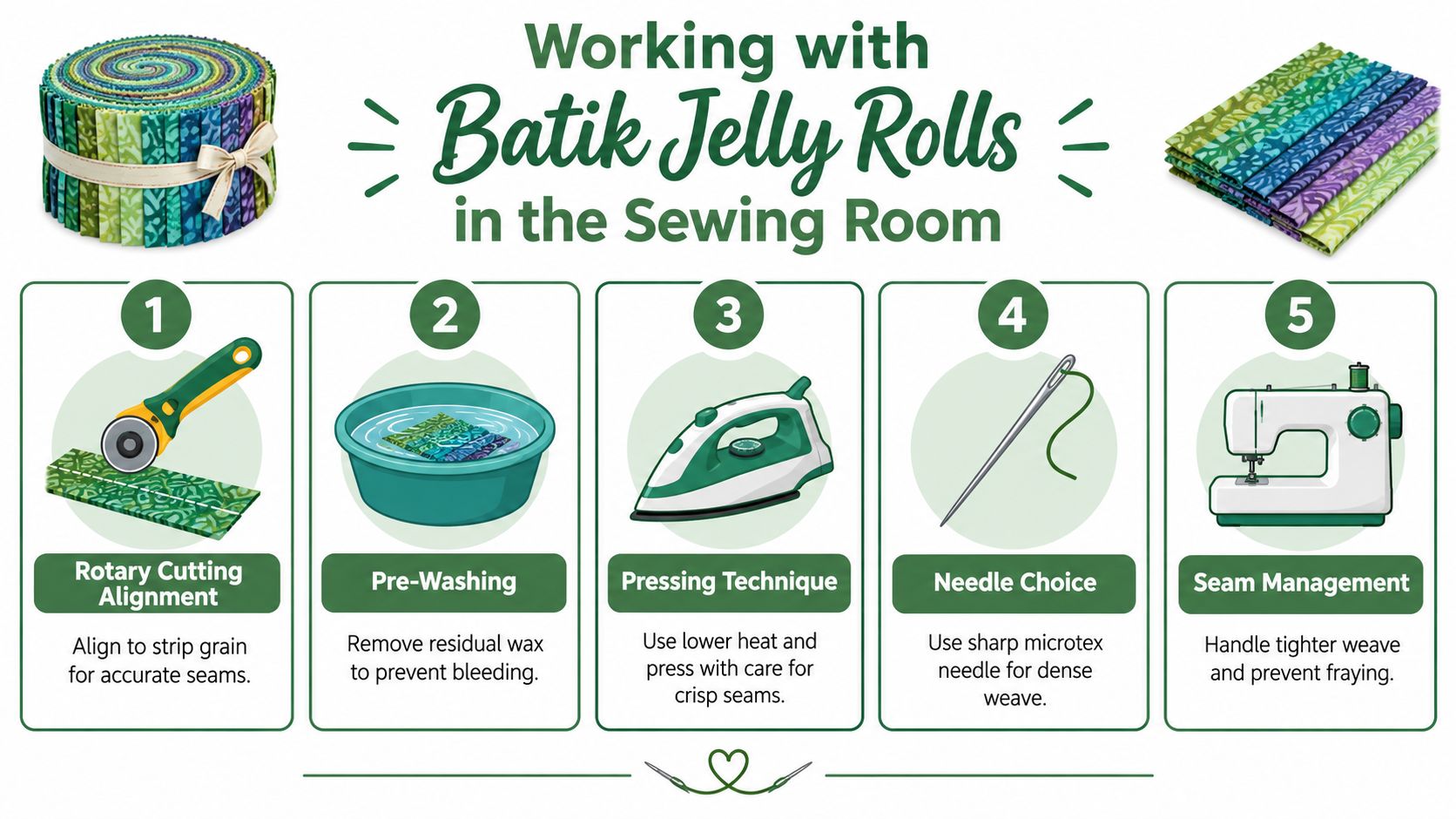
Start with the cut, not the machine. Lay each strip flat and check that its long edges follow the grain. Because these precuts are typically cut on grain, they usually have minimal bias stretch, but rough handling can still distort a long strip.
Pre-washing is a choice rather than a universal rule. Some batiks have already been wetted and dried during dyeing, which can make them effectively pre-shrunk, but washing can still remove residual dye, wax, or sizing before you combine the strips with other cottons.
A reliable preparation sequence
- Inspect the bundle. Smooth wrinkles before measuring or sewing, and keep the strips stacked flat rather than hanging over a chair.
- Test for color release. Dampen a small offcut and press it against a white cloth. Darker colors deserve extra caution before they meet a pale solid.
- Cut with alignment. Use a sharp rotary blade, a true ruler edge, and light pressure. The tighter weave rewards accuracy but doesn't forgive careless trimming.
- Sew with a precise quarter-inch seam. A narrow deviation accumulates quickly in long strip sets. Clip or pin according to your preference, but keep the layers aligned at the needle.
- Press with control. Medium-high heat and steam can work well, but test first. Batik may hold a crease firmly, and pressing open can take more pressure than pressing seams to one side.
Small adjustments that make sewing easier
A sharp Microtex needle is a sensible starting point for the dense weave. If several batik layers feel resistant under the presser foot, check thread tension and stitch length on a scrap before changing settings for the whole project.
End-to-end strip joins may be diagonal or straight. For a flatter strip set, one instructional guide recommends trimming the allowance to 1/4 inch and pressing seams open in its jelly roll construction instructions.
Keep the roll away from direct heat and store it flat enough that the strips don't develop hard folds. For related ideas on handling precut lengths, see fabric strip rolls and their uses.
Pressing reminder: Let the iron flatten the seam before you drag it. Pulling along a long strip can introduce distortion even when the fabric itself has very little stretch.
Best Projects for Jelly Roll Batiks
Jelly roll batiks shine when the pattern lets long strips carry the design. Their deep color and subtle surface variation create movement without requiring complicated fabric placement.
A straightforward strip race quilt is a friendly first project because the bundle supplies coordinated lengths. Log Cabin variations also suit the format, especially when the batik's tonal changes can separate rounds without relying on printed motifs.
Strong matches
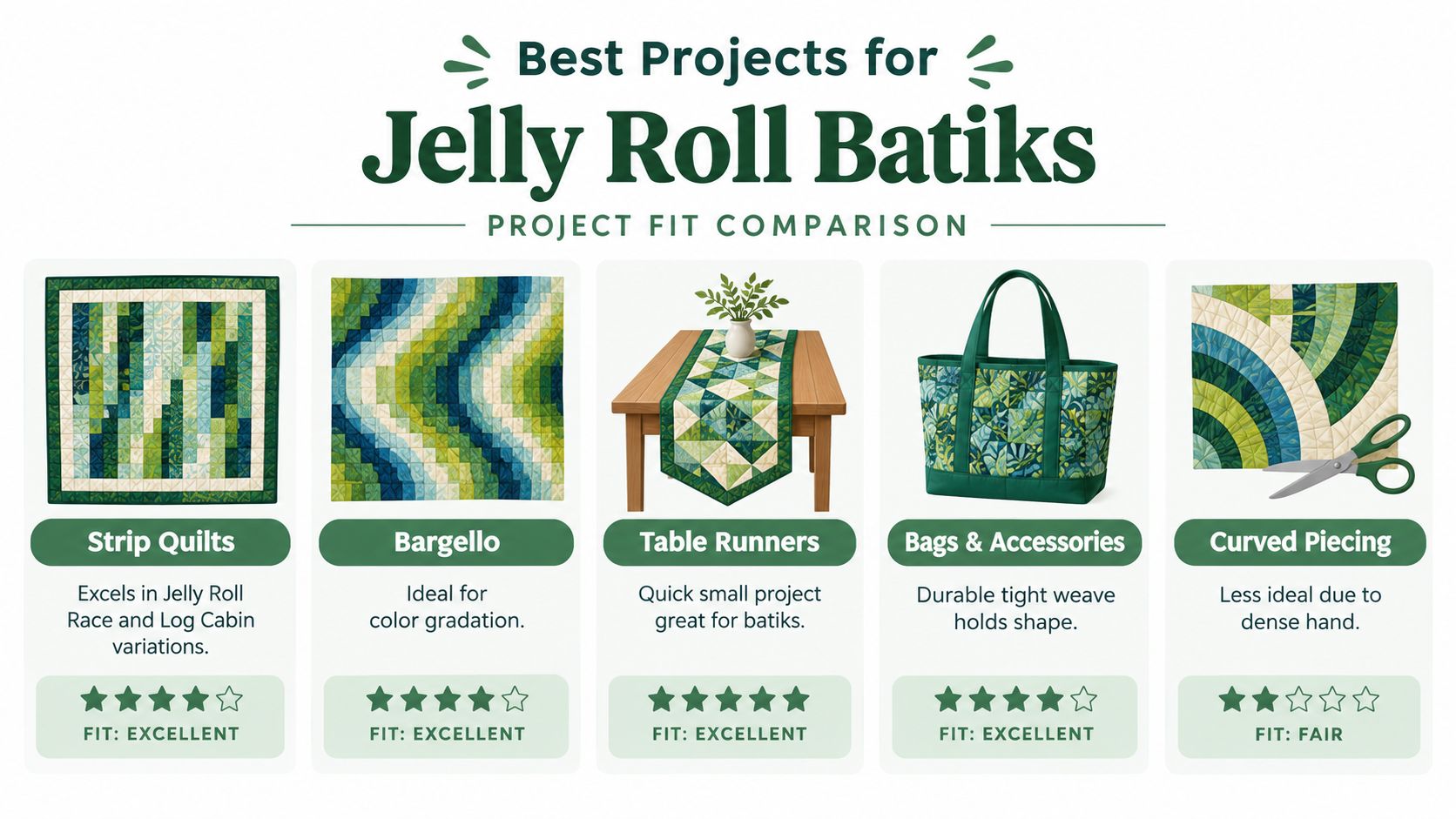
- Strip quilts: Jelly Roll Race layouts, rail-fence arrangements, and log cabin variations make direct use of the precut length.
- Bargello designs: Batik color gradations can create a rich wave effect, provided you sort the strips carefully before sewing.
- Table runners and toppers: These smaller surfaces showcase wax-resist texture without requiring a large commitment of fabric.
- Bags and market totes: The tighter weave can add body and help the finished accessory hold its shape.
- Gift quilts: Charity quilts, baby quilts, and practical throws can benefit from coordinated color selection and efficient strip piecing.
Projects that need caution
Batik strips aren't a substitute for broad yardage. They're a poor fit for a large backing, a design dominated by wide sashing, or a project that requires one uninterrupted dye lot across a substantial area.
Curved piecing can also feel less forgiving because the denser hand doesn't ease as softly as a more flexible printed cotton. That doesn't make curves impossible, but it does make testing and careful clipping more important.
Project-fit rule: Choose jelly roll batiks when the strip is part of the visual structure. Don't buy a strip bundle expecting it to solve a yardage-heavy design.
Pairing Batik Strips with Kona and Other Solids
A solid can either quiet a batik bundle or intensify it. Kona Cotton is a useful reference because a broad solid field gives the eye somewhere to rest while the batik strips provide texture and color movement.
Begin by identifying the dominant undertone. A bundle may appear blue overall but contain green, violet, or gray beneath the surface. Hold candidate solids beside the strips in natural light, because batiks can read warmer than printed cotton.
Three dependable contrast approaches
Pull the deepest shade when you want the strips to appear lighter and more luminous. Pull the lightest shade when you want a darker batik collection to anchor the quilt. A cream or soft neutral can bridge a bundle with several unrelated color families without competing with the resist pattern.
Use one solid for sashing when you want a calm, unified structure. Multiple solids can echo the bundle's range, but they also create more visual decisions and may dilute the contrast between strip groups.
For a closer look at solid fabric choices, use this guide to Kona Cotton solids. Before cutting, place the fabrics together under the lighting where the finished quilt will usually be seen.
Planning the solid
Don't estimate solid yardage from strip count alone. The pattern, seam allowances, borders, and direction of cutting all affect the requirement, so use the pattern's cutting chart whenever one is available.
| Project Size | Finished Dimensions | Solid Strips Required | Approximate Solid Yardage |
|---|---|---|---|
| Small runner or topper | Pattern dependent | Pattern dependent | Pattern dependent |
| Small throw | Pattern dependent | Pattern dependent | Pattern dependent |
| Twin-size topper | Pattern dependent | Pattern dependent | Pattern dependent |
The table intentionally keeps the planning categories qualitative. No single yardage substitute works across all jelly roll patterns, and cutting diagrams may use the solid for sashing, background, borders, or multiple roles.
For backing and finishing, consider how the top's dense batik surface will meet batting. Hobbs Bonded Fibers, Pellon, and The Warm Company offer different batting constructions, so match loft and stitch definition to the quilting design rather than assuming every batik top needs the same finish.
Buying and Kit Guidance for First-Time Buyers
A first bundle should make your project easier, not create a detective job. Start by checking the strip edges, the stated count, the color range, and whether the bundle comes from one collection or combines unrelated fabrics.
A coordinated example may contain 40 unique strips with no repeats, as shown by one batik bundle listing from Bold Notion Quilting. Don't assume every product uses identical naming, so read the description instead of relying on the picture.
What to inspect before checkout
- Cut quality: Look for strips with clean, even edges and a consistent width.
- Color organization: Check whether the tonal values vary enough to create contrast. A bundle of similar midtones may look beautiful but flatten into one mass in a quilt.
- Dye-lot clarity: Keep collections and dye lots together when the project depends on repeated color. Mixing later can introduce an unexpected shift.
- Fabric behavior: Look for descriptions that identify batik quilting cotton rather than a loosely described decorative fabric.
- Project contents: Confirm whether the purchase includes a pattern, coordinating solid, binding, or only the strips.
Roll or ready-to-sew kit
A bare roll gives you maximum control. You can add Kona Cotton, a favorite thread, and batting from your existing supplies, which suits experienced quilters with a well-organized stash.
A curated kit reduces decisions for a beginner or a busy maker. Pre-cut quilt kits for beginners can bring the pattern and coordinated components together, but read the contents carefully so you know what remains to purchase.
I'd start with a table runner before committing to a large quilt. That smaller project lets you test pre-washing, pressing, seam accuracy, and color bleeding without consuming the entire bundle.
Frequently Asked Questions About Jelly Roll Batiks
Do jelly roll batiks need pre-washing?
Not always. Some batiks are wetted and dried during production, but pre-washing can remove residual dye, wax, and sizing. Test a dark strip before pairing it with cream or white fabric, then dry it as you expect to launder the finished quilt. This also reveals whether the fabric changes hand or size before piecing.
Can I substitute jelly roll strips for yardage?
Sometimes. A jelly roll strip is usually 2.5 inches wide and about 42 to 45 inches long, as described earlier. Its narrow, stable shape suits strip-pieced blocks and other repeated cuts, but yardage may offer a different grain direction and larger uninterrupted pieces.
Batik's wax-resist dyeing process often leaves the cloth with a firmer hand and less bias stretch than printed cotton. That stability can make long seams easier to control, yet it may give large sashing or backing a crisper drape. Check the pattern's cutting plan before substituting.
Do I need a special needle?
A sharp Microtex needle is a practical choice for batik's tighter weave. Test the needle, thread, tension, and stitch length on scraps because the best setting depends on your machine and the number of fabric layers.
How can I recognize a well-made batik?
Look for a firm but workable hand, color that appears through the cloth, clean cuts, and few loose threads. Strong wrong-side contrast, uneven edges, or an excessively limp feel may indicate fabric that will not behave like dense batik quilting cotton.
What do Bali Pops and batik strips mean?
These names may describe branded or collection-specific bundles of coordinated 2.5-inch precut strips. Naming varies, so confirm the dimensions, strip count, fabric content, and whether the strips repeat or show unique designs. Do not assume the name alone guarantees a particular assortment.
If long piecing makes strips curl or wrinkle, press them flat and test a light application of starch. Let the fabric dry before cutting, then check whether the starch has changed the hand more than you prefer.
QuiltKit.com offers ready-to-sew kits and quilting supplies that may combine precut fabrics with patterns, solids, batting, and finishing materials. Visit quiltkit.com to browse batik-friendly project options, and look for the Email Sign-up Savings while comparing bundles before making your first cut.