


Quilting Cotton Fabric by the Yard: 2026 Buying Guide
You're standing in a fabric shop with a pattern in one hand and three nearly identical bolts in the other. Online, the choice can be harder: a solid may look perfect on screen, but the listing might not tell you how it cuts, presses, frays, or changes after washing. Quilting cotton fabric by the yard is easier to buy confidently when you judge more than color.
The practical questions are simple. Is the weave stable enough for accurate piecing? Will the usable width suit your cutting plan? Should you prewash it? Does the fabric's hand match the quilt you're making? The answers affect waste, seam matching, longarm behavior, and how the finished quilt feels in use.
Why Quilting Cotton Matters Before You Buy by the Yard
Early fabric purchases often teach the most expensive lessons. I remember choosing a beautiful cotton print that felt soft in my hands, only to discover during cutting that it shifted more than expected and frayed at every edge. The print was attractive, but it wasn't behaving like dependable quilting cotton.
Quilting cotton is generally a stable, balanced plain-weave fabric intended for cutting, piecing, pressing, and repeated handling. Apparel cottons may be designed for fluid drape, while novelty or loosely woven fabrics can distort more readily under a rotary cutter. That difference matters most in half-square triangles, flying geese, paper-pieced blocks, and any design where a small error repeats across many units.

The fabric has to suit the job
A fabric can be lovely and still be the wrong choice for a quilt top. For beginners, a medium-weight 100% cotton with a firm hand is forgiving because it holds a crease, stays relatively stable under the presser foot, and gives seams enough structure to nest cleanly.
For experienced quilters, the decision becomes more specific. A tight weave can support crisp points and reduce edge fraying, while a softer fabric may give a quilt more drape after quilting. Neither choice is automatically superior. The right answer depends on whether you're making a graphic modern quilt, a soft baby quilt, a heavily pieced sampler, or a durable collegiate gift.
Before ordering, check:
- Fiber content: Look for 100% cotton when you want predictable pressing and a familiar quilting hand.
- Usable width: Confirm how much fabric lies between the selvages, especially for borders, binding, and backing calculations.
- Surface and hand: A smooth, even surface is easier to evaluate than fabric that feels thin, rough, waxy, or irregular.
- Color continuity: If the project needs additional yardage later, collection and dye-lot availability can matter.
Cotton is part of a broad international fiber system, not a tiny craft niche. Textile Exchange reported that global fiber production reached 124 million metric tonnes in 2023, compared with approximately 116 million tonnes in 2022, while cotton represented about 20% of total global fiber output. The report also found that approximately 28% of cotton produced in 2023 came from sustainability programs. Those conditions help explain why availability, pricing, and continuity can change between production seasons. See how cotton fabric bolts reach the quilting market for useful shopping context.
Practical rule: Buy for the finished quilt, not just for the photograph. A striking print that shifts during cutting can cost more in time and replacement fabric than a steadier option.
Understanding Fabric Construction and Technical Specs
Quilting cotton is usually a balanced plain weave in which warp and weft threads cross in a regular over-under structure. Typical quilting-fabric guidance places many fabrics around 110 to 160 GSM, with approximately 68 by 68 threads per square inch often cited as a balance between softness and stability. Broader industry guidance gives a typical range of roughly 80 to 100 threads per inch. These figures are useful reference points, not a substitute for handling the actual fabric.
GSM means grams per square meter. It gives you a way to compare fabric mass, but it doesn't tell the whole story. Two fabrics with similar GSM can feel different if their yarns, finishing, and weave density differ.
What the numbers tell you
A tighter weave generally gives fabric more resistance to edge movement and fraying. That helps when you're trimming blocks, sewing bias edges, or feeding small pieces through a domestic machine. A looser structure may feel softer or more relaxed, but it can demand more careful starching, pressing, and handling.
| Specification | Typical Range | Impact on Quilting |
|---|---|---|
| Fiber content | 100% cotton is common for quilting cotton | Presses predictably and suits conventional patchwork |
| Fabric weight | Approximately 110 to 160 GSM | Influences body, drape, needle feel, and layering |
| Thread density | Approximately 68 by 68 threads per square inch is a cited balance | Supports stable cutting and crisp piecing |
| Broader thread guidance | Roughly 80 to 100 threads per inch | Helps compare weave density across product descriptions |
| Weave | Balanced plain weave | Provides a consistent grid for rotary cutting and seams |
The phrase tight weave is more useful than a vague promise of “premium quality.” Check whether the fabric looks even when held toward light, whether the selvedge runs straight, and whether the cut edge sheds fibers immediately. A firm fabric with minimal fraying can save time during chain piecing and trimming.
For a more detailed vocabulary of quilting substrates, consult the guide to quilting fabric types.
Weight changes the sewing experience
Lighter quilting cotton can feel pleasant in a summer quilt, but it may require more care when aligning seams. Heavier cloth gives blocks more body and can make pressing easier, although multiple seams may create bulk at intersections. On a longarm, the top, batting, and backing work as a system. A firm top paired with lofty batting can produce pronounced stitch definition, while a softer top over a flatter batting may give a quieter surface.
Cotton also responds to moisture. Research describes equilibrium moisture contents of approximately 6.7% to 7.2% at 65% relative humidity, and USDA work notes that moisture affects cotton strength and yarn-processing quality. The practical conclusion is modest but important: let fabric acclimate indoors before precision cutting rather than cutting immediately after storage in a very dry or rapidly changing environment. Read the technical discussion of cotton moisture behavior for the underlying fiber research.
Top Brands and Collections for Quilting Cotton
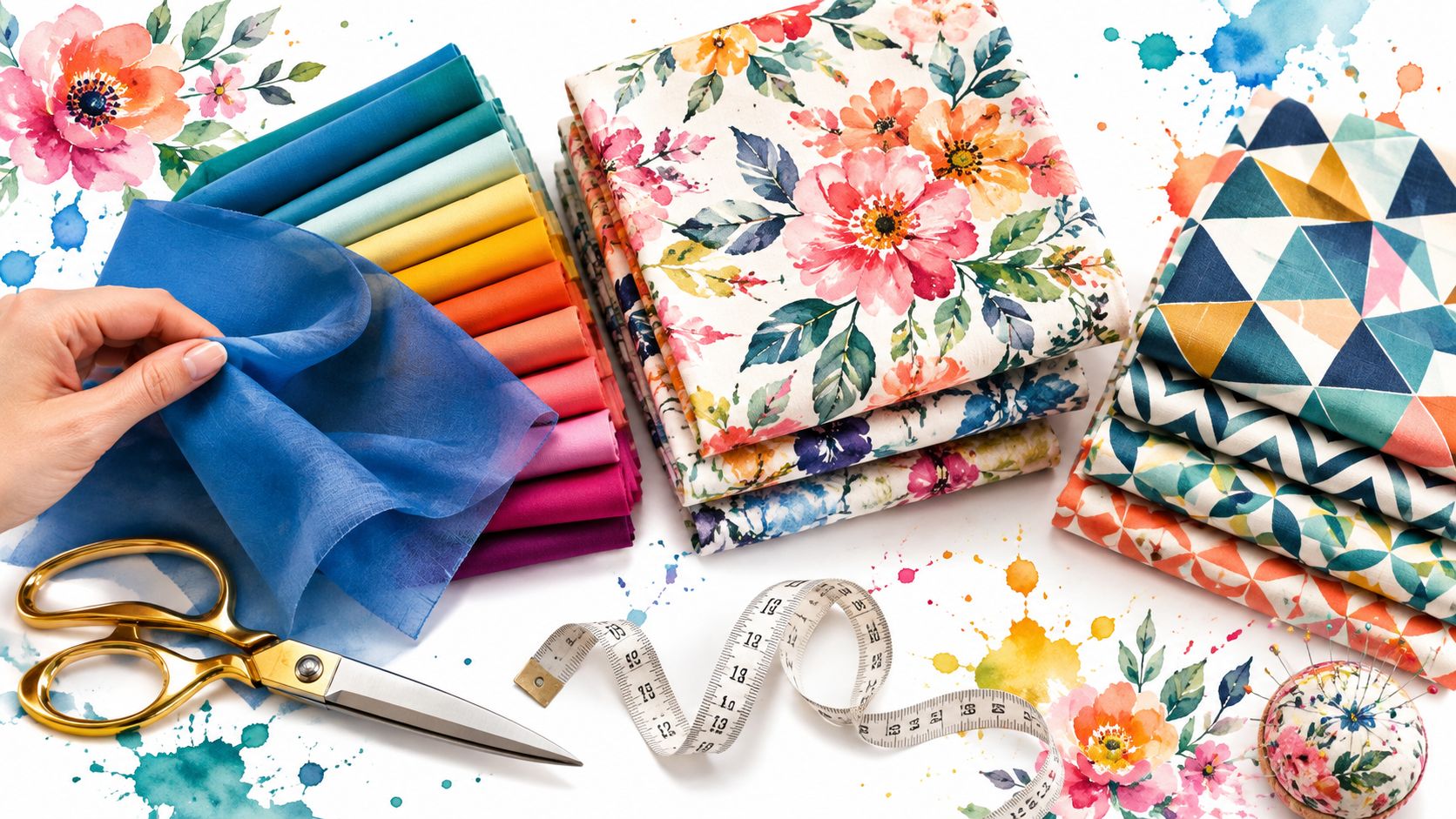
Brand names help narrow a crowded selection, but the label isn't a guarantee that every fabric will suit every project. I judge cotton by how it feels on the cutting table, how easily it holds a pressed seam, and whether the print stays legible after quilting. Kona Cotton solids have a familiar, substantial hand that works well for graphic backgrounds, while Ruby Star Society prints often bring strong color and clear modern motifs to a fabric pull.
Solids, modern prints, and dependable coordinates
For a modern quilt, a solid can carry as much visual weight as a print. Kona Cotton is useful when you need a broad color field that makes seams and quilting lines visible. I've found that a smooth, stable solid makes pressing and trimming feel especially controlled in repeated half-square triangle units.
Ruby Star Society collections take a different role. Their prints can supply the focus fabric, then guide supporting solids and small-scale coordinates. Watch the scale before cutting. A large motif may disappear inside small squares, while a tiny blender can lose impact across a broad sashing strip.
Marcus Fabrics is worth considering for traditional palettes and coordinated colorways. Consistency matters when a quilt uses a background repeatedly, so check the exact collection and product listing before assuming a later purchase will match an earlier cut.
How batting changes the fabric decision
Fabric and batting should be considered together. Hobbs batting options can create different levels of loft and stitch definition, while Pellon fusible products may help with selected appliqué or stabilizing tasks. Fusible materials are useful when the construction calls for them, but they aren't a universal replacement for ordinary quilt batting.
A dense pieced top with many seam intersections can become bulky when paired with lofty batting. Conversely, a simple whole-cloth or large-patch design may benefit from more visible loft beneath it. For domestic-machine work, consider how the layered sandwich feeds under the foot. For longarm quilting, also consider roll resistance, needle choice, and how the fabric's surface responds to the chosen quilting density.
When comparing brands, evaluate:
- Hand and drape: Does the cloth feel crisp, soft, smooth, or stiff?
- Print registration: Are lines and color boundaries sharp?
- Fraying: Does the cut edge remain manageable during piecing?
- Color role: Is this a focus print, background, blender, binding, or backing?
- Availability: Can you buy enough now, with a little reserve for directional cutting?
A reputable brand can reduce uncertainty, but a swatch or small cut still gives the most honest information. Product pages for Kona Cotton and Ruby Star Society yardage can help you compare solids and prints by project role.
Yardage Calculation and Project Planning Strategies
Yardage math works best when you match the method to the project. For a simple table runner made from rectangles, a quick estimate may be sufficient. For a directional print, intricate star, or large quilt with borders, a cutting diagram is safer because it accounts for grain, motif placement, seam allowance, and usable width.
The basic calculation begins with the finished size of each piece. Add the seam allowance required by the pattern, then determine how many pieces fit across the usable fabric width. Remember that nominal width isn't the same as usable post-wash width. Selvages, shrinkage, and a slightly uneven cut edge reduce what reaches the cutting mat.
Two ways to plan the cut
The simple method is fast. Multiply the number of pieces by their cut dimensions, then compare the total area with the fabric width and length. It gives you a starting point, but it doesn't show how pieces nest or whether directional motifs need to face a particular way.
Layout optimization treats the fabric like a cutting puzzle. Place the largest pieces first, preserve the grain where the pattern requires it, then fit smaller units into the remaining spaces. This approach can reduce waste in theory, but it takes longer and may not suit a fabric where you need extra allowance for flaws or motif matching.
| Method | Best For | Accuracy Level |
|---|---|---|
| Pattern yardage | Standard projects with tested instructions | Good when the pattern specifies fabric width |
| Simple area estimate | Small, non-directional projects | Quick estimate, but vulnerable to layout waste |
| Cutting diagram | Repeated blocks and border systems | More precise and easier to audit |
| Full-size layout | Directional prints and complex designs | Highest practical control over placement |
| Extra reserve yardage | First attempts or hard-to-replace fabric | Protects against mistakes and irregularities |
Yardage versus precuts
Buying by the yard gives you control over strip length, borders, binding, and large background cuts. It also lets you select a continuous piece when a design needs uninterrupted color or direction.
Precuts reduce preparation time and can simplify coordinated color selection. Fat quarters, strips, and squares are convenient, but their fixed dimensions limit the cutting plan. They also shouldn't be assumed to replace yardage for borders or backing. If you're unsure which approach fits your pattern, compare the fabric yardage calculation method with the pattern's own cutting instructions.
Cutting-table habit: Write the usable width, grain direction, and cut list on a sticky note before opening the fabric. It prevents a beautiful print from becoming an expensive collection of incorrectly oriented pieces.
Leave room for reality. A rotary blade can drift, a directional print can reveal an unwanted placement, and a first attempt may need a replacement unit. Buying the smallest mathematically possible amount works only when the layout is forgiving and the fabric is readily available.
Prewashing, Cutting, and Pairing Techniques
Prewashing is a risk-management choice, not a moral test. Cotton fabrics can experience relaxation shrinkage as washing, heat, and agitation release tensions from manufacturing. One laundering study reported average first-wash shrinkage of 6.8% ± 0.7%, with an average across repeated washes of 7.6% ± 0.7%. Another detergent study reported overall dimensional losses of approximately 2% to 5%, showing why construction and care conditions matter. See the cotton laundering study for the measured results.
A reliable preparation sequence
Wash yardage if you want the quilt components to settle before piecing. Use the intended care process, dry the fabric in the way you expect to dry the finished quilt, and press with an up-and-down motion rather than dragging the iron across the grain.
Then:
- Inspect the fabric: Look for distortion, loose threads, and color transfer.
- Press without stretching: Smooth wrinkles while keeping the grain aligned.
- Square the edge: Use the selvedge and a long ruler to establish a reliable reference.
- Cut in batches: Group identical pieces and check the ruler position between cuts.
- Label the units: Especially useful for light, medium, and dark value groups.
If the backing, batting, and top shrink differently after assembly, the quilt can develop seam stress, puckering, or altered block dimensions. Prewashing won't eliminate every change, but it makes the pieces more predictable. The fabric care instructions can help you align preparation with the finished quilt's intended use.
Here's a visual demonstration of fabric handling and preparation:
Pairing the top with batting and backing
A firm quilting cotton top usually works well with cotton or cotton-blend batting, but the final choice depends on the quilt's purpose. Hobbs 100% cotton can support a natural, softly textured finish, while an 80/20 blend may offer a different balance of loft and drape. Black batting can be useful beneath dark tops, but it changes the visual risk if light fabrics are included.
Wideback fabric simplifies large quilt backs by reducing the need for a central seam. QuiltKit offers wideback cottons up to 108 inches, along with batting from Hobbs Bonded Fibers, Pellon, and The Warm Company. For a product-focused option, compare 108-inch wideback cotton and batting choices before calculating the final backing cut.
Use a walking foot when the layers need controlled feeding on a domestic machine. On a longarm, test tension on a scrap sandwich that includes the actual top, batting, and backing. A fabric combination that behaves beautifully in piecing can still need tension adjustment during quilting.
Smart Buying Strategies for Your QuiltKit Shopping
A useful shopping decision starts with the project role. Buy yardage for borders, binding, backgrounds, and large continuous cuts. Choose precuts when speed and coordinated color matter more than complete control over dimensions. Select wideback fabric when avoiding a pieced backing will save time and reduce alignment work.
For a beginner, a ready-to-sew kit can remove several decisions at once. For a precision piecer, the better purchase may be extra background yardage, a stable solid, and batting that matches the desired loft. Modern makers may want Kona Cotton solids beside Ruby Star Society prints, while collegiate gift-makers may prioritize durability, team spirit, and a backing that can handle regular use.
Keep these checks beside your cart:
- Project role: Top, border, binding, backing, appliqué, or accent.
- Fabric behavior: Firmness, fraying, drape, and directional design.
- Care plan: Whether the top and backing will be washed before assembly.
- Finishing system: Domestic machine or longarm, batting loft, and quilting density.
- Replacement risk: Whether you need reserve yardage for a print that may not return.
QuiltKit carries quilting cotton by the yard, precut rolls, coordinated bundles, batting, widebacks, thread, irons, sewing machines, and ready-to-sew project formats. Its fabric bundle selection can be useful when you want a coordinated palette without building every color relationship from scratch.
For readers who aren't ready to order, the Email Sign-up Savings is a practical way to watch for offers while you finish your calculations.
QuiltKit brings together quilting cotton fabric by the yard, modern solids, Ruby Star Society prints, coordinated bundles, widebacks, batting, and ready-to-sew kits for different project speeds and skill levels. Review your pattern, confirm the usable width, choose the fabric role, and visit quiltkit.com when you're ready to turn a considered yardage plan into a finished quilt.