


Green Cotton Fabric Guide for Modern Quilters
Saturday morning, you walk into a small quilt shop with a project bag over one shoulder and stop in front of a wall of green bolts. Sage shifts toward grey under one light, then toward mint under another. Hunter looks almost black beside a brighter emerald, and every bolt seems to carry a different version of the same promise. The folded half-yard in your hand has a reassuring weight, a faint sizing smell, and far too many possible futures.
I've stood in that spot with a quilt plan, a swatch, and no reliable way to decide whether the right answer is a solid, a print, or a backing. Green cotton fabric becomes much easier to choose when you sort it by shade family, project type, weave, and brand pairing instead of trusting the color name alone.
Staring at a Wall of Green Bolts
A green fabric wall can overwhelm even an experienced quilter because color names aren't standardized. One manufacturer's sage may read like another's eucalyptus, while a photographed bolt can look warmer or darker than the cloth on the cutting table. Your first job isn't to pick a shade. It's to reduce the wall to a useful group.
Start by holding the fabric beside the colors already in your project bag. A green that looks gentle on its own may become yellow beside cream, blue beside navy, or almost black beside a bright white. I usually pull three bolts from different parts of the wall, fold each one over my hand, and compare the way the cloth bends. The right choice should feel appropriate for the quilt, not merely attractive under shop lighting.
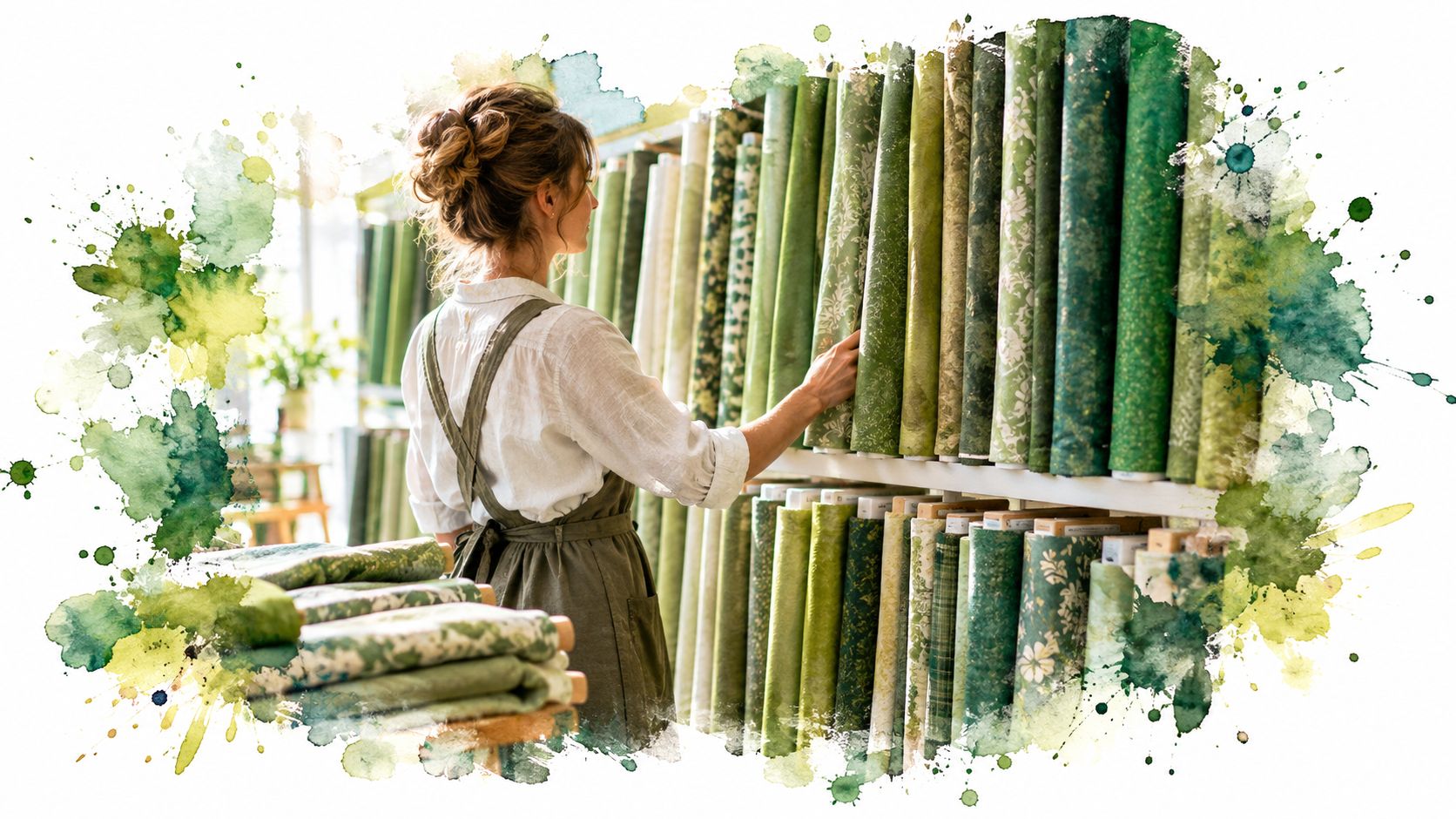
The hand matters. A tightly woven quilting cotton should feel stable when you pinch the fold, with enough body for accurate cutting but no cardboard stiffness. A softer print may drape more readily, while a wideback can feel slightly firmer because of its larger construction and finishing.
Practical rule: Choose the project format before you fall in love with a shade. A beautiful green in the wrong width can create more work at the cutting table.
QuiltKit's guide to bolts of cotton fabric is useful when you're deciding how much yardage to inspect, but the shop-floor decision still comes down to value, hand, and purpose. Once those three are clear, the names on the bolt start helping instead of confusing you.
What Green Cotton Fabric Means
Green cotton fabric has two meanings. It can mean cotton cloth in the green color family, from pistachio and sage through jade, emerald, forest, and moss. It can also describe cotton sold with sustainability claims, including organic fiber, lower-impact dyeing, certified processing, or a recycled blend.
The color meaning matters most at the cutting table. A shade still needs to suit the project format, whether you are choosing a solid for a calm background, a print for movement, or a wideback for simpler quilt finishing. Sustainability claims deserve separate attention if you are buying for baby projects, skin-contact items, or a maker who wants documented fiber and processing standards.
A color label does not tell you whether the cloth is quilting cotton. Quilting cotton is generally a stable, plain-weave fabric made for piecing. Apparel cotton may feel softer and drape more freely, canvas is heavier and more structured, and cotton lawn is lighter with a finer hand. They can all appear in search results for green cotton, but they will not behave the same way under a rotary cutter or sewing machine. Compare types of quilting fabric before choosing by color alone.
The category also includes solids, prints, precuts, and widebacks. A green bolt may be sold by the yard, while the same color story appears in a fat quarter bundle or a backing cut. That distinction affects how much fabric you inspect and how easily the shade fits your plan.
Sustainability language requires the same care as color language. Read the certification scope instead of assuming a green name indicates environmental performance. GOTS covers the textile processing chain, including fiber processing, spinning, wet processing, manufacturing, trading, and traceability, while OCS focuses more narrowly on tracking organic fiber. The GOTS standard explains that distinction.
GOTS products need at least 70% certified organic fibers, while the stricter organic label grade requires at least 95% certified organic fibers. The standard also restricts inputs including toxic heavy metals, formaldehyde, aromatic solvents, and GMO use in processing, as detailed in the GOTS requirements guide.
Solids, Prints, Precuts, and Widebacks Compared
The best green fabric format depends on what your quilt needs to do. A solid gives you control over value and seam matching. A print supplies movement and personality. A precut lets you test a palette without committing to long yardage, while a wideback simplifies the least glamorous part of finishing.
| Format | Best For | Typical Cut |
|---|---|---|
| Solid | Backgrounds, appliqué, low-volume quilts, blenders | Yardage, half-yard, or fat quarter |
| Focal blocks, borders, novelty quilts, visual texture | Yardage or coordinated cuts | |
| Precut | Samplers, quick palette testing, scrappy projects | Fat quarters, charm squares, jelly rolls, or layer cakes |
| Wideback | Quilt backs with fewer seams | Large-width yardage |
Kona Cotton, Bella Solids, and Moda Grunge basics are dependable starting points when you want a clean background or a quiet blender behind busier fabric. A solid makes piecing errors easier to spot, but it also makes pressing, nesting seams, and stitch tension more visible. If you're new to quilting, that visibility can help you improve quickly.
Prints from Ruby Star Society, Tula Pink, and Art Gallery bring a different kind of decision. Look at motif scale before buying. Tiny florals can act like textured solids from a distance, while large geometrics may need careful placement so the design doesn't disappear into small units. Explore Ruby Star Society fabric ideas when you want a print to lead the palette.
Precuts are practical for sampler quilts because they provide variation in one purchase. They're also a low-risk way to compare several greens before ordering more of a favorite.
Widebacks reduce the need to piece a backing and can give the finished quilt a cleaner reverse side. The hand may feel a little stiffer than standard-width quilting cotton, so unroll the fabric and let it relax before judging it. For a large bed quilt, check the finished dimensions and quilting plan before ordering. The useful question isn't just “is this green?” but “will this cut cover the back without an awkward join?”
Thread count can help you understand weave density, but compare like with like. A higher count generally creates a tighter fabric when the yarn counts are comparable, as explained in this cotton fabric buying guide.
Popular Green Shades and How Quilters Name Them
Shade names work best as search terms, not as final proof of a match. I sort green bolts into four working families, then compare the actual swatches under daylight and indoor light.
| Shade Family | Common Names | Example Kona Color | Best Paired With |
|---|---|---|---|
| Soft botanical | Sage, pistachio, celery, mint | K001-1057 Sage, K001-480 Pistachio | Cream, blush, pale blue, warm white |
| Mid-range classic | Grass, jade, emerald, shamrock | Manufacturer swatch required | Ochre, navy, coral, natural linen |
| Deep saturated | Forest, hunter, pine, ivy | Manufacturer swatch required | Black, rust, gold, deep berry |
| Muted or greyed | Eucalyptus, olive, moss, loden | Manufacturer swatch required | Taupe, charcoal, clay, oatmeal |
Soft botanical greens are forgiving in baby quilts and calm bedroom pieces. Sage often works as a background because it has enough color to avoid looking flat, while pistachio and celery bring more light into a block. Mint can turn seafoam when paired with blue, particularly under cool bulbs.
Mid-range greens carry the most visual energy. Jade and emerald hold their own in a modern quilt, but they need a clear value relationship beside them. If every neighboring fabric sits at the same intensity, the blocks can blur together after quilting.
Deep greens are excellent anchors for a dramatic quilt. Forest, hunter, pine, and ivy can look rich beside warm neutrals, but they may photograph as black-green under tungsten lighting. Take a phone photo only as a rough reference. It won't replace a physical swatch.
Muted greens are useful when you want a quilt to feel aged, botanical, or understated. Eucalyptus and loden can bridge blue and yellow families, while olive and moss bring warmth.
Swatch habit: Keep a small green reference card made from Kona color cards before committing to yardage. Two bolts labeled “sage” from different dye houses rarely match exactly.
Building a Green Palette with Kona and Ruby Star
At the cutting table, start with the print you want to use. Pull solid swatches from its green notes, then check the value beside the pattern pieces. Kona Cotton solids give you clean, stable color fields, while Ruby Star Society prints bring scale and movement. This approach is more dependable than matching shade names across separate product pages, because two greens with similar names can behave differently under quilting-room light.
Soft botanical
Use Kona Sage and Celery as the base, then add a Ruby Star Society floral such as Stay Gold or Stay Busy if its green notes sit comfortably beside those solids. The combination stays light without becoming sugary. A warm neutral or muted blush can give the blocks enough contrast without overpowering the botanical feeling.
For the backing, choose a quiet botanical wideback or soft neutral so the pieced front remains the focus. Aurifil 50wt thread in close sage, soft olive, or neutral green can recede into the seams. Check the thread against both the lightest and darkest fabric before committing, since a close match on one solid may stand out on another.
Mid-tone saturated
Kona Leprechaun and Emerald can carry a stronger modern quilt. Pair them with a Ruby Star Society Crescent or Tomato Run motif that repeats green without making every block look interchangeable. The print should support the solids, not flatten their value differences.
Add a small warm accent in cornerstones, binding, or selected blocks. Keeping that accent contained gives the quilt a clear center of gravity and prevents the saturated green from competing with every other color.
Deep tonal
Kona Forest or Hunter creates a grounded, moody base. Low-volume Ruby Star Society prints, stitch-and-sew patches, and restrained geometrics can break up the dark solids without turning the quilt busy.
A deep green backing looks polished, but it also reveals lint and stray threads during construction. A tonal wideback with visual variation is often easier to maintain. Choose yardage from the pattern's cutting requirements, block size, and finished dimensions rather than forcing every project into one formula.
QuiltKit color bundles let you replace one shade without rebuilding the full palette. Review the Kona Cotton solids overview while checking the final value range.
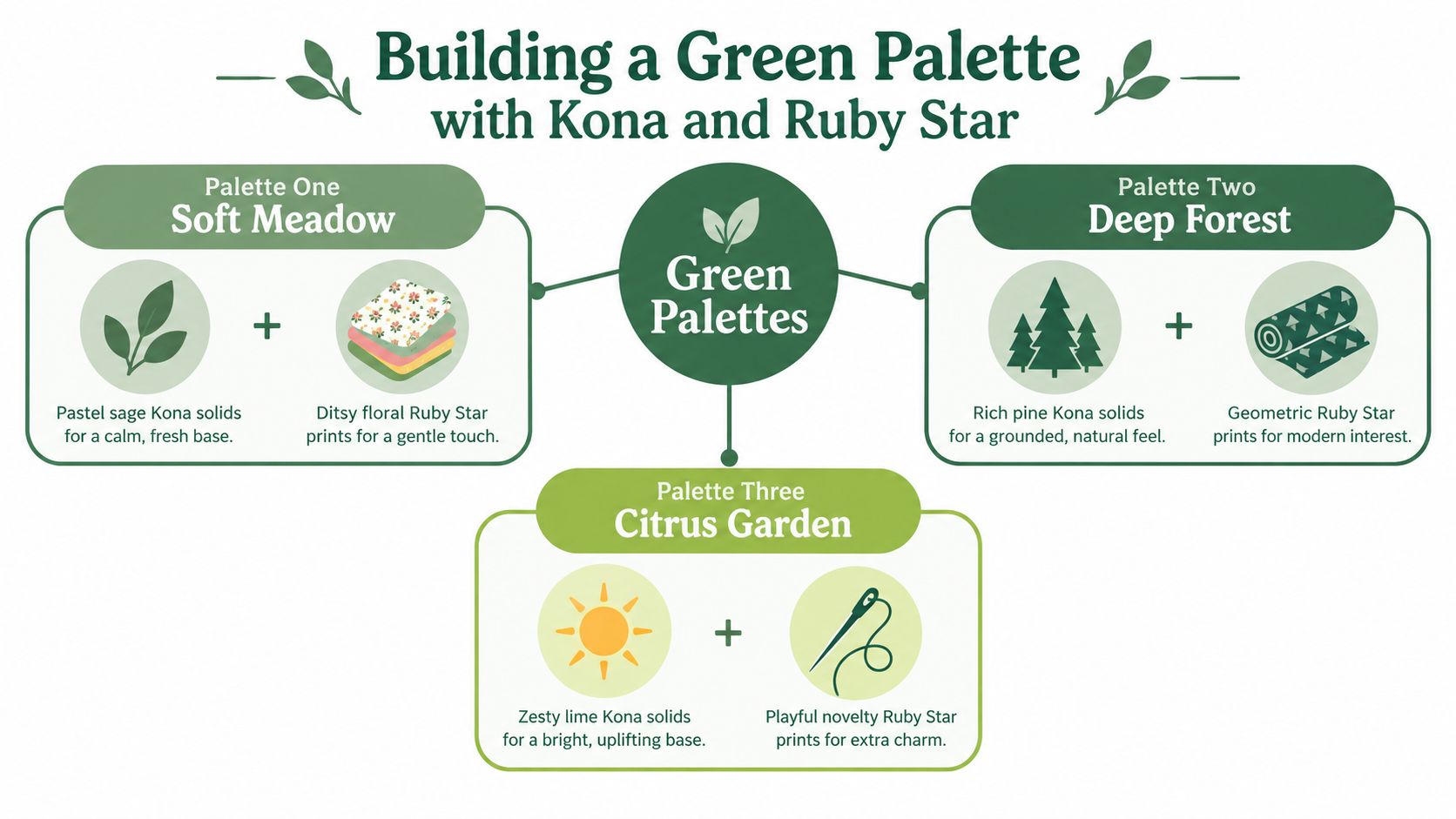
Use the visual reference to compare light, middle, and dark greens before cutting. It gives beginners a quick way to judge whether the palette has enough separation.
For a ready-to-cut starting point, compare the green Kona and Ruby Star fabric selection with your pattern's color map. Order a small coordinating cut first, then commit to full-quilt yardage once the hand feel and values work together.
Care and Handling That Keeps Greens Looking
Saturated green dye often reveals handling problems first along fold lines and cut edges. Prewashing isn't mandatory for every project, but it gives you useful information about shrinkage, color release, and the fabric's finished hand before you piece a large top.
Before cutting
Wash the fabric in cold water with a pH-neutral detergent such as Orvus Paste. Skip harsh brighteners, which can change how greens read, and use a cup of white vinegar in the rinse if you're testing a darker green. Treat that as a practical color-care step, not a guarantee that dye will never release.
Tumble dry on low and remove the fabric while it's slightly damp. Press from the wrong side with a hot, dry iron so the surface stays clean and the fold lines flatten without polishing the right side.
At the cutting table
Use a fresh 45mm rotary blade for clean cuts, especially on tightly woven solids. Wipe the self-healing mat with a damp cloth so loose dye dust doesn't transfer from a saturated green onto pale fabric.
Keep the grain straight before you trim. A green solid exposes small distortions in half-square triangles, and a slightly skewed cut can make a precise block fight you at the sewing machine.
In storage
Roll green yardage on a three-inch core instead of folding it tightly. Store it away from direct ultraviolet light, which can fade botanical greens, and place a silica gel packet in the bin to help manage humidity.
I keep a fat-quarter test square from every green bolt used in a project. That scrap becomes a repair reference later, when the original bolt is gone and a replacement labeled “forest” is noticeably different.
Follow QuiltKit's fabric care instructions when the manufacturer's finishing information is available, particularly for widebacks and specialty fabrics.
Choosing the Right Green for Your Next Project
At the fabric wall, start with the project rather than the trend. A soft sage suits a baby quilt, while a deep forest wideback can make more sense for a bed quilt because it avoids unnecessary backing seams.
For apparel and other skin-contact projects, inspect the fabric's construction and finish. Quilting cottons do not all have the same hand. Totes and pouches need more body, so hunter or pine canvas and home-dec cotton can hold their shape. Standard quilting cotton can work with interfacing when you want a similarly firm result.
| Project Type | Fabric Format | Recommended Green Shade | Weight |
|---|---|---|---|
| Baby quilt | Soft quilting cotton | Sage, mint, or pistachio | Stable, gentle hand |
| Bed quilt | 108-inch wideback | Emerald, forest, or moss | Backing-weight cotton |
| Tote or pouch | Canvas or home-dec cotton | Hunter or pine | Structured |
| Sampler quilt | Solids plus prints | Sage with contrasting values | Standard quilting cotton |
| Wall hanging | Solid or expressive print | Jade, Kelly, or emerald | Stable for precise piecing |
A sampler benefits from a low-volume Ruby Star Society print in sage as its anchor. Place two Kona solids on either side of the print's lightest and darkest green values. The blocks gain definition, while the palette still feels intentionally coordinated rather than mechanically matched.
Saturated jewel green reads clearly from across a room, making it a practical choice for wall hangings and graphic modern designs. Choose batting by the finished quilt's desired loft, stitch definition, and drape. Hobbs, Pellon, and The Warm Company offer different batting profiles, so compare the hand and quilting effect you want instead of selecting by fiber label alone.
Before ordering, compare the shade, designer, and format in curated green cotton fabric collections, then gather coordinating thread, zippers, and batting with the project.
QuiltKit carries Kona Cotton solids, Ruby Star Society prints, green widebacks, precuts, batting, and quilting tools. Visit QuiltKit to compare the green options against your pattern and join the Email Sign-up Savings list if you are still building the fabric plan.
People Also Ask About Green Cotton Fabric
Is green cotton fabric always sustainable?
No. Green can describe the color, not the environmental profile. For sustainability claims, check the fiber source, processing standard, dyeing information, and traceability documentation separately.
What is the best green fabric for a quilt background?
A soft or muted solid such as sage, eucalyptus, or loden usually works well because it supports prints without competing with them. Compare it with the lightest and darkest fabrics in the quilt before ordering yardage.
Should I choose green solids or green prints?
Choose solids when you need value control, clean negative space, or precise appliqué. Choose prints when the quilt needs motif, movement, or a focal area. Many strong palettes use both.
How can I match two green fabric bolts?
Compare physical swatches in daylight, check the weave and hand, and avoid trusting the shade name alone. Keep a reference square from every bolt so future repairs have a reliable color target.
Is a green wideback useful for a bed quilt?
Yes, when the width suits the finished quilt and quilting plan. A 108-inch wideback can reduce the need for a pieced backing, but check its hand, grain, and color before cutting.